The scientific underpinning of Achievers’ engagement surveys
This resource is brought to you by:
Topics Covered:
Employee engagement
Achievers’ mission is to Change the Way the World Works.
To do that, we know that we need to provide our customers with technological solutions that help create environments where employees can be fully engaged in doing the best work of their lives. Achievers’ Workforce Institute is dedicated to curating and conducting research on engagement and the employee experience to understand what hasn’t been working with prevailing engagement strategies – and the path to effective engagement management.
Our research team then uses this academic and business research to inform the technology solutions and thought leadership Achievers provides to the business arena to measurably drive engagement.
The Achievers science approach
To ensure that our technology effectively empowers engagement, Achievers has continued with our longstanding history of using science to inform our solutions.
The science that stands beneath the engagement questions that make up the Listen™ Engagement survey. In addition to conducting our own primary research, we have done all the heavy lifting of assimilating number of landmark academic studies, findings from organisational development business research, and insights from psychology thought leaders to develop the Achievers Engagement Science Model — which sits at the foundation of all employee feedback solutions, making it possible to powerfully enhance engagement for both individuals and teams, within every company.
The engagement research outlined has illuminated the reality that, as a business arena, we have been addressing engagement with a set of outdated assumptions: that engagement is (1) static (can be measured every year or every other year), (2) generic (responsive to one size fits all solutions), and (3)
automatic (improved via data collection and action planning alone).
Academic research tells us that we, instead, need to be treating engagement as highly fluid, exceptionally personal and requiring real-time micro-action in order for leaders to be able to understand and address engagement issues before they result in a negative impact on organisational performance.
Achievers’ Engagement Science Model
The Achievers Engagement Science Model is underpinned by these three engagement pillars:
- Engagement is fluid: It changes day to day and moment to moment
- Engagement is personal: It is determined at the local level, so must be personal
- Engagement requires action: Real-time microactions drive engagement
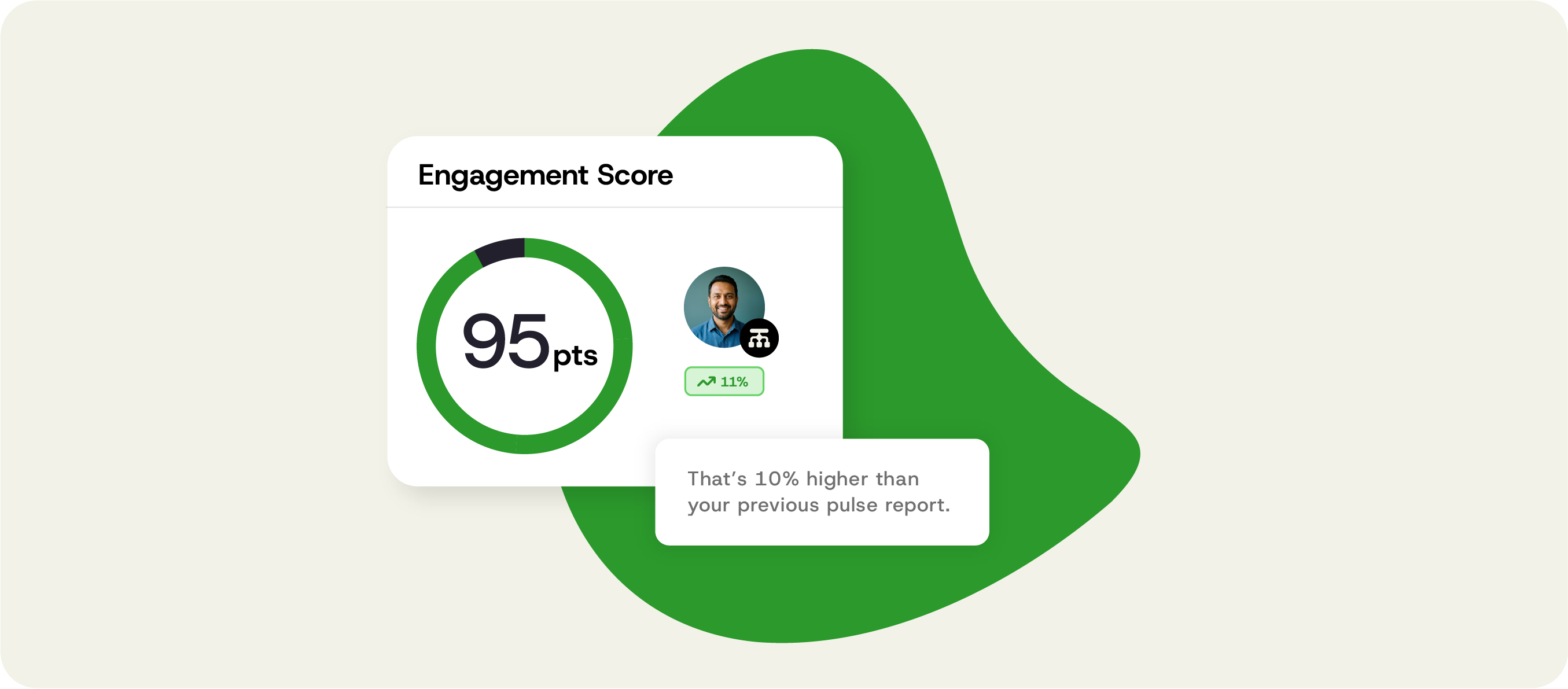
The Achievers Engagement Science Model is used to guide the development of all of our technological solutions.
Survey questions have been selected based on a rigorous research process relating the measurement of employee engagement to peer reviewed academic research on the employee engagement construct. This process culminated in the identification of both the driver questions and the indicator questions.
Why do we need both? Simply adding up all of the Driver scores and averaging to determine overall engagement is not a best practice because that averaging can mask issues within specific elements that need to be addressed in order to positively impact engagement.
Our research shows that there are three key components of engagement: Advocacy, Commitment, and Enthusiasm (ACE) – and these make up our Indicator questions. Averaging across these three Indicator questions gives us a reliable measure of whether an individual or team is engaged. We then refer to the Driver questions to understand which levers need to be addressed, and how.
Drivers are the levers of engagement that scientific research has shown to most strongly impact how employees function at work every day. Think of them as the ingredients of engagement.
Indicators provide an overall measure of the extent to which employees are, indeed, engaged. Think of them as the overall measure of actual engagement.
Driver question scientific background
Expectations
Statement: The expectations of me at work are reasonable
Rationale: Being appropriately challenged at work with reasonable expectations – typically thought of in terms of workload, job scope, and level of responsibility, is positively correlated with engagement. When individuals feel that the expectations of them are sufficiently high, they show increases in effort, persistence, and performance. Conversely, when individuals are overwhelmed by overly oppressive expectations – whether in terms of quantity or quality, they report decreased engagement.
Role
Statement: My role is a good fit based on my skills and interests
Rationale: Being in a role that is a good fit for both skills and interest – often referred to as person-job fit – is positively correlated with job performance, job satisfaction, and overall engagement. When individuals feel they are competent and interested in their role, they are more likely to put in discretionary effort. If they feel unable to complete their tasks, or uninterested in the role, this will drive dissatisfaction and disengagement.
Support
Statement: I have the resources, tools and support I need to succeed at my job
Rationale: Having the right resources to complete assigned tasks is a foundational requirement for employee engagement. When proactively provided with all the necessary tools and support, employees are likely to work efficiently and effectively. They will feel supported by the organisation, increasing
organisational trust. Lack of appropriate resources is likely to lead to dissatisfaction, frustration, and distrust.
Team
Statement: There is good cooperation and collaboration across my team or group
Rationale: Teamwork is crucial for effective workflow. Measuring team cooperation and collaboration can be an early indicator for any trouble spots. Understanding how well individuals see their teams working together is a good measure of overall effectiveness. Effective teamwork is indicative of coordination, communication, adaptability and more.
Development
Statement: My role is a good fit based on my skills and interests
Rationale: Being in a role that is a good fit for both skills and interest – often referred to as person-job fit – is positively correlated with job performance, job satisfaction, and overall engagement. When individuals feel they are competent and interested in their role, they are more likely to put in discretionary effort. If they feel unable to complete their tasks, or uninterested in the role, this will drive dissatisfaction and disengagement.
Feedback
Statement: I have the resources, tools and support I need to succeed at my job
Rationale: Having the right resources to complete assigned tasks is a foundational requirement for employee engagement. When proactively provided with all the necessary tools and support, employees are likely to work efficiently and effectively. They will feel supported by the organisation, increasing organisational trust. Lack of appropriate resources is likely to lead to dissatisfaction, frustration, and distrust.
Recognition
Statement: The recognition I receive makes me feel valued
Rationale: Recognition is a key pillar of engagement and performance. Given the right kinds of recognition, employees will feel inspired and will be more willing to put in discretionary effort because they know it will be seen and recognised. Effective recognition is timely, frequent, specific, and values-based.
Purpose
Statement: I find meaning and purpose in my work
Rationale: Finding deeper meaning and purpose in work allows individuals to see their role as more than just a job. It is positively correlated with high job satisfaction, which is linked to better engagement and lower turnover.
Manager support
Statement: I am getting what I need from my manager
Rationale: The manager-employee relationship is one of the most important. A dysfunctional relationship drives dissatisfaction and high turnover, whereas a positive relationship is linked to retention and perceived career success.
Leadership and strategy
Statement: I have confidence in our leadership
Rationale: Trust and confidence in one’s leaders is an important part of organisational engagement. Believing that organisational leaders make good decisions helps drive discretionary effort and overall engagement levels.
Culture
Statement: I am a good fit with the culture and the way we do things here
Rationale: Culture fit drives retention, commitment, and engagement. When an employee feels they are a strong culture fit, they are more likely to be
engaged and remain with their organisation. Conversely, when an individual feels that they are a poor fit, then they are more likely to be less engaged
and productive in their role – and more open to leaving to find a better fit.
Work-life balance
Statement: I am able to balance work and personal life in a way that works for me
Rationale: Work-life balance is maintaining healthy attention to both work and life beyond work. Strong balance is correlated with productivity and retention. Poor work-life balance can lead to employee burnout, increased turnover, and lower long-term productivity.
Indicator question scientific background
Advocate
Statement: I would recommend this as a great place to work
Rationale: Comparable to a Net Promotor Score, measuring employee advocacy is an effective way to measure overall satisfaction and commitment
to an organisation. Individuals who would recommend their organisation to others are more likely to be satisfied in their job and committed to the organisation.
Committed
Statement: I rarely think about looking for a job elsewhere
Rationale: Employees who are satisfied and engaged in their role are less likely to be active job seekers. This question is a predictor of turnover and commitment, which correlate with many positive behaviours including job performance and organisational citizenship behaviour.
Enthusiastic
Statement: I am enthusiastic about my job
Rationale: Employee enthusiasm is a strong indicator of engagement. Individuals who do not feel enthusiastic about their jobs are less likely to offer discretionary effort and more likely to be active job seekers. Measuring employee enthusiasm across the organisation gives a good picture of how likely
employees are to truly care about their roles, and to go above and beyond to drive company success.
Using survey results to drive action
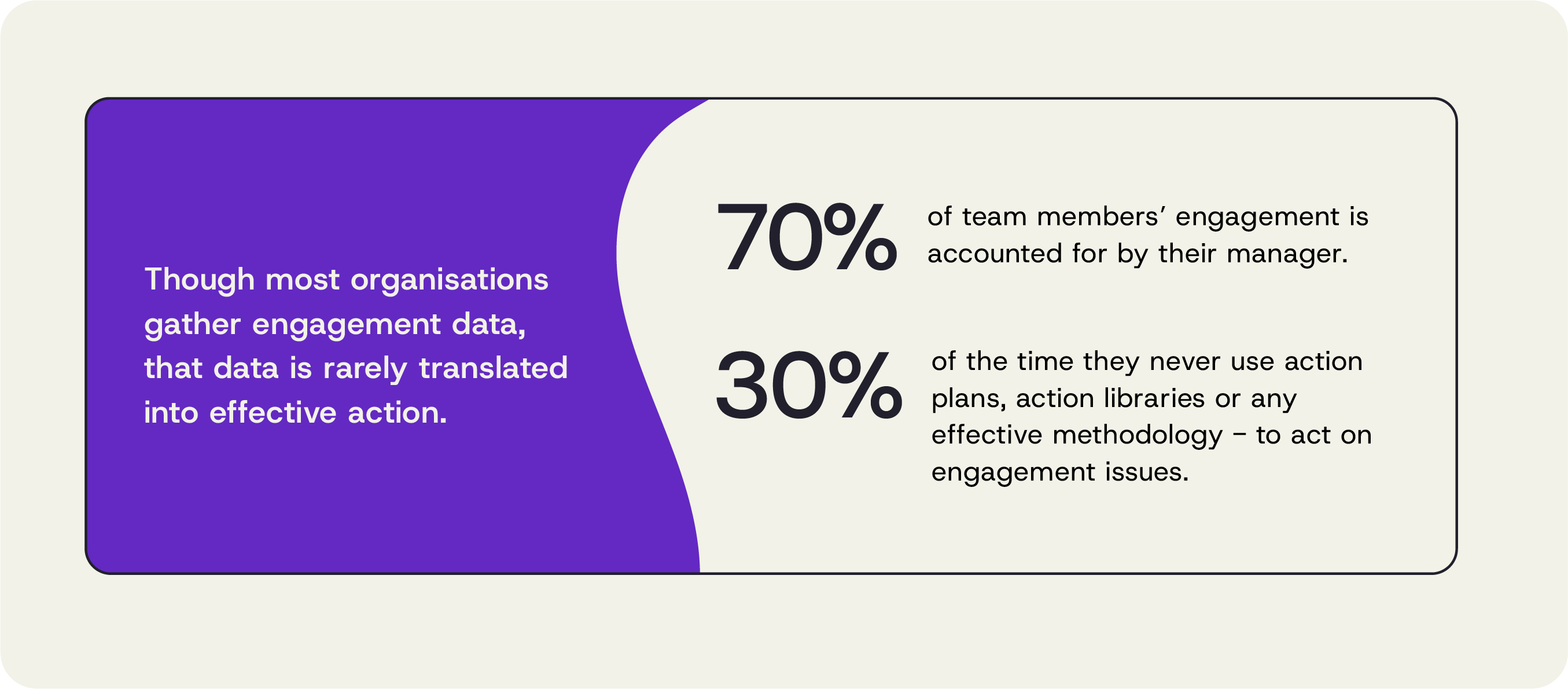
Though most organisations gather engagement data, that data is rarely translated into effective action. 70% of team members’ engagement is
accounted for by their managers. 30% of the time they never use action plans, action libraries or any effective methodology – to act on engagement issues.
This workplace reality inspired Achievers to build a simple but powerful process, called Action Builder, for managers to follow to move from data to action in real time. Action Builder makes it easy for managers to identify the most important issues to address and then supports them in working with their team to identify real time microactions to drive to solution.
At the close of each survey, managers hold a Listening Session with their team to identify the one or two drivers that are working well (highlights) and the one to two areas that need improvement (hotspots). They work together to determine a small specific set of micro-actions to improve the hotspots, rather than relying on a stagnant action library to establish next steps.
Best practices
Given our mission at Achievers, to change the way the world works, we know that it is important to ensure that organisations are measuring and managing all of the key drivers of engagement. The Driver and Indicator questions were specifically developed to measure the engagement drivers that most predict employee success. As these research-informed questions are removed or replaced, Listen™ loses its ability to impact engagement in a
science-informed manner.
All of that said, if an organisation still finds that there is a small number of questions that they wish to add in order to address topics not covered by the standard questions, the Workforce Institute offers a Mapping Session to discuss survey adaptation and to support ultimate survey success.
It is also important to maintain continuous listening best practices by limiting the number of survey questions. At Achievers, we believe there is no such thing as survey fatigue, only inaction fatigue. Given that surveys are typically implemented up to four times a year, it is important to keep the number of questions low to ensure managers and their teams have time to act on engagement data before checking in again.
Get your copy of this complete resource. Download your copy of Engagement survey: Scientific underpinning now.