
Table of contents
Create a culture that means business™
Schedule a demo with an Achievers solution expert today.


 Copy URL
Peer‑to‑peer recognition is becoming increasingly important as Australian organisations navigate dispersed teams, hybrid work, and frontline‑heavy environments where great work isn’t always visible to managers. While leader‑led recognition still plays an important role, it can’t capture the everyday collaboration, problem‑solving, and support that happens between colleagues across shifts, sites, and time zones.
That gap is becoming harder to ignore. Achievers Workforce Institute’s 2026 Engagement and Retention — APAC edition shows that only around one in four employees feel genuinely appreciated or engaged at work, and fewer than half see a clear long‑term future with their employer. When effort goes unnoticed, the impact extends beyond morale — putting retention, performance, and connection at risk.
This is where peers make the difference. Colleagues see the moments managers can’t always catch: the teammate who stayed back to help during a busy period, the collaboration that kept work moving, or the behaviours that bring organisational values to life on the ground.
But for peer‑to‑peer recognition to have lasting impact, it needs to be consistent and intentional. When appreciation is encouraged, visible, and reinforced as part of everyday work, peer recognition becomes a powerful driver of engagement — helping Australian organisations strengthen connection, support performance, and retain talent.
What is peer-to-peer recognition?
Peer‑to‑peer recognition is the practice of employees recognising and appreciating one another for meaningful contributions, collaboration, and living organisational values — in real time and as part of everyday work. Instead of appreciation being buried in emails, chats, or informal shout‑outs, peer‑to‑peer recognition brings visibility to the moments that matter most between colleagues.
At its core, peer‑to‑peer recognition removes barriers to appreciation. It encourages timely, meaningful recognition that reinforces the behaviours that drive engagement and performance, helping employees understand how their actions contribute to shared success.
When done well, peer‑to‑peer recognition turns everyday moments of appreciation into a consistent habit. Employees feel seen, heard, and valued — and leaders gain clearer insight into how culture shows up across teams, allowing them to shape connection and performance with intention.
Why peer-to-peer recognition matters in Australian workplaces
While spreadsheets, chat shout‑outs, and informal programs can work in the short term, they often rely on individual effort and memory — which makes recognition uneven and easy to miss. In Australia’s hybrid, remote, and frontline‑heavy workplaces, that inconsistency means everyday contributions can go unnoticed, particularly across shifts, locations, and time zones.
Peer‑to‑peer recognition helps close that gap by encouraging colleagues to acknowledge one another’s impact as work happens. When recognition is part of everyday interactions — not dependent on managers or formal moments — appreciation becomes more consistent, more inclusive, and more reflective of how work actually gets done. The result is stronger connection, clearer reinforcement of shared values, and a workplace where people feel seen and appreciated, no matter where or how they work.
15 best practices for peer-to-peer recognition
Peer‑to‑peer recognition delivers real impact — but without intention and consistency, it’s difficult to sustain. When appreciation relies on ad‑hoc moments or individual effort, recognition becomes uneven and easy to miss. A strong peer‑to‑peer recognition approach helps organisations turn appreciation into a consistent, everyday habit that reflects how work actually gets done.
Below are 15 best practices for peer‑to‑peer recognition, grounded in Achievers Workforce Institute insights and designed to help Australian organisations build a recognition culture that drives real results.
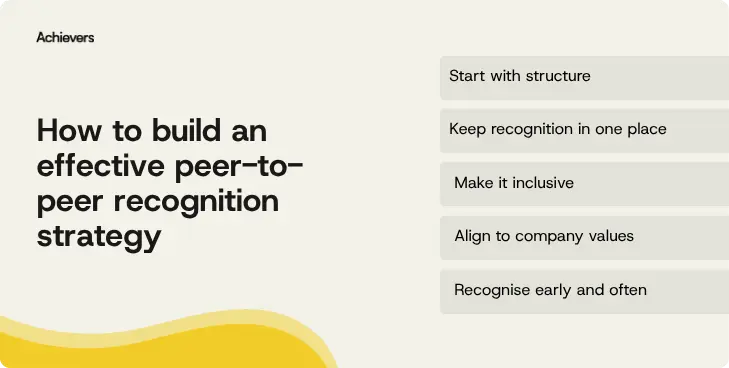
1. Start with structure
Peer‑to‑peer recognition works best when employees understand what great work looks like and why it matters. Clear expectations and alignment to organisational values guide recognition towards meaningful behaviours, turning appreciation into a culture‑shaping practice.
Example: A team member recognises a colleague for demonstrating the organisation’s safety value by speaking up about a potential risk on site.
2. Keep recognition visible
When recognition happens quietly or inconsistently, its impact fades. Making peer recognition visible helps appreciation travel beyond individual teams and reinforces shared standards.
Example: Recognition shared openly allows teams across locations to see how collaboration helped meet a critical deadline.
3. Make recognition inclusive
Effective peer recognition isn’t limited by role, location, or personality. Everyone should be able to recognise and be recognised — not just the most vocal team members.
Example: A corporate employee recognises a frontline colleague for stepping in to support customers during a busy period.
4. Tie recognition to company values
Recognition is most powerful when it reinforces what your organisation stands for. Linking peer recognition to values turns abstract principles into visible, everyday behaviours employees can see and celebrate.
Example: A peer calls out a teammate for living the organisation’s respect value by supporting a new starter through their first shift.
5. Encourage frequent, in‑the‑moment recognition
Timing matters. Recognition has more impact when it happens close to the behaviour it celebrates. Timely appreciation helps reinforce behaviours while they’re fresh and repeatable.
Example: A colleague sends a quick thank‑you straight after a successful client handover.
6. Make recognition visible
Shared recognition amplifies impact. When appreciation is visible to others, it reinforces what success looks like and encourages more of the same behaviour.
Example: Public recognition highlights cross‑team collaboration that helped resolve an issue before it escalated.
7. Keep it simple
If recognition feels complicated, participation drops. The simpler it is to recognise a colleague, the more likely people are to do it consistently.
Example: An employee recognises a peer in under a minute, without forms, approvals, or extra steps.
8. Support recognition in the flow of work
Recognition shouldn’t feel like extra admin. When appreciation integrates into everyday tools, it becomes part of how teams operate.
Example: A quick moment of recognition is shared at the end of a regular team check‑in.
9. Reinforce recognition with meaningful rewards
Recognition doesn’t require rewards, but thoughtful rewards can strengthen its impact when used intentionally and fairly.
Example: A recognised employee chooses a reward that suits them, such as a local retail or experience voucher.
10. Empower employees — not just managers
Recognition is more powerful when it flows in every direction. Empowering employees to recognise one another increases frequency, authenticity, and reach.
Example: Team members regularly recognise each other’s contributions without waiting for manager approval.
11. Prioritise authenticity
Recognition should feel human. Personalised messages that explain why the recognition matters — and its impact — feel more genuine than generic praise.
Example: A recognition message clearly explains how a colleague’s support helped the team hit a tight deadline.
12. Use insight to understand what’s working
Recognition shouldn’t be a black box. Understanding patterns in recognition helps organisations reinforce the behaviours that matter most.
Example: Leaders notice teamwork is frequently recognised and reinforce it as a cultural strength.
13. Celebrate everyday wins — not just big moments
Not every contribution comes with a milestone. Recognising everyday actions keeps people engaged and momentum going.
Example: A peer recognises a colleague for consistently helping cover shifts during a busy trading period.
14. Reinforce recognition consistently
One‑off campaigns don’t build culture. Peer‑to‑peer recognition works best when it’s reinforced year‑round.
Example: Recognition is built into weekly team rhythms, not reserved for annual awards.
15. Connect recognition to business outcomes
Peer‑to‑peer recognition isn’t just about feel‑good moments. When employees feel appreciated, they’re more engaged, more likely to stay, and more motivated to perform.
Example: Teams with higher levels of peer recognition also show stronger engagement and lower turnover.
How peer-to-peer recognition software brings these best practices to life
The 15 best practices for peer-to-peer recognition provide a strong foundation — but without the right technology, they’re difficult to apply consistently across Australian workplaces. This is where peer-to-peer recognition software turns best practice into everyday practice. A single, shared platform gives recognition the structure, visibility, and consistency it needs, so appreciation doesn’t depend on location, shift patterns, or who happens to be on site.
By centralising recognition, linking it to company values, enabling in‑the‑moment appreciation, and providing clear insights, peer-to-peer recognition software supports every best practice — from inclusivity and frequency to visibility and impact. Recognition moves out of policy documents and annual initiatives and into the flow of work, across teams and locations, shaping culture, strengthening connection, and driving measurable engagement and retention outcomes.
Building a peer-to-peer recognition culture that scales with Achievers
Peer‑to‑peer recognition works because it’s personal. A genuine thank‑you from a colleague carries meaning in a way top‑down praise often can’t — especially when it reflects real effort, collaboration, or support.
But for peer recognition to scale and deliver lasting business impact, it needs to be encouraged, reinforced, and embedded into everyday ways of working. Recognition has to move beyond good intentions and become part of how people show up for one another.
That’s where Achievers supports organisations in bringing peer‑to‑peer recognition to life. By helping teams recognise the behaviours that matter most and making appreciation a regular, visible part of work, Achievers enables organisations to build cultures where recognition is consistent, meaningful, and aligned to shared values.
The result is a recognition culture that truly scales — where employees feel seen, heard, and appreciated, and where peer‑to‑peer recognition becomes a powerful driver of engagement, retention, and performance.
Peer-to-peer recognition FAQs
Key insights
- Peer-to-peer recognition captures everyday impact managers miss.
- Structure and visibility make peer recognition consistent.
- Frequent recognition drives engagement, retention, and performance.