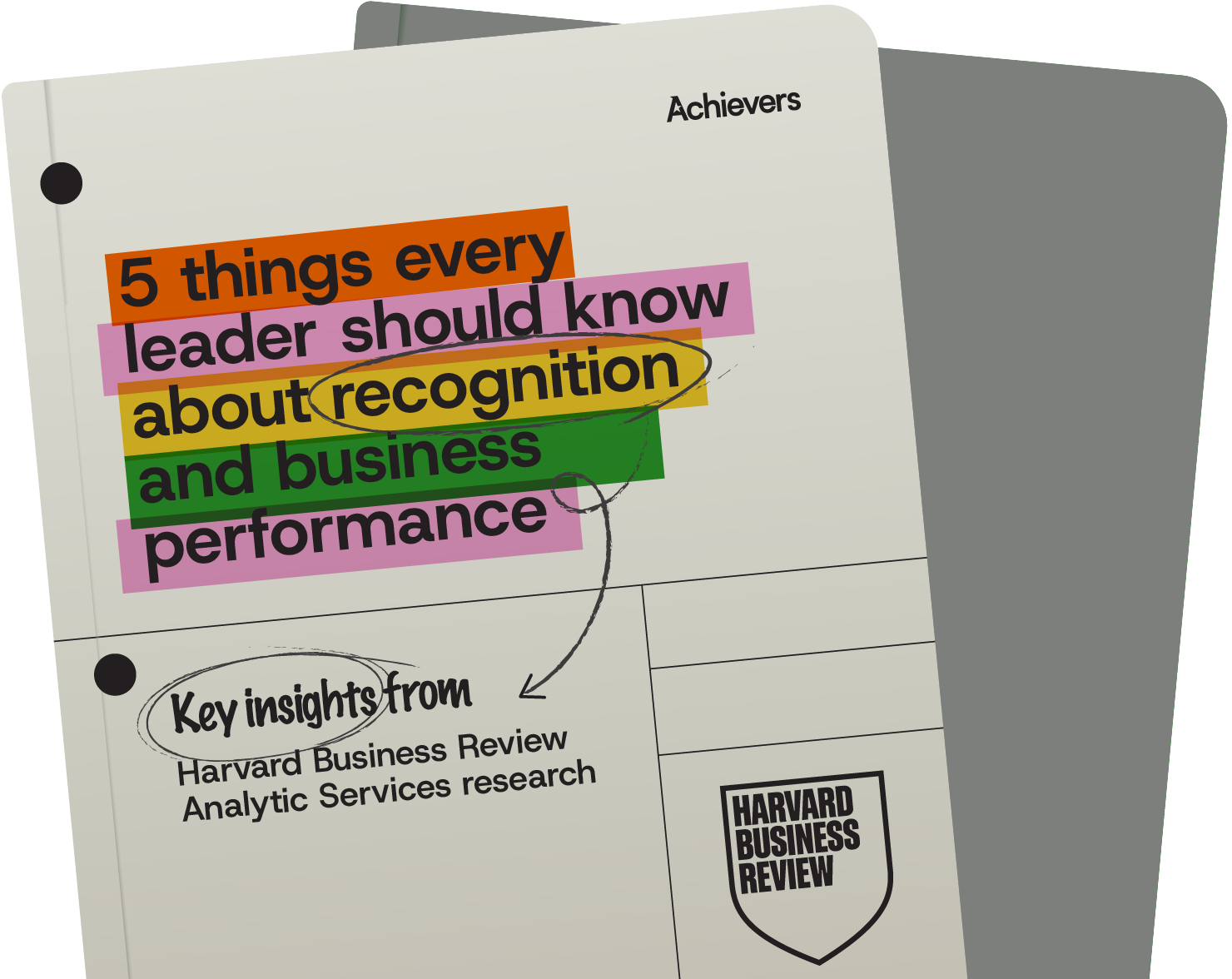
5 things every leader should know about recognition and business performance
Key insights from Harvard Business Review Analytic Services research
Pain point
Productivity and Performance
Access this resource anytime
Table of contents
Topics Covered:
Productivity and Performance
Organisations are under pressure to adapt faster than ever. Whether the goal is driving innovation, strengthening collaboration, improving productivity, or accelerating AI adoption, success ultimately comes down to one thing: people changing how they work.
New research from Harvard Business Review Analytic Services, sponsored by Achievers, reveals that recognition plays a much larger role in achieving these outcomes than many leaders realise.
Recognition is no longer just an employee engagement initiative. The most successful organisations use it as a strategic tool to reinforce behaviours that drive business performance.
Here’s what you need to know.
1. Recognition is a business performance driver, not just an engagement tool
For years, recognition has been viewed primarily as an engagement initiative. Research today tells a different story.
The organisations seeing the greatest impact from recognition aren’t using it simply to boost morale. They’re using it to reinforce the actions, habits, and behaviours that drive business results. When appreciation is specific, timely, and connected to impact, it helps employees understand what matters most and encourages them to repeat those behaviours.
Why it matters
Organisations don’t execute strategy through plans alone; they execute through employee behaviour. Recognition creates clarity around what success looks like and helps turn desired behaviours into everyday habits. When leaders intentionally recognise the actions that support business goals, they create alignment between culture and performance.
2. There is a significant execution gap
Most organisations understand the importance of recognition. Far fewer are getting the outcomes they want.
This gap reveals a critical challenge: belief alone doesn’t drive results. Organisations need a deliberate strategy for connecting recognition to business priorities and ensuring appreciation happens consistently across the workforce.
Why it matters
Recognition delivers value only when it’s intentional and well executed. Closing the gap between recognising the importance of recognition and making it effective can unlock meaningful improvements in collaboration, productivity, innovation, and execution.
3. High-performing organisations intentionally reinforce specific behaviours
The organisations seeing the greatest business impact don’t leave recognition to chance.
Instead of recognising effort in general terms, these organisations clearly connect appreciation to behaviours that support organisational goals, whether that’s innovation, customer focus, collaboration, safety, adaptability, or embracing new technologies.
Recognition becomes a signal that helps employees understand what the organisation values and what behaviours should be repeated.
Why it matters
Employees make countless decisions every day about where to focus their time and energy. Recognition acts as a compass, helping people prioritise the behaviours that matter most. When recognition is tied to strategy, it becomes a scalable way to influence performance across the organisation.
4. Frequent recognition drives better business outcomes
Recognition is most effective when it’s continuous, not occasional.
Organisations with highly effective recognition programs are significantly more likely to report stronger business performance across a range of critical outcomes. From productivity and collaboration to innovation and customer experience, frequent appreciation helps reinforce the behaviours that move work forward.
The full report explores more data points around the additional business benefits linked to effective recognition programs, highlighting the powerful connection between employee appreciation and organisational performance.
Why it matters
Business results are driven by the actions employees take every day. Frequent recognition reinforces desired behaviours in real time, helping organisations build momentum, drive alignment, and create a culture where high performance becomes repeatable. Recognition doesn’t just celebrate success, it helps create it.
5. Technology helps organisations scale and measure impact
As organisations grow, recognition needs to be easy, visible, and measurable.
The most effective recognition strategies combine human appreciation with technology that makes recognition simple to give, easier to track, and more visible across the organisation. Dedicated recognition platforms help embed appreciation into the flow of work while giving leaders greater insight into the behaviours driving performance.
Beyond enabling recognition at scale, technology can help organisations connect appreciation to strategic objectives and better understand its impact across teams and the business.
Why it matters
Recognition shouldn’t depend on a manager remembering to say thank you. Technology helps create consistency, expand visibility, and make appreciation part of how work gets done every day. The result is a recognition strategy that can scale with the organisation and support measurable business outcomes.
You have the highlights. Now uncover the full story.
The research points to a clear conclusion: recognition has evolved from an engagement initiative into a business performance strategy.
Organisations that see the greatest impact understand the importance of recognition, intentionally connect it to strategic behaviours, deliver it frequently, and use technology to scale and measure results.
But these findings are only part of the story.
The full report explores the data behind these trends, the gap between recognition intent and execution, and how leading organisations are using recognition to drive outcomes such as productivity, collaboration, innovation, customer experience, and more. It also includes real-world examples and expert perspectives from organisations putting these practices into action.
Download your copy of the report
Get the complete Harvard Business Review Analytic Services report, sponsored by Achievers, for the complete research findings, deeper analysis, and actionable insights for building a recognition strategy that drives measurable business performance.
“Recognition is powerful but tends to be underestimated by people in practice. For recognition to be powerful, it needs to be meaningful.”
Robert Dur
Professor of Economics, Erasmus University Rotterdam
“Nothing is more important than appreciation in shaping organisational culture and delivering on strategy.”
Amy Edmondson
Novartis Professor of Leadership and Management, Harvard Business School
88% of leaders say their recognition program is designed to drive specific employee behaviours
49% of organisations with the most effective recognition programs report improved productivity
57% of organisations using a dedicated recognition platform say it helps support peer-to-peer recognition
| Recognition benchmark | Percentage |
|---|---|
| Say recognition is very important to business performance | 66% |
| Say their recognition program is very effective at influencing business performance | 33% |