Table of contents
Create a culture that means business™
Schedule a demo with an Achievers solution expert today.


 Copy URL
Employee engagement models are frameworks that help organisations understand how to keep people engaged, motivated, and committed at work. And with only 22% of employees in Australia feeling appreciated, according to the latest APAC Engagement and Retention Report, those frameworks have never mattered more.
Because the best engagement models don’t just explain what employee engagement is. They show leaders how to build it and how to stop it from slowly disappearing between meetings.
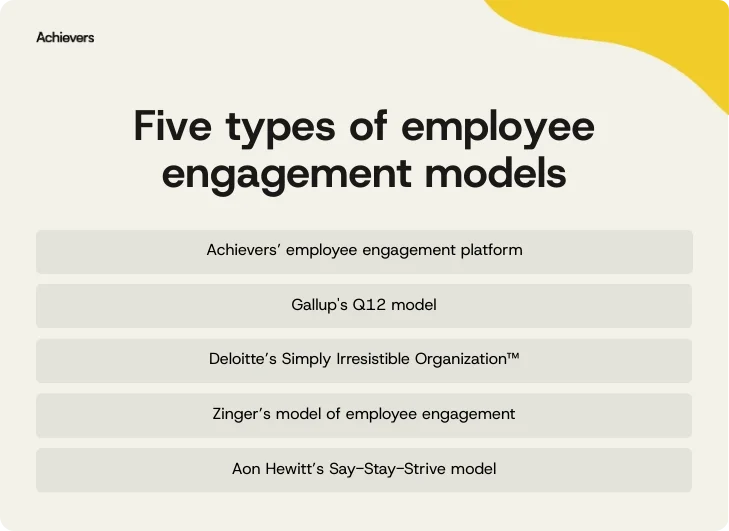
Let’s break down what engagement models really mean, how they work in practice, and why activating them matters — starting with the top five models used today.
What is an employee engagement model?
An employee engagement model is a structured framework that explains what drives engagement at work and how organisations can influence it. It gives leaders a clear way to understand what helps employees feel motivated, connected, and committed — and how those experiences shape performance, culture, and retention.
Why do employee engagement models matter?
Employee engagement models help organisations understand what motivates employees, design consistent engagement strategies, and connect those efforts to real business results. And in Australia, that insight couldn’t be more relevant. According to ADP Research’s People at Work 2025 report, fewer than one in five Australian employees (16%) say they’re fully engaged at work.
Most importantly, they create a shared language for engagement across the organisation. Because when everyone knows what engagement looks like, it’s a lot easier to build it, and much harder to pretend it’s happening.
How do employee engagement models work?
Employee engagement models work by identifying the core drivers that shape how people experience work — things like purpose, relationships, workload, recognition, and growth. These drivers are then measured and analyzed so organisations can understand where engagement is strong, where it’s fragile, and why.
From there, most models connect engagement insights to business outcomes like retention, productivity, and customer experience. Leaders use that understanding to shape priorities, guide behaviour, and design initiatives that actually move the needle.
The five most widely used models of employee engagement
1. Achievers’ employee engagement platform
Purpose:
The Achievers employee engagement platform is built to help organisations shape their workforce through recognition. It connects meaningful employee recognition and motivating rewards to the behaviours that drive performance, belonging, and retention — turning everyday moments into measurable business impact.
More than a framework, Achievers gives leaders a system to influence culture intentionally, reinforce the right behaviours, and create engagement that sticks. Because culture doesn’t change in strategy decks. It changes in what people notice, celebrate, and repeat.
Idea:
Recognition activates behaviour. Behaviour shapes culture. Culture drives business results. When employees are consistently recognised for meaningful contributions, those behaviours repeat. Over time, those repeated behaviours become the culture people experience — and the reason they choose to stay.
Application:
Achievers applies its engagement model through a recognition-led platform that connects everyday actions to culture and performance. Recognition, feedback, and insight are built directly into the tools employees use every day, making engagement easy to see and easier to sustain.
Employees can recognise each other for meaningful, values-based contributions. Managers can reinforce performance and growth in the moments that matter. And leaders can clearly see which behaviours are being celebrated, where engagement is strengthening, and where teams need support — turning engagement from a concept into something people experience.
This creates a continuous engagement loop:
- Recognition reinforces the right behaviours
- Repeated behaviours shape culture
- Culture strengthens connection, performance, and retention
And the impact shows up quickly. Data from the Australia State of Recognition Report shows that employees recognised at least monthly are 2x more likely to feel engaged and less likely to set their LinkedIn status to open to work. Achievers makes this impact possible by using recognition as a tool to shape behaviour, culture, and more.
Best for:
Organisations that want a practical, scalable way to improve engagement and retention by embedding recognition, behaviour, and culture into everyday work.
2. The Gallup G12 model
Purpose:
Gallup’s Q12 model offers a practical, research-backed way to understand what drives engagement at work. Built on decades of workforce research and insights from millions of employees worldwide, the model connects everyday employee experiences directly to productivity, retention, and performance.
Idea:
Engagement can be measured, understood, and improved by consistently asking the right questions. Gallup’s Q12 shows that how employees answer those questions reflects how well a team is set up to succeed.
Application:
The Q12 model organises engagement into a clear progression:
- Basic needs
- Individual contribution
- Team belonging
- Growth
Organisations use Q12 results to measure engagement, benchmark across teams, and track improvement over time — turning employee feedback into actionable insight.
Best for:
Organisations looking to measure engagement consistently and benchmark performance across teams.
3. Deloitte’s Simply Irresistible Organisation™ model
Purpose:
Deloitte’s Simply Irresistible Organization™ model helps organisations understand why some workplaces attract and retain talent better than others. Developed through extensive employee interviews, the model focuses on the experiences that make organisations feel engaging, supportive, and worth committing to.
Idea:
Employee engagement is shaped by experience, leadership, and trust — not just performance metrics. When people feel supported, valued, and connected to purpose, engagement follows naturally.
Application:
Deloitte organises engagement around five core factors:
- Meaningful work: Employees are in the right roles, have autonomy, and understand how their contributions matter.
- Positive work environment: Inclusion, flexibility, and well-being shape how safe and supported people feel.
- Hands-on management: Leaders provide clarity, coaching, and regular feedback.
- Growth opportunities: Employees see clear paths to learn, develop, and advance.
- Trust in leadership: Transparency, honesty, and a shared mission build confidence in the organisation’s direction.
Best for:
Organisations focused on employee experience, leadership effectiveness, and long-term cultural alignment.
4. Zinger’s employee engagement model
Purpose:
The Zinger model is an employee engagement framework that helps organisations understand engagement through a human lens — grounded in psychology, purpose, and personal energy. Created by David Zinger, it treats engagement as something shaped by how people experience their work, their relationships, and their sense of meaning, rather than just by performance metrics.
Idea:
Engagement is built through everyday human experiences — how people are treated, supported, and recognised at work.
Application:
Zinger’s model brings engagement to life through two connected structures: the CARE mindset and a practical engagement pyramid.
The CARE concept reinforces that engagement must be continuous and human:
- Connection: People feel engaged when relationships are real and inclusive.
- Authentic relationships: Trust and belonging matter as much as performance.
- Recognition: Employees should feel seen and valued every day.
- Engage continuously: Engagement isn’t a programme. It’s a habit.
The pyramid then shows how engagement builds over time:
- Well-being and strengths: Energy, health, and personal capabilities
- Relationships and recognition: Belonging and appreciation
- Meaningful work and progress: Purpose and momentum
- Results: Individual and organisational success
Best for:
Organisations that value human connection, purpose, and relationship-driven engagement.
5. Aon Hewitt’s Say-Stay-Strive model
Purpose:
Aon Hewitt’s Say-Stay-Strive model positions employee engagement as a direct driver of business performance. Rather than treating engagement as a soft signal, the model links how employees experience work to measurable outcomes like retention, productivity, safety, and financial growth.
Idea:
Employee engagement shows up in what people say about their organisation, whether they choose to stay, and how much extra effort they put in. Together, these behaviours reflect real commitment and help predict outcomes like retention, productivity, safety, and customer satisfaction.
Application:
The model identifies six core elements that shape engagement:
- The basics: Benefits, job security, safety, and work-life balance
- Company practices: Communication, inclusion, infrastructure, and enablement
- The work: Collaboration, empowerment, and autonomy
- Leadership: Direction, visibility, and accountability
- Performance: Growth opportunities, rewards, and recognition
- Brand: Reputation, responsibility, and organisational pride
Together, these elements influence three observable engagement behaviours:
- Say: Employees speak positively about the organisation
- Stay: Employees choose to remain and build long-term commitment
- Strive: Employees put in discretionary effort and go beyond expectations
Best for:
Organisations that want to link engagement behaviours directly to business outcomes and performance indicators.
How to activate your staff engagement model
An employee engagement model only creates value when it’s put into practice. Not when it lives in a document. To activate your engagement model: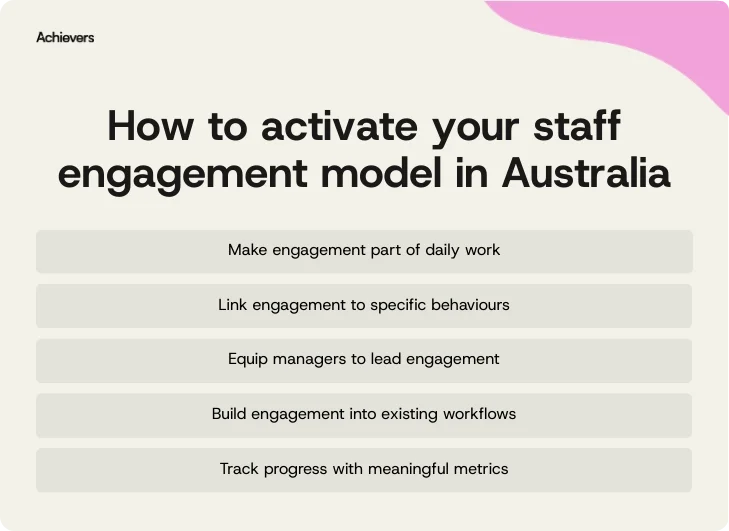
Make engagement part of daily work
Reinforce engagement through regular feedback, recognition, and connection — not just formal programmes.
Link engagement to specific behaviours
Call out and reward the actions that reflect your values, goals, and culture.
Equip managers to lead engagement
Give managers clear tools and expectations to recognise, coach, and support their teams.
Build engagement into existing workflows
Let engagement happen where work already happens, instead of adding new processes.
Track progress with meaningful metrics
Measure participation, behaviour patterns, and outcomes — not just survey scores.
From model to action: Making your engagement framework work
Employee engagement models give organisations a shared language for understanding what drives motivation, connection, and performance. Some focus on measuring employee engagement. Others on experience, relationships, or outcomes. Together, they all point to the same truth: engagement is shaped by how people are treated, supported, and recognised at work.
But they all point to the same truth: engagement is built through everyday behaviour, not annual strategy.
That’s where most models fall short — and where Achievers steps in.
Achievers turns engagement into action by embedding recognition into daily work, reinforcing the behaviours that shape culture, and making engagement visible, measurable, and scalable. It doesn’t just explain engagement. It helps organisations practice it.
Because the most effective employee engagement model isn’t the one you understand best. It’s the one your people actually experience.
Employee engagement models FAQs
Key insights
- Engagement frameworks help organisations understand what drives engagement, but engagement only improves when those insights are embedded into daily behaviour.
- Different models highlight different engagement drivers, but they share a goal: better employee connection and performance.
- When engagement is reinforced through timely, meaningful recognition, behaviours repeat, culture strengthens, and retention follows.