Table of contents
Create a culture that means business™
Schedule a demo with an Achievers solution expert today.


 Copy URL
Let’s call it what it is: something’s off in the Australian workplace.
Pay might be competitive. Benefits might be solid. But engagement? Connection? That’s where things start to wobble. According to the 2026 Engagement and Retention Report (APAC edition), only around one in five Australian employees feel genuinely appreciated at work — and even fewer feel connected to their organisation’s values.
That’s not a “soft” problem. It’s a business one.
When people don’t feel seen, heard, or valued, effort drops, innovation slows, and retention becomes a game of chance. Some employees stick around for security or convenience (hello, mortgage), but motivation? That’s usually the first thing to quietly exit the building.
This pressure isn’t happening in isolation. Research from organisations like the Australian HR Institute (AHRI) continues to highlight declining engagement and rising expectations around flexibility, recognition, and meaningful work across Australian industries.
This is where employee incentive programs earn their keep.
Done well, they don’t just reward outcomes — they shape behaviour, reinforce connection, and build cultures people actually want to be part of. Done poorly, they become another dusty HR initiative everyone forgets exists.
So let’s focus on the first option.
What are employee incentive programs (really)?
Employee incentive programs are structured ways to motivate and recognise employees for the behaviours that matter most to your organisation. Think beyond base pay and benefits. These programs use meaningful rewards — monetary and non‑monetary — to reinforce performance, values, and contribution.
At their best, employee incentive programs connect the dots between:
- What your organisation is trying to achieve
- What employees do every day to make that happen
Historically, many Australian organisations leaned heavily on annual bonuses, commissions, or long‑service awards. They’re familiar. They’re easy. And…they’re no longer enough on their own.
Modern incentive programs look different. They include:
- Social and peer recognition
- Points‑based rewards
- Learning and development incentives
- Well-being and lifestyle rewards
- Experiences employees actually get excited about
Most importantly, the best programs are embedded into the flow of work. They don’t feel like a policy. They feel like part of how work gets done.
Why employee incentive programs matter in Australia
Australian employees are clear about what they expect from work: fairness, flexibility, growth — and genuine recognition. When those things are missing, engagement takes a hit, even in organisations with strong pay and conditions.
Achievers Workforce Institute data shows that employees who feel appreciated are far more likely to:
- Find their work meaningful
- Feel connected to colleagues and leaders
- See a long‑term future with their organisation
With job mobility remaining high in Australia, according to the Australian Bureau of Statistics, organisations can no longer rely on tenure or comfort to retain talent. Incentive programs help create the connection and appreciation that give employees a reason to stay.
Employee incentive programs matter because they:
- Make appreciation visible and consistent
- Reinforce the behaviours you want more of
- Support retention in a competitive labour market
- Complement (not replace) compliant pay structures under bodies like the Fair Work Ombudsman
Incentives should always sit alongside — not instead of — fair wages, leave, and entitlements outlined on business.gov.au, ensuring organisations stay compliant while still recognising effort in meaningful ways. This is the best way to shape culture — on purpose.
10 types of employee incentive programs that actually work in Australia
After working with millions of employees globally — including across Australia — here are 10 employee incentive programs we’ve seen drive real engagement and retention.
1. Points‑based recognition programs
Simple, scalable, and flexible. Employees earn points for meaningful contributions and redeem them for rewards that suit their lives — from groceries to experiences. Choice matters.
2. Peer‑to‑peer social recognition
Recognition shouldn’t be manager‑only. Making it easy for colleagues to recognise each other (in Teams, Slack, or Workday) builds everyday connection — especially in hybrid teams.
3. Manager‑led spot awards
Manager recognition still hits differently. Spot awards let leaders acknowledge great work in the moment, not six months later in a performance review.
4. Professional development incentives
Growth is a big deal — and many Australians don’t feel they’re getting enough of it. Incentivising learning, certifications, and skill development sends a clear message: we’re invested in your future.
5. Well-being incentives
Work–life balance is under pressure. Incentives tied to wellbeing — mental, physical, and financial — show care that goes beyond words (and goes a long way).
6. Service milestones (done properly)
Forget the generic plaque. Celebrate early wins, personalise major milestones, and let employees choose rewards that actually mean something to them.
7. Values‑based incentives
Want to strengthen your culture? Recognise the behaviours that bring your values to life — whether that’s safety, innovation, or customer focus.
8. Employee referral incentives
Referrals are powerful — when recognised along the way. Micro‑rewards throughout the process keep energy high and participation steady.
9. Team‑based incentives
Shared goals, shared rewards. Team incentives encourage collaboration and help rebuild connection in workplaces where silos have crept in.
10. Experiential and lifestyle rewards
Sometimes it’s not about cash. Experiences — travel, dining, learning, giving back — create memories, not just transactions.
Designing an effective employee incentive program (without overcomplicating it)
The most effective employee incentive programs aren’t flashy. They’re focused, intentional, and built to fit into how work gets done.
Strong programs tend to share a few fundamentals — regardless of industry, size, or location:
Clear business goals
Incentives should exist for a reason. Whether the goal is improving retention, reinforcing values, increasing safety, or driving performance, employees should understand why certain behaviours are rewarded. When incentives are clearly connected to business priorities, recognition feels purposeful — not random.
Visible leadership support
If leaders don’t use the program, neither will anyone else. When executives and managers actively recognise employees, they send a powerful signal: this matters. Incentive programs gain credibility when leadership models the behaviours they want repeated.
Fairness, equity, and compliance
Trust is non‑negotiable. Employees need to believe the program is fair, inclusive, and compliant with local regulations. That means consistent criteria, transparent guidelines, and rewards that work across roles, locations, and demographics — not just for corporate office staff.
Seamless integration into everyday tools
If employees have to jump through hoops to participate, adoption will stall. The best incentive programs are embedded into the flow of work — easy to access, simple to use, and visible where employees already collaborate and communicate.
Data to evolve and improve over time
An incentive program shouldn’t be set‑and‑forget. Participation data, recognition trends, and redemption insights help organizations understand what’s working — and what’s not. That feedback loop is what turns a good program into a great one.
Avoid common pitfalls
Even well‑intentioned employee incentive programs can miss the mark if common pitfalls aren’t addressed. Limiting recognition to annual awards disconnects appreciation from daily effort — recognition works best when it’s timely and ongoing. Excluding frontline or deskless workers can also undermine trust and impact, especially if programs rely on desk‑based access. Unrealistic goals are another risk: while stretch targets can motivate, goals that feel impossible quickly disengage employees. And finally, rewards only matter if they’re meaningful — programs that offer choice consistently outperform one‑size‑fits‑all incentives.
At the end of the day, simplicity wins. If it’s hard to use, it won’t get used. If it feels generic, it won’t motivate anyone.
Best practices for employee incentive programs
The most effective employee incentive programs start with clarity. Clear goals. Clear expectations. Clear connections between what people do and why it matters. When incentives are aligned to your organization’s values and performance priorities, recognition becomes more than a nice gesture — it drives the behaviours that move the business forward.
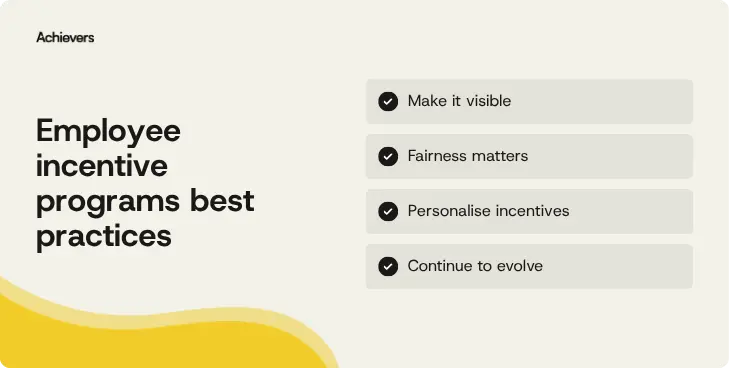
Visibility matters
Embedding recognition into everyday tools like Teams and Outlook keeps appreciation front and center and makes it easy for everyone to participate, whether employees are desk-based, frontline, remote, or on the move. When recognition fits naturally into the flow of work, it becomes part of how work gets done.
Fairness is nonnegotiable
Apply consistent, transparent criteria for rewards, follow Australian compliance requirements, and review programs regularly to ensure equity and legal alignment. This includes understanding how incentives are treated under Fringe Benefits Tax (FBT) and aligning programs with Fair Work standards. Getting the tax and compliance details right protects your organization — and reinforces trust by ensuring recognition is delivered fairly, transparently, and as intended.
Personalization turns recognition into motivation
Give employees choice in how they’re rewarded, whether that’s points, experiences, or wellbeing-focused options. When rewards reflect what people value, recognition feels authentic, not transactional.
The strongest programs evolve
Track participation and outcomes, celebrate everyday wins alongside big milestones, and listen closely to employee feedback. When recognition adapts to what your workforce needs, engagement stays high and momentum builds.
<
How to implement an employee incentive program
Implementing an employee incentive program works best when it follows a clear, step‑by‑step approach. Each stage builds on the last, helping you create a program that’s meaningful for employees and delivers measurable impact for the organisation.
1. Set clear objectives from the start
Begin by defining exactly what you want the program to achieve. This might include increasing engagement, improving retention, reinforcing core values, or driving specific business outcomes. Clear objectives give your program purpose and ensure recognition is tied to behaviours that matter most. When employees understand the “why” behind recognition, it feels intentional — not random.
2. Secure leadership and stakeholder buy‑in
Strong incentive program are supported from the top. Engage leaders and key stakeholders early to ensure the program aligns with broader organisational priorities. Visible leadership support signals that recognition is a strategic priority, not a side initiative, and helps build long‑term momentum and credibility across the organisation.
3. Understand what your workforce values
Listen before you design. Use employee surveys, focus groups, and workforce data to understand what motivates your people and what they value most. When incentives reflect real employee preferences, participation increases and recognition feels personal. One‑size‑fits‑all rewards rarely drive lasting engagement.
4. Design the incentive structure with intention
Create a balanced mix of recognition and rewards that suit your workforce demographics and ways of working. This may include points‑based rewards, monetary incentives, experiences, wellbeing benefits, or development opportunities. Most importantly, embed recognition into everyday workflows through both peer‑to‑peer and manager‑led moments. Recognition should happen in real time—where work happens—not just during annual events.
5. Establish clear criteria and communicate often
Transparency builds trust. Clearly define how recognition is earned, what great performance looks like, and how rewards align with your organisation’s values. Support this with consistent, multi‑channel communication before launch and throughout the program lifecycle. Strong communication educates employees, creates excitement, and ensures shared understanding across teams and locations.
6. Measure engagement and outcomes
Track participation rates, engagement levels, and reward usage using data and employee feedback. Reporting dashboards and workforce insights help you understand what’s working and where adjustments are needed. Measurement also connects recognition to business outcomes such as improved retention, stronger performance, and greater cultural alignment.
7. Evolve the program over time
Treat your incentive program as a living system. Regularly review results, listen to employee feedback, and adapt your approach as your workforce and business priorities change. Programs that stay relevant, fair, and trusted continue to deliver value long after launch.
ROI of employee incentive programs for Australian companies
For Australian organizations, measuring the ROI of employee incentive programs is essential to turning recognition into a business strategy, not just a feel-good initiative.
Well-designed incentive programs support the outcomes leaders care about most: higher productivity, stronger retention, greater job satisfaction, and a more compelling employer brand. Engaged employees are more likely to stay, show up, and do their best work. Incentives amplify those effects by reducing absenteeism, improving customer experiences, and lowering the high costs of turnover.
Recognition programs also generate data leaders can act on. Participation trends, engagement signals, and reward insights help organizations continuously refine their approach and clearly demonstrate impact. In a competitive, fast-moving market, organizations that invest in recognition gain an edge—building cultures where values are lived, contributions are visible, and people want to stay.
How to calculate ROI
Start by accounting for total program costs, including administration, technology, rewards, and communications. Then measure direct business benefits:
- Retention savings: Calculate reductions in turnover and multiply by the average cost to replace an employee.
- Productivity gains: Link improvements in engagement to higher output or reduced absenteeism.
- Absence reduction: Track changes in attendance and the associated cost savings.
Don’t overlook indirect value. A stronger employer brand can reduce recruiting costs. Increased internal mobility supports agility and lowers hiring friction. Together, these gains add up.
Use this formula to calculate ROI:
Review results regularly, refine assumptions, and share outcomes with stakeholders. A clear, data-backed story builds confidence and reinforces why investing in recognition pays off — today and over time.
Shape your workforce with meaningful incentives
Australian employees are rethinking what work should feel like. Pay matters — but recognition is what turns jobs into careers.
With the right employee incentive programs, organisations can build cultures where people feel seen, heard, and appreciated — not occasionally, but every day. That’s exactly what Achievers helps organisations do.
Shape your workforce. Recognise. Reward. Results.
Employee incentive programs FAQs
Key insights
- In Australia, employee incentive programs work when recognition is frequent, visible, and part of everyday work
- Pay gets people in the door, but appreciation and meaningful incentives are what keep them engaged and staying put
- The most effective incentive programs don’t just reward outcomes — they shape behaviour, strengthen culture, and make people feel genuinely valued
In short: appreciation isn’t a perk. It’s a predictor.
(Retention savings + productivity gains + absenteeism reduction + employer brand value – total program costs) ÷ total program costs = ROI %