Table of contents
Create a culture that means business™
Schedule a demo with an Achievers solution expert today.


 Copy URL
An employee recognition program is one of the most effective ways to improve engagement, retention, and performance — yet in Australia, it’s often underused. According to research from the Australia State of Recognition Report, only 21% of Australian employees feel meaningfully recognised, just 23% are highly engaged, and 60% are job‑hunting. That disconnect doesn’t come from a lack of effort. It comes from a lack of visible, consistent appreciation.
Recognition doesn’t need to be loud to be powerful. In a culture that values humility and low‑fanfare wins, appreciation often goes unsaid — and that silence speaks volumes. When recognition happens weekly, people feel more connected, trust their managers more, and perform better. And in a market juggling talent shortages, burnout, and tighter budgets, recognition is one of the smartest levers organisations can pull.
Ready to learn how to build a recognition program that actually works? Let’s dive in.
What is a recognition program: Definition, purpose, and business impact
An employee recognition program is a structured approach to acknowledging the contributions, behaviours, and achievements that help an organisation succeed. Done well, it makes appreciation consistent, visible, and meaningful — not left to chance or personal style.
Recognition programs combine multiple forms of recognition, including social recognition, peer‑to‑peer and manager recognition, monetary and experiential rewards, and milestone recognition. Together, these create consistent signals about what matters, encourage the right behaviours, and turn organisational culture from an abstract idea into something employees experience every day.
Why recognition is essential for today’s workforce
Australian employees are clear about what’s missing at work: connection, clarity, and appreciation. Belonging and purpose remain low, manager recognition is inconsistent, and disengagement is driving people to look elsewhere. According to the Randstad Workmonitor 2025 report, 83% of Australian workers perform better when they feel a sense of belonging — and yet for a lot of staff, that connection is nowhere to be found.
Here’s where recognition earns its keep. It’s how organisations turn intention into action — making expectations clear, progress visible, and effort acknowledged in the moments that matter. When people feel seen and valued, they don’t just work harder; they work smarter, stay longer, and show up with more trust, energy, and resilience.
Key outcomes for organisations (engagement, retention, culture, performance)
Writer direction:
When recognition is done consistently, the impact is undeniable. Research from the Achievers Workforce Institute shows that weekly recognition is strongly linked to higher belonging and productivity — two of the most reliable predictors of performance and retention.
For organisations in Australia, a strong recognition program helps deliver:
- Higher engagement and productivity: Frequent recognition reinforces the behaviours that drive results and helps people bring more energy and focus to their work.
- Improved retention and reduced turnover risk: When employees feel seen and valued, they’re less likely to job hunt and more likely to stay committed through change.
- Stronger culture and values alignment: Recognition makes values visible in everyday moments, not just leadership decks or performance reviews.
- Greater trust in managers and leaders: Regular, specific recognition builds credibility, clarity, and stronger manager‑employee relationships.
- Clearer insight into what’s working: Recognition data reveals which behaviours are being reinforced — and where leaders should focus next.
How to build an employee recognition program: A guide for Australian organisations
Building an employee recognition program is about creating a system that consistently reinforces what matters most. In Australia, the most effective programs are clear, fair, and embedded into daily work, not bolted on as a once‑a‑year event.
Here’s a step‑by‑step approach to building a recognition program that drives connection, performance, and results:
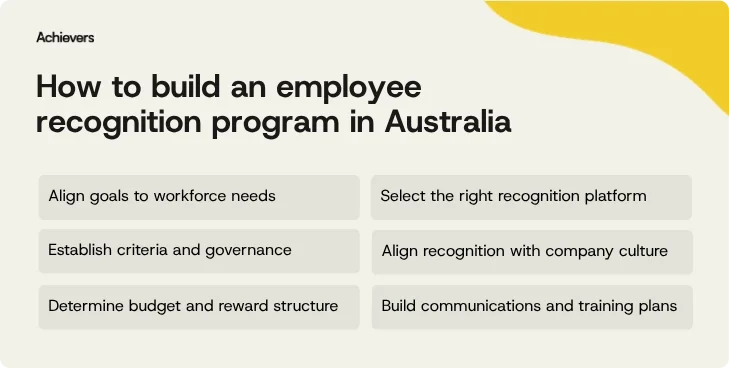
Step 1: Define recognition goals aligned to workforce needs
Start by getting clear on why recognition matters for your organisation right now. Are you trying to lift engagement? Reduce turnover? Strengthen belonging? Reinforce values? Support managers through change?
Strong recognition goals are tied directly to business outcomes and employee experience. Common KPIs include:
- Recognition frequency (weekly is the benchmark for impact)
- Manager participation rates
- Improvements in belonging or engagement scores
- Reductions in voluntary turnover
- Increases in peer‑to‑peer recognition activity
If recognition doesn’t have a purpose, it becomes noise. When it does, it becomes momentum.
Step 2: Establish recognition criteria, governance, and fairness standards
Next, define what gets recognised and who can recognise whom. This is where trust is built — or lost.
Clear criteria help avoid bias and ensure recognition feels fair across roles, locations, and work types. Consider:
- Which behaviours and outcomes should be recognised
- How recognition aligns to company values
- Guardrails to prevent favouritism or over‑recognition of a few visible teams
In Australia, fairness matters. Programs should work just as well for frontline, casual, hybrid, and office‑based employees — not only those closest to leadership. Fair recognition builds trust, and trust is the difference between a program people believe in and one they tolerate.
Step 3: Determine program budget and reward structure (with local tax considerations)
A sustainable recognition program balances impact with longevity. Set a budget that supports frequent recognition without relying solely on large, infrequent rewards.
When designing rewards:
- Offer a mix of non‑monetary, experiential, and monetary options
- Focus on flexibility and choice — what’s meaningful varies by person
- Be mindful of when rewards may trigger Fringe Benefits Tax (FBT) or payroll implications
Recognition should feel generous, not transactional — and never replace pay or entitlements.
Step 4: Select the right recognition platform for Australian organisations
Technology plays a critical role in making recognition easy, visible, and scalable. The right platform should support how Australians actually work.
Key features to look for include:
- Mobile‑first access for frontline and distributed teams
- In‑the‑flow recognition via tools like Microsoft Teams or Slack
- Analytics to track frequency, participation, and equity
- Support for local compliance considerations, including STP‑related reporting where relevant
When evaluating vendors, ask how the platform supports fairness, manager adoption, and long‑term engagement — not just launch success. Because if recognition fits the way work actually happens, it becomes habit. If not, it becomes homework.
Step 5: Align recognition with company culture and embed it into daily workflows
Recognition has the most impact when it shows up in the flow of work. That means embedding it into:
- Team stand‑ups and meetings
- Project milestones and handovers
- Safety moments and shift changes
- Digital channels employees already use
In Australian workplaces, authenticity matters more than grand gestures. Specific, timely recognition that calls out real effort will always land better than scripted praise. Over time, what you recognise most clearly is what your culture becomes best known for.
Step 6: Build a communications and training plan that drives adoption
Even the best‑designed program needs support to stick. Set leaders and employees up for success with a clear enablement plan:
- Launch messaging that explains why recognition matters
- Manager training on how to recognise effectively and consistently
- Recognition champions to model behaviour and build momentum
- Campaigns that prompt early participation and habit‑building
Just as important: make recognition psychologically safe. People should feel comfortable giving and receiving appreciation, without feeling awkward or performative.
Step 7: Launch the program with clear expectations and a compelling first action
Launching a recognition program is about setting clear expectations for behaviour, not creating a one‑time moment of excitement. A strong launch creates momentum. Make it visible, simple, and action‑oriented.
Steps might include:
- Leadership kickoff messages and visible participation
- First‑week challenges (e.g., “Recognise three people who helped you this week”)
- Frontline‑friendly communications and reminders
Recognition scales when leaders feel capable, not cautious, about using it.
Step 8: Measure program performance and link results to business outcomes
Measurement is essential for understanding whether recognition is reinforcing the behaviours and outcomes your organisation cares about.
Track metrics like:
- Recognition frequency and participation
- Manager adoption
- Sentiment and belonging indicators
- Engagement trends
- Retention and turnover patterns
Measurement is what turns recognition from something leaders feel good about into something the business can stand behind.
Step 9: Optimise and scale the program using feedback and insights
Writer direction:
As organisations grow and change, recognition programs need to evolve to remain relevant, inclusive, and effective.
Use data and employee feedback to:
- Address low manager participation
- Identify under‑recognised teams
- Refresh campaigns and reward options
- Strengthen equity across roles and locations
- Localise approaches for multi‑site or distributed workforces
When recognition evolves with insight instead of instinct, it stays relevant, credible, and worth investing in.
Best practices for implementing an employee recognition program
Designing a recognition program is only half the work. How it’s implemented determines whether it becomes part of everyday culture or fades into the background.
These are the best practices for implementing a recognition program, ensuring recognition feels meaningful, fair, and sustainable over time:
Make recognition equitable so all employees have equal opportunities to be seen
Equitable recognition ensures that appreciation is accessible to everyone — regardless of role, location, shift, or work arrangement. Without clear guardrails, recognition can skew toward more visible teams or individuals, creating perceptions of favouritism that undermine trust.
To keep recognition fair, organisations should:
- Enable peer‑to‑peer recognition so appreciation isn’t limited to manager discretion
- Monitor recognition data to identify under‑recognised teams, roles, or demographics
- Ensure frontline, casual, and distributed employees have the same access as office‑based teams
Equity doesn’t happen by accident. The data will usually tell you who’s being missed — if you’re willing to look.
Personalise recognition to individual preferences and comfort levels
Recognition is only meaningful if it lands well with the person receiving it. Some employees appreciate public recognition, while others prefer private, one‑to‑one acknowledgment. Understanding these preferences helps recognition feel thoughtful rather than performative.
Personalised recognition can include:
- Choosing public or private delivery based on individual comfort
- Using values‑aligned language that reflects how the work was done
- Offering rewards that feel relevant to the person and the moment
The goal isn’t to over‑engineer appreciation — it’s to make it feel human. When recognition feels personal, people remember it.
Ask for employee input and shape recognition and rewards around what people value
Recognition programs work best when they’re built with employees, not just for them. Assumptions about what motivates people often miss the mark, especially across different roles, generations, and life stages.
Gather input through:
- Short surveys or pulse checks
- Focus groups or listening sessions
- Ongoing feedback tied to recognition usage and sentiment
Involving employees increases relevance, improves adoption, and helps recognition evolve as needs change. It also sends a clear signal: this isn’t a top‑down initiative — it’s a shared one.
Train your managers how to give timely, specific, authentic recognition
Managers play a critical role in shaping how recognition shows up day to day. Yet in Australia, manager‑led recognition remains one of the biggest gaps in the employee experience.
Effective manager training should focus on:
- Recognising employees weekly, not just at milestones
- Being specific about the behaviour and its impact
- Tying recognition back to company values
- Avoiding vague or generic praise
- Modelling recognition during meetings and stand‑ups
When managers are equipped to recognise well, recognition stops feeling awkward — and starts feeling like part of leadership.
Core compliance must-haves for building an employee recognition program in Australia
Employee recognition programs don’t exist in a vacuum. In Australia, they sit alongside well‑established workplace laws designed to protect employees and ensure fair treatment. While recognition is discretionary by nature, it must still align with core employment obligations — particularly where rewards, visibility, and behaviour reinforcement are involved.
Getting this right helps organisations build trust, avoid confusion, and ensure recognition supports, instead of undermines, compliance.
Fair Work Act and NES: Ensure recognition complements with minimum entitlements
Writer direction:
Employee recognition programs sit alongside Australia’s employment laws. Under the Fair Work Act, the National Employment Standards (NES) set mandatory minimum conditions, including leave entitlements and maximum working hours. These cannot be replaced or offset by rewards or recognition.
When building a recognition program, keep these essentials in mind:
- Recognition must always be additional — never a substitute for pay, leave, or entitlements
- Rewards should not compensate for overtime, missed breaks, or excessive workloads
- Employees should not feel pressure to “earn” basic rights through recognition
- Recognition should reinforce contribution and behaviour, not minimum obligations
Privacy Act 1988 and APPs: Protect employee data collected through recognition systems
Writer direction:
Recognition platforms collect more than praise. They often capture behavioural data, participation patterns, and sentiment — all of which are considered personal information under the Privacy Act and Australian Privacy Principles (APPs).
At a minimum, organisations should ensure that recognition data is handled with the same care as any other employee record. That means:
- Storing recognition data securely, with appropriate technical and organisational safeguards
- Restricting access to authorised roles only, based on legitimate business need
- Maintaining audit logs so access and changes can be traced if required
- Ensuring data is stored within Australia, or transferred overseas only in line with APP cross‑border requirements
- Having clear processes for managing data breaches, including obligations under the Notifiable Data Breaches scheme
Record-keeping requirements: Maintain secure, accurate records of rewards and recognition activity
Writer direction:
According to the Australian Government, organisations are required to keep employee‑related records for seven years, and recognition activity can form part of that record set when it involves rewards, decisions, or documented discussions.
For recognition programs, this typically includes:
- Monetary reward allocations, including points, vouchers, or cash‑equivalent rewards
- Recognition sent or received when it’s referenced in performance or development discussions
- Program rules and criteria, showing how recognition decisions are made
- Internal communications related to reward distribution or eligibility
Policy alignment: Ensure recognition practices match WHS, EEO, and conduct obligations
Recognition programs should reinforce the behaviours organisations want more of — and never undermine safety, fairness, or inclusion.
That means recognition programs in Australia should:
- Avoid bias and favouritism, ensuring all employees have fair access to recognition
- Comply with anti‑discrimination laws, regardless of role, background, or work arrangement
- Reinforce psychological safety, recognising effort, collaboration, and learning — not just outcomes
- Align with WHS policies, avoiding incentives that reward unsafe speed, risk‑taking, or overwork
Benefits of an employee recognition program
The benefits of an employee recognition program go far beyond morale. In workplaces across Australia, where appreciation is often understated, recognition plays an especially important role.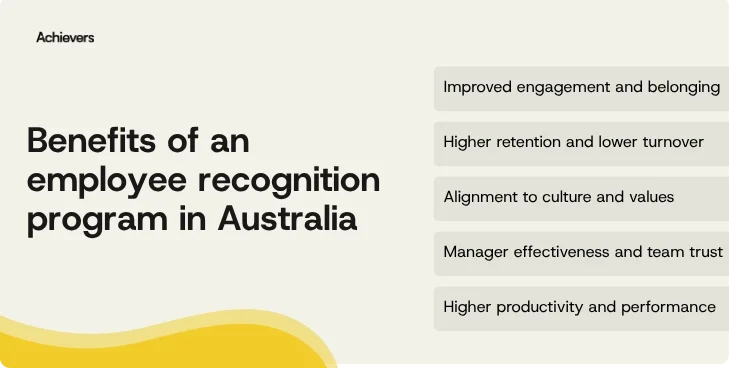
Improved engagement and belonging through frequent, meaningful recognition
Research from the latest APAC Engagement and Retention Report tells us that only 25% of employees across the region say their work feels meaningful, and just 17% feel connected to their company’s values. That disconnect shows up in day‑to‑day work as lower engagement, uncertainty about expectations, and a weaker sense of purpose.
When recognition acknowledges effort regularly and calls out what’s being done well, it makes people feel seen and connected. In Australian workplaces, where praise can be understated or quietly assumed, frequent recognition cuts through the silence.
Higher retention and reduced turnover costs in competitive labour markets
Retention remains one of the biggest challenges for Australian organisations navigating skills shortages, work burnout, and high workforce mobility. Recognition plays a critical role in whether people stay or start looking elsewhere.
When employees are recognised regularly, they’re less likely to job hunt and more likely to feel loyal to their organisation.
Stronger alignment to company values and culture across hybrid and frontline workforces
Many Australian employees say they struggle to see company values reflected in day‑to‑day work. Recognition helps bridge that gap by turning values from statements into actions.
By recognising behaviours that reflect what the organisation stands for, leaders make culture visible — across hybrid teams, shift workers, and multi‑site operations.
Better manager effectiveness and team trust through consistent, specific recognition
Manager recognition remains one of the weakest points in the Australian employee experience, with jus. Too few employees feel regularly recognised by their leaders, and that absence shows up in trust, clarity, and performance.
The good news? There’s a solution, and direct results to back it up. When employees are recognised weekly, they are 11.3x more likely to feel connected to their manager than those who are never recognised.
Increased productivity and performance through timely behaviour reinforcement
Recognition reinforces the behaviours organisations want more of — whether that’s collaboration, safety, innovation, or customer focus. When appreciation is timely and specific, it sharpens role clarity and encourages discretionary effort.
This is especially critical in industries like healthcare, mining, retail, and logistics, where performance, safety, and consistency matter. Recognition keeps people aligned, motivated, and focused — even in high‑pressure environments.
Examples of successful recognition programs in APAC
Across APAC, organisations are using employee recognition programs to solve real business challenges, from boosting engagement during disruption to creating consistency across fast‑growing teams.
Here are two success stories that show what “good” looks like in practice:
Moxa
During a period of disruption and uncertainty, Moxa wanted to strengthen engagement and create new ways for employees to feel seen, heard, and connected. Rather than treating recognition as a separate initiative, they integrated their Achievers platform directly into existing tools like Microsoft Teams and Outlook, making appreciation part of daily workflows.
The program focused on celebrating culture‑building behaviours, empowering managers to recognise meaningfully, and supporting development through peer‑to‑peer recognition.
The results:
- 4,000+ peer‑to‑peer recognitions sent in the first month
- 90% user activation within the first two weeks
Moxa’s experience shows that when recognition is easy to access and closely tied to everyday work, engagement can build quickly — even in times of uncertainty.
Dyson
Dyson ANZ wanted to make recognition more frequent, consistent, and closely aligned with its core values across a large, distributed workforce. To do that, they launched Applause, a recognition platform powered by Achievers, and embedded it into everyday tools employees already used. The program focused on connecting teams across geographies, empowering managers to recognise meaningfully, and spotlighting behaviours that reinforced Dyson’s culture.
The results:
- 4.4 recognitions sent per person in the first seven days
- 97% activation rate within the first 90 days
- 82% monthly active usage
Dyson’s experience shows that when recognition is visible, values‑led, and easy to use, it quickly becomes part of how work gets done. Not just another program, but a shared habit.
Choosing the right recognition partner
Chooding the right partner helps you embed recognition into daily work, support diverse teams, and measure what’s actually changing — not just what’s being sent.
For Australian organisations, there are a few non‑negotiables to look for:
- Local support, with teams who understand regional workforce norms, compliance expectations, and frontline realities
- Recognition tools that integrate with platforms employees already use, so recognition happens naturally and not as another task
- Mobile‑first access to reach Australia’s frontline, deskless, and hybrid workforce
- Global reward capabilities that offer meaningful, locally relevant choices
- Robust analytics that connect recognition to belonging, engagement, retention, and performance
Achievers brings these together in a single platform. Backed by behavioural science, Achievers delivers high‑frequency recognition, one of the world’s largest rewards marketplaces, localised support with global fulfilment, seamless integrations with tools like Workday, Slack, and Microsoft, and analytics that show how recognition drives real business outcomes.
Build a more connected culture with recognition
Recognition isn’t a one-size-fits-all perk or a momentary boost.It’s how strong cultures are built — and how performance is sustained. When appreciation is frequent, meaningful, and clearly tied to what matters, it creates connection, reinforces the right behaviours, and helps people do their best work every day.
That’s what Achievers does. Not with grand gestures or forced enthusiasm, but with recognition that’s easy to give, meaningful to receive, and grounded in how people actually work. When leaders model it and teams use it every day, recognition stops being a program and starts becoming part of the culture.
Ready to turn appreciation into impact? Let’s shape your workforce together.
Employee recognition program in Australia FAQs
Key insights
- The most effective recognition programs in Australia are designed as systems, not initiatives — built to be frequent, inclusive, and part of everyday work.
- Recognition drives culture and performance when leaders model it and tie appreciation directly to behaviours, values, and impact.
- When recognition is meaningful and consistent, it turns feeling seen into stronger engagement, retention, and results.