Table of contents
Create a culture that means business™
Schedule a demo with an Achievers solution expert today.


 Copy URL
Australian organisations have something many regions are still working toward: momentum.
Compared with other APAC markets, Australian employees feel more connected, more confident, and more supported at work. Recognition happens more often. Belonging is stronger. Purpose is clearer.
That advantage matters. And it’s no accident.
According to the 2026 State of Recognition Report: APAC edition, Australia leads the region on many of the indicators that underpin performance, resilience, and retention. But the data also points to a clear opportunity. As organisations scale, transform, and adopt new technologies, leadership behaviours need to evolve just as quickly.
Recognition is how that evolution happens.
Not as a one‑off gesture, but as a consistent leadership signal that shapes performance, reinforces priorities, and helps people thrive through change.
What leaders need to know now
At first glance, the report highlights a clear pattern: strong recognition foundations, high motivation, and a growing opportunity to scale recognition more consistently as organisations grow.
What this tells us: Motivation is strong, but recognition can amplify it even further.
What this tells us: Australia leads on frequency, but there’s still room to make recognition more consistent and embedded in everyday work.
What this tells us: As organisations scale, recognition is at risk of becoming less visible where it matters most, in day‑to‑day leadership.
Australia’s workforce already has momentum. The opportunity for leaders is to build on that foundation by making recognition more consistent, visible, and scalable. When recognition evolves alongside the organisation, it becomes a powerful lever to sustain performance, strengthen connection, and maintain Australia’s advantage as expectations continue to rise.
Recognition is already driving performance in Australia
For Australian employees, recognition isn’t a perk. It’s what helps them perform at their best.
More than one‑third say recognition inspires higher productivity. Others link it to very practical outcomes, including balancing heavy workloads, sustaining morale during redundancies, and easing the stress of understaffing.
That matters in a high‑growth environment. Australian organisations are asking more of their people, more often. Roles are shifting. Expectations are rising. New tools and technologies are becoming part of everyday work.
In that context, recognition becomes a source of capacity. It helps people stay motivated, focused, and resilient when the pace accelerates.
A strong recognition foundation, with room to build
Australia stands out across APAC for recognition frequency. Sixteen percent of employees receive recognition weekly, and 27% receive it monthly. Belonging is also stronger than in neighbouring markets, with more employees feeling welcomed, included, respected, and known as individuals.
These are important signals. They show that recognition already plays a meaningful role in Australian workplace culture.
Yet, the report highlights where organisations can go further. Some employees still hesitate to recognise others because they are unsure how to make recognition meaningful. Others worry about saying the wrong thing. Nearly a quarter say recognition is not yet embedded in their workplace culture.
This is not resistance. It is an enablement gap.
When leaders provide clear examples, simple tools, and consistent modelling, recognition becomes easier, more confident, and more natural. That is how good intentions turn into everyday behaviour.
Recognition needs to scale with the organisation
As organisations grow, the way recognition shows up has to change too. What works in smaller teams or slower environments often breaks down as roles expand, priorities shift, and leaders manage larger, more complex groups. Without intentional systems, recognition becomes inconsistent, reactive, or invisible just when employees need clarity most.
The State of Recognition data shows this most clearly in the manager experience. In Australia, only around one in five employees feel meaningfully recognised by their manager, fewer than one in five have regular one‑to‑one meetings, and only 20% say they receive coaching that helps them do their job better.
This does not point to a lack of care. It reflects how quickly recognition can fall away when leaders are under pressure, priorities compete, and recognition hasn’t yet scaled with the organisation.
As workloads increase and change accelerates, leaders need simple, repeatable ways to recognise effort, reinforce priorities, and support growth. When recognition scales alongside the organisation, it stays visible, credible, and effective, even as everything else moves faster.
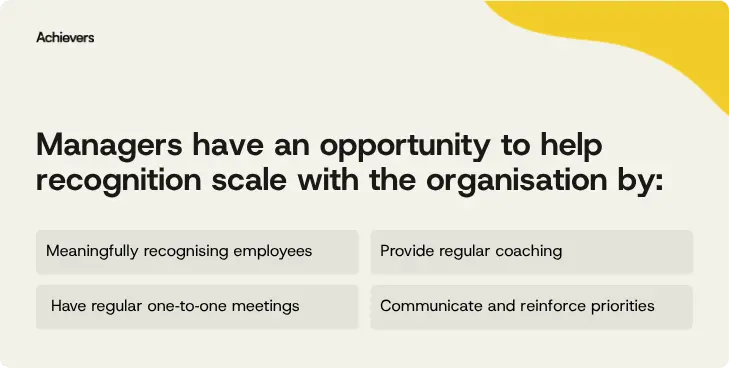
The impact of consistency is powerful. Employees who receive frequent recognition are far more likely to trust their manager, feel supported in their growth, and engage in regular coaching conversations. Recognition becomes a signal of presence and leadership effectiveness.
In fast‑moving organisations, those signals shape how confident employees feel navigating change.
Visibility and progression still matter deeply
Australian employees are clear about what they want to be recognised for, and it goes beyond results.
They value recognition for learning new skills, adapting to change, collaborating with others, and showing resilience as expectations evolve. These behaviours are essential for long‑term performance, yet they are often invisible in traditional performance systems.
Recognition makes this work visible.
Employees who receive weekly recognition are significantly more likely to see how their work connects to the bigger picture and how their role aligns with their personal values. They are also far more likely to see a long‑term future with their organisation.
In competitive talent markets, that sense of progression and clarity is a real differentiator.
Recognition brings clarity during change and AI adoption
Even with stronger foundations, Australian employees still experience uncertainty during change. Only 14% feel informed when changes affect their job, and just 26% say organisational communication is clear. While Australia leads APAC on AI readiness, fewer than one in five employees feel confident using new tools or supported adapting to them.
Recognition plays a critical role here.
Employees who are recognised are more than twice as likely to feel informed during change and to understand how new technologies affect their work. Recognition does not replace communication. It reinforces it by making priorities tangible and personal.
When leaders recognise the behaviours that matter during change, learning, experimentation, and adaptability, employees gain confidence and direction at the same time.
Why recognition maturity matters now
Australia’s position today is a strength. Recognition is more frequent. Belonging is stronger. Employees are willing to go the extra mile.
The opportunity now is to mature recognition as organisations scale.
Recognition maturity means making appreciation frequent, visible, and aligned with what the organisation is trying to achieve. It means equipping managers with simple habits they can rely on, even during busy periods. And it means recognising progress and effort, not just outcomes.
The impact is clear in the data. Seventy‑two percent of employees say regular recognition makes them more likely to stay during periods of change, and 81% say it contributes to successful business transformation. Recognition is not just cultural reinforcement. It is performance infrastructure.
How APAC leaders are keeping pace with employee expectations
Across APAC, employee expectations are rising faster than traditional leadership habits. The organisations that are pulling ahead are not doing everything differently, but they are doing a few critical things more intentionally.
Here’s where APAC organisations are leaning in, and where others may need to catch up. Use it as a guide to see how your organisation fairs against rising employee expectations.
What leading APAC organisations are doing well
Treating recognition as a leadership behaviour, not a program
- Recognition shows up consistently in manager conversations, team moments, and change milestones, not just during formal campaigns.
Making progress visible, not just outcomes
- Leaders regularly recognise learning, adaptability, and collaboration, especially as roles and expectations evolve.
Using recognition to reinforce priorities during change
- Recognition is tied directly to what matters most right now, helping employees understand where to focus their effort.
Keeping recognition human, even as technology increases
- Tools support recognition, but messages remain personal, specific, and clearly delivered by real people.
What other organisations need to do differently
Move beyond occasional recognition
- Infrequent or reactive recognition no longer meets employee expectations in fast‑moving environments.
Equip managers with simple, repeatable habits
- Many managers want to recognise more but lack clear guidance, prompts, or confidence.
Close the gap between intent and experience
- Employees are willing to go the extra mile, but inconsistent recognition sends mixed signals about what is truly valued.
Recognise change behaviours early and often
- Waiting until results are delivered misses the chance to reinforce learning, experimentation, and resilience when they matter most.
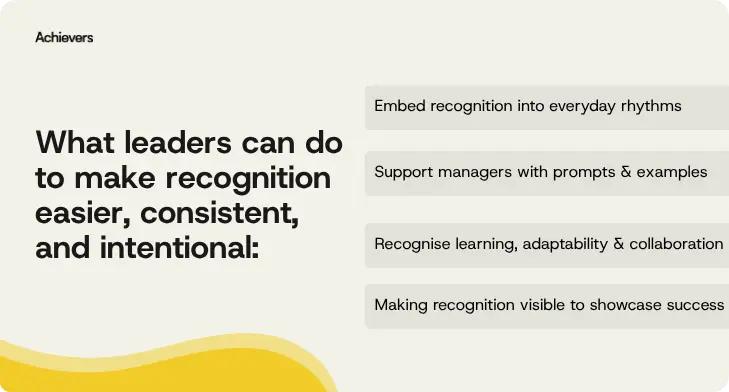
The takeaway for APAC leaders
Keeping pace with employee expectations is not about doing more. It is about being more deliberate. The organisations pulling ahead are using recognition to shape behaviour, build confidence, and sustain performance as change accelerates.
Recognition is no longer just a reflection of culture. In APAC, it is becoming one of leadership’s most effective tools for growth.
What comes next for Australian workplaces
Australia is well positioned, but momentum is not something organisations can take for granted.
As growth continues and change accelerates, recognition will play an even bigger role in shaping performance, retaining talent, and sustaining culture. The organisations that treat recognition as a leadership system, not an afterthought, will be the ones that continue to stand out.
The Achievers Workforce Institute’s 2026 State of Recognition Report: APAC edition dives deeper into what Australian employees are experiencing, what leaders can do differently, and how recognition drives real results across performance, belonging, and change readiness.
If you want to understand where Australia is leading, where the gaps remain, and how to turn recognition into a lasting advantage, the data is waiting.
Australia’s recognition advantage FAQs
Key insights
- Australia leads APAC in recognition and belonging, creating a strong foundation for performance and growth.
- Frequent, meaningful recognition boosts productivity, resilience, and motivation through change.
- As organisations scale, recognition maturity becomes a clear leadership advantage.
91% of employees would put in extra effort if recognised
16% receive recognition weekly (and 27% monthly)
Only ~20% feel meaningfully recognised by their manager