Table of contents
Create a culture that means business™
Schedule a demo with an Achievers solution expert today.


 Copy URL
Across EMEA, transformation isn’t coming in waves. It’s constant, layered, and often unresolved.
AI is advancing. Organisational structures are shifting. Expectations are evolving in real time. Yet for many employees, clarity, confidence, and connection aren’t keeping pace.
That gap doesn’t show up as resistance. It shows up as hesitation. Slower adoption. Lower trust.
And increasingly, it shows up as a disconnect between what leaders intend and what employees actually experience.
According to the Achievers Workforce Institute (AWI) State of Recognition Report: EMEA edition, only 20% of employees feel informed when change affects their role, and just 23% say communication is clear during uncertainty.
This is the tension defining EMEA right now: strategy is moving forward, but belief isn’t. Recognition is what bridges that gap.
In this blog, we’ll examine some of the key themes from this year’s report and how workplaces will be impacted.
What leaders need to know now
At first glance, the EMEA report highlights a region navigating tension: strong intent, growing structure, and a widening gap between recognition design and everyday experience. Let’s take a look:
What this tells us: Motivation is not the constraint — reinforcement is. Recognition is the lever that turns willingness into action.
What this tells us: Communication alone isn’t enough. Recognition is filling the clarity gap by reinforcing priorities in real time.
What this tells us: Connection remains fragile across EMEA, making recognition a critical driver of inclusion and stability.
What this tells us: Scale matters — but credibility matters more. Recognition must stay distinctly human to build trust.
What this tells us: Recognition is becoming more structured, but risks losing immediacy and impact if it isn’t embedded into daily work.
The opportunity for leaders is to move recognition from structured to responsive — making it more frequent, more human, and more closely tied to the moments that shape behaviour. Done well, recognition becomes the signal that turns strategy into action and uncertainty into momentum.
Intention vs. impact: where recognition breaks down
On paper, many EMEA organisations are doing the right things. Recognition programmes exist, values are defined, and communication strategies are in place.
But behaviour tells a different story. Recognition across the region is becoming more structured — often landing in predictable monthly cycles.
That improves consistency. But it can also dilute meaning. Because recognition, at its best, isn’t a process. It’s a signal. It tells employees:
- What matters
- What good looks like
- What to do more of
When that signal is delayed, generic, or disconnected from real work, it loses its power. And when that happens, employees don’t push back — they simply disengage from the message.
That’s where intention breaks from impact.
One region, many expectations
EMEA is not a single recognition culture. It’s a collection of distinct expectations shaped by history, language, leadership norms, and trust dynamics.
What resonates in one market can feel performative, or even uncomfortable, in another.
The data makes that tension clear. Only 15% of employees in EMEA are comfortable receiving recognition written or suggested by AI, while 71% trust recognition more when it clearly comes from a real person.
This isn’t resistance to technology. It’s a boundary around authenticity.
Leaders often misread this. They assume scaling recognition means automating it. But in EMEA, scale without credibility erodes trust faster than no recognition at all.
The takeaway is subtle but critical: Recognition needs to be consistent, but it must still feel human, specific, and earned in every market it touches.
Trust, fairness, and visibility: The real drivers of recognition impact
Recognition works differently in EMEA because it’s tied so closely to trust. Employees aren’t just asking, “Am I being recognised?” They’re asking:
- Is this fair?
- Is this meaningful?
- Does this reflect real contribution?
When those answers are unclear, recognition becomes noise. When they’re clear, the impact is immediate.
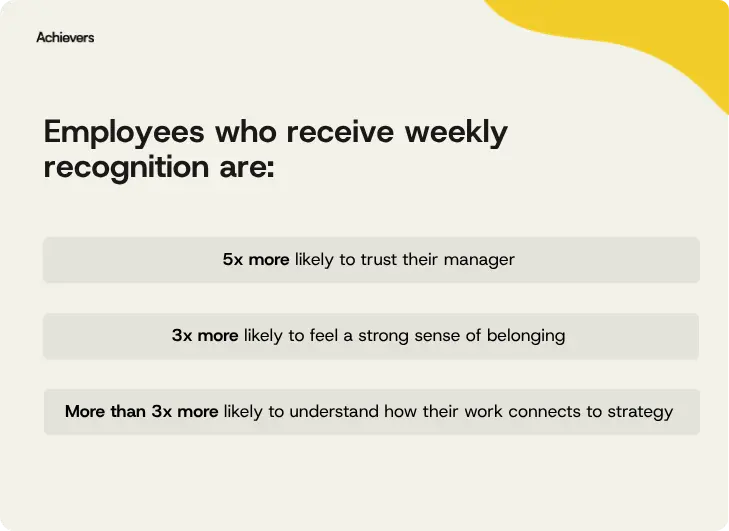
Employees who receive weekly recognition experience a clear shift in how they connect to their work and organisation. They are five times more likely to trust their manager, over six times more likely to feel a strong sense of belonging, and more than three times as likely to understand how their role aligns with broader business strategy. In other words, consistent recognition strengthens trust, deepens connection, and brings greater clarity to everyday work.
This is where recognition shifts from culture initiative to business infrastructure. It doesn’t just motivate. It reinforces. It stabilizes. It creates shared understanding when formal communication falls short.
In a region where only 27% of employees report a strong sense of belonging, those signals matter even more.
Why one-size-fits-all recognition fails in EMEA
Global consistency is important. But in EMEA, rigid uniformity can backfire. Because the risk isn’t inconsistency — it’s perceived inequity.
Different markets bring different expectations around:
- How recognition is delivered (public vs. private)
- What is recognised (effort vs. outcomes)
- Who gives recognition (peer vs. manager)
When global strategies ignore these nuances, employees don’t see standardization. They see mismatch. That’s where well-intentioned programmes start to feel disconnected from reality.
The most effective EMEA organisations take a different approach, they:
- Standardise principles (fairness, frequency, alignment to values), but
- Localise delivery (tone, visibility, cultural norms)
This balance protects trust while maintaining scale and prevents organisations from creating multiple, uneven employee experiences across the region.
Recognition as a stabiliser in uncertain systems
EMEA organisations are operating under sustained pressure: economic uncertainty, organisational change, and accelerating AI adoption all at once.
In this environment, employees don’t need more messaging. They need more proof. Recognition provides that proof in real time, it:
- Reinforces effort when outcomes are unclear.
- Highlights progress when direction shifts.
- Builds confidence when strategy feels abstract.
The data shows how powerful that stabilization effect can be:
- 69% of employees say recognition makes them more likely to stay during periods of change
- 91% say it increases their willingness to support organisational change
Recognition doesn’t eliminate uncertainty. But it makes uncertainty navigable.
And for many organisations, that’s the difference between momentum and stall.
The UK perspective: Strong impact, rising expectations
Within EMEA, the United Kingdom stands out — not because it’s immune to these challenges, but because recognition appears to have a more immediate operational impact.
UK employees report:
- 27% feel meaningfully recognized (vs. 24% across EMEA)
- 30% are highly engaged
- 30% see a long-term career at their company
Recognition also drives measurable outcomes in the UK:
- 95% say it increases their willingness to support change
- 70% say it makes them more likely to stay during transitions
- It boosts productivity (38%) and task completion (31%)
That’s a powerful signal. But it comes with a challenge. Recognition frequency in the UK still skews toward monthly cycles with only 14% receiving meaningful recognition weekly.
In other words, the impact is proven, but it’s not yet maximized.
For UK leaders, the opportunity isn’t to rethink recognition. It’s to increase its consistency and immediacy without losing authenticity. Because when recognition is both frequent and credible, its effect amplifies quickly.
From programme to practise: What leaders need to do next
Across EMEA, the message is clear: recognition works, but only when it’s real. Not automated, delayed, or disconnected from daily work.
The organisations moving forward aren’t treating recognition as an initiative. They’re embedding it into how work happens as a leadership behaviour, a real-time signal, and a system that reinforces change, not just celebrates it.
Because in moments of uncertainty, recognition answers the question employees are really asking: does this matter? In EMEA, that answer can’t come from strategy alone, it has to show up in everyday moments. Recognition isn’t the reward at the end of transformation; it’s the credibility layer that determines whether change takes hold at all.
In a region shaped by nuance, trust, and complexity, it’s one of the most powerful, and most misunderstood, levers leaders have. The opportunity is to move from structured to responsive recognition, balance global consistency with local relevance, and protect human authenticity as technology scales — turning recognition into more than engagement, but a source of alignment, stability, and momentum.
The Achievers Workforce Institute’s 2026 State of Recognition Report: EMEA edition dives deeper into what employees across the region are experiencing, why trust and clarity gaps persist, and how recognition helps organizations move from uncertainty to confidence.
If you want to understand where EMEA organizations are gaining ground, where credibility gaps remain, and how to make recognition a driver of real transformation, the data is waiting.
EMEA’s recognition gap FAQs
Key insights
- Recognition only works in EMEA when it’s real, timely, and connected to daily work.
- The recognition gap is driven by a disconnect between leaders’ intent and employees’ lived experience.
- When done well, recognition becomes the credibility layer that enables trust, alignment, and transformation.
91% of employees would put in extra effort if recognised
16% receive recognition weekly (and 27% monthly)
Only ~20% feel meaningfully recognised by their manager