Table of contents
Create a culture that means business™
Schedule a demo with an Achievers solution expert today.


 Copy URL
Employee service awards have been around forever. In some workplaces, they still look the same too: a certificate, a handshake, a quick “Congrats on X years.” But in the UK, the employee experience has hit a turning point. People aren’t just asking for better perks. They’re asking to feel consistently seen, heard, and appreciated.
And the UK data shows why this matters. Statistics from the Engagement and Retention Report: EMEA edition show that in the UK, employees report relatively strong purpose signals — 37% say their work feels meaningful and 30% feel connected to company values — yet only 25% feel appreciated and engaged.
That gap is the opportunity. Service awards can help close it, but only when they’re designed as more than tenure tracking.
What is an employee service award?
An employee service award is a structured form of recognition that celebrates an employee’s tenure at an organisation, typically tied to milestone anniversaries such as 1, 5, 10, or 25 years of service.
But in modern UK workplaces, it’s more than a date on a calendar. An employee service award should be a meaningful moment to recognise not just how long someone has stayed, but the impact they’ve made and how their contributions connect to the organisation’s purpose.
The UK service awards problem (and why it’s not really about tenure)
On paper, service awards are straightforward: recognise time served. But in practice, UK employees are navigating a workplace where connection, coaching, and clarity are inconsistent, and those are the conditions that shape retention.
For example Achievers Workforce Institute (AWI) data shows that in the UK:
- Only 20% feel connected to their manager
- Only 20% have regular 1:1s
- Only 21% feel effectively recognised
These aren’t small gaps. They shape how work feels day to day. When employees don’t feel connected to their manager, they lose more than a relationship; they lose context. They’re less clear on expectations, less confident in their direction, and less likely to feel supported when things change. Over time, that uncertainty turns into disengagement.
When regular 1:1s don’t happen, feedback becomes reactive instead of consistent. Employees aren’t sure if they’re growing, improving, or even on the right track. And when growth feels unclear, motivation tends to drop with it.
And when recognition is inconsistent, effort can start to feel invisible. Employees still do the work, but without acknowledgement it’s harder to see how that work connects to something bigger. That’s where engagement quietly begins to erode.
The result isn’t always immediate turnover. More often, it shows up as something slower:
- Lower discretionary effort
- Weaker connection to the organisation
- Growing openness to other opportunities
As AWI research shows, connection and recognition aren’t just “culture” levers, they are core drivers of engagement, performance, and retention. So, when those everyday moments of connection are missing, they don’t disappear. They accumulate. And over time, that accumulation shapes whether employees stay, disengage, or leave.
That’s why milestone moments matter more. When everyday connection is fragile, service awards become a rare opportunity to reset the experience and deliver the kind of recognition, clarity, and human connection that employees aren’t consistently getting in the flow of work.
Not as a fix for everything, but as a moment that reminds people: You’re seen. You matter. And your contributions haven’t gone unnoticed.
What an employee service award should accomplish today
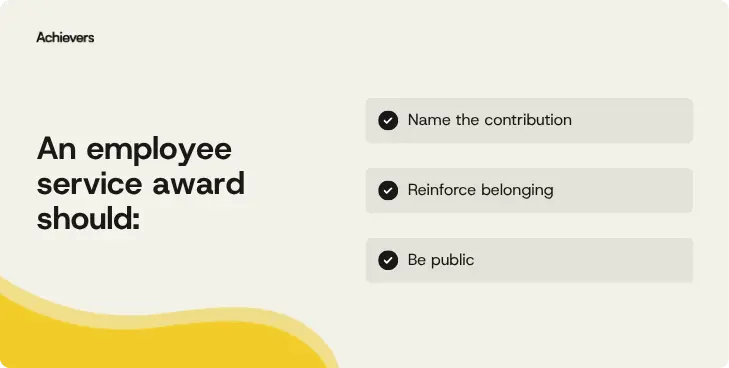
A modern service award still celebrates tenure, but it should also do three more important things:
- Name the contribution (not just the number of years)
- Reinforce belonging (so employees feel part of something, not just present in it)
- Create a visible moment of appreciation (so recognition doesn’t disappear into private emails)
But what does that actually look like in practice?
Name the contribution
Tenure alone doesn’t tell the story. Two employees can both hit five years, but their experiences, impact, and contributions will be completely different. Recognition that focuses only on years served misses the opportunity to make that moment meaningful.
Naming the contribution means being specific:
- What did this person bring to the team?
- How did they make a difference?
- What would be missing if they weren’t here?
This is what transforms recognition from a milestone into a message: “We see what you’ve done and it matters.”
Reinforce belonging
Staying in a role doesn’t automatically mean feeling connected to it. Belonging comes from understanding that you’re part of something — that your work contributes to a bigger whole and that you have a place in it.
A strong service award should reinforce that sense of belonging by connecting the individual to:
- Their team
- The organisation’s purpose
- Their future within it
It’s the difference between saying, “You’ve been here five years,” and “You belong here and you matter to what we’re building.”
Make it visible
Recognition that isn’t seen has limited impact. Private recognition has value, but public recognition shapes culture. It shows others:
- What great work looks like
- What the organisation values
- How appreciation shows up in practice
When service awards are shared — in team meetings, company platforms, or leadership messages — they do more than recognise one person. They create a ripple effect that strengthens connection across the organisation.
What defines a modern service award programme
The strongest service award programmes move beyond generic gestures and focus on the employee experience, not just the milestone itself.
At their best, they combine four essential elements:
High-impact employee service awards:
- Are tied to meaningful milestones
- Highlight individual contributions
- Create a relevant rewards experience
- Are shared publicly
These four elements work together. When one is missing, the moment loses impact. When they come together, recognition becomes something employees remember, and something that shapes culture.
1. Meaningful milestones (not just major anniversaries)
Long gaps between milestones create recognition blind spots, and those gaps often happen at the exact moments employees are deciding whether to stay.
Modern programmes close those gaps by recognising earlier:
- Year 1: Early commitment and first belonging signals
- Year 3: Momentum and growing connection
- Year 5+: Long-term contribution and impact
This ensures recognition shows up at key points in the employee journey, not just at the end of it.
2. Personalised messages that feel genuine
Recognition is only meaningful if it feels real.
That means moving beyond templated messages and focusing on specific contributions:
- What the employee has achieved
- How they’ve impacted others
- What makes their work valuable
Personalisation is what turns a service award into a moment of connection rather than a process.
3. Reward choice that reflects real life
Not all employees value the same things, which is why a fixed reward often misses the mark.
The most effective programmes offer choice that reflects real needs and preferences. In UK organisations, this often includes:
- Additional annual leave
- Well-being-related rewards
- Development opportunities
- Experience-based rewards
The goal isn’t the reward itself, it’s giving employees control over what recognition means to them.
4. Visible recognition (shared, not silent)
Recognition that stays private has limited impact.
When service awards are visible — shared in team meetings, internal platforms, or leadership messages — they do more than recognise one person. They reinforce:
- What great work looks like
- What the organisation values
- How appreciation shows up in practice
That visibility is what turns individual moments into cultural signals. Modern service award programmes don’t just celebrate time. They recognise contribution, reinforce belonging, and make appreciation visible so employees don’t just stay, they feel like they belong.
Why service awards matter for retention in the UK
UK employees often understand their organisation’s purpose, but don’t consistently feel connected to it.
For example, AWI data shows that:
- Only 22% feel connected to colleagues
- Only 19% can access the people they need to be productive
- Only 23% say communications help them feel informed and connected
That connection gap has real consequences. When employees don’t feel connected, the basics of the employee experience start to break down. Work becomes harder to navigate, not because of the role itself, but because of what’s missing around it:
- Collaboration slows down: When people aren’t sure who to go to or how to access support
- Confidence drops: When employees lack clarity about priorities, decisions, or direction
- Engagement weakens: When work feels disconnected from people, purpose, or progress
As AWI research highlights, connection isn’t just a cultural factor, it’s a core driver of engagement, performance, and retention. When employees feel disconnected from managers, teams, or the organisation itself, they’re less likely to invest fully in their work, and more likely to start looking elsewhere.
What to look for in an employee service awards partner
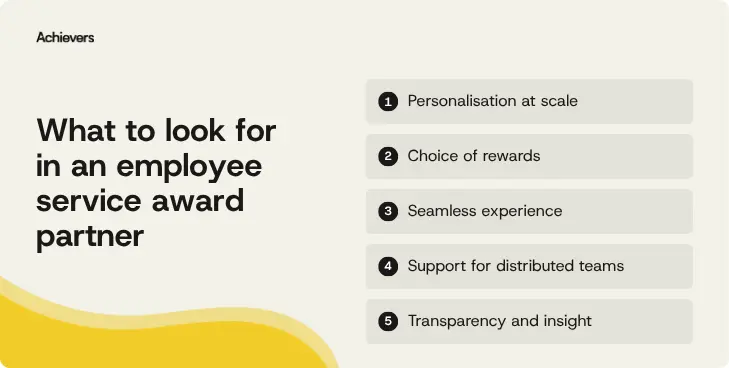
Choosing the right partner starts with one question: Can this help us deliver meaningful recognition consistently without adding complexity?
The strongest partners don’t just offer flexibility. They make it easy to deliver personal, relevant recognition at scale.
1. Personalisation at scale
Recognition should feel tailored, even when delivered across large or distributed teams.
Look for:
- Personalised messaging and milestone moments
- Flexible reward options that reflect individual preferences
- The ability to connect recognition to your organisation’s values
Because when recognition feels generic, it quickly loses its impact.
2. Employee choice that reflects real life
In UK organisations, expectations around rewards have shifted. Employees don’t want one-size-fits-all recognition; they want choice.
That often means:
- Additional annual leave or time off
- Well-being or lifestyle-based rewards
- Professional development or qualifications
- Experiences that reflect personal interests
Choice matters because it makes recognition feel relevant, not transactional.
3. A seamless, intuitive experience
If recognition is difficult to deliver, it won’t happen consistently.
Your platform should make it easy for:
- HR teams to manage milestones at scale
- Managers to deliver recognition without extra effort
- Employees to access rewards simply and quickly
The easier it is to use, the more often recognition actually happens, and frequency is what drives impact.
4. Support for hybrid and distributed teams
UK workplaces are increasingly hybrid, and recognition needs to work across locations.
Look for:
- Digital-first delivery
- Visibility across teams and locations
- Integration into everyday tools (e.g. Teams, Slack, HR systems)
Recognition should meet employees where they work, not sit in a separate process.
5. Transparency and insight
Recognition should be measurable, not just visible.
Strong partners provide:
- Clear reporting on participation and usage
- Insight into recognition trends
- Data that helps you understand impact over time
Because recognition isn’t just a cultural initiative, it’s a driver of engagement and retention outcomes.
Why simplicity matters
Behind the scenes, simplicity is one of the most important — and most overlooked — factors.
If a platform is difficult to manage:
- Milestones get missed
- Recognition is delayed
- Managers disengage from the process
And that inconsistency shows up directly in the employee experience.
Consistency is what builds connection over time. The easier it is to deliver recognition, the more likely it is to happen consistently.
Implementation tips for lasting impact
Choosing the right partner is only the first step. How you embed service awards into your organisation will determine their long-term impact.
Do:
- Make the purpose clear
- Help employees understand why service awards exist, not just what they are
- Enable managers
- Give them simple tools and guidance to deliver meaningful recognition
- Automate the basics
- Ensure milestones are tracked and celebrated consistently
- Connect to everyday recognition
- Service awards should reinforce, not replace, ongoing appreciation
Don’t:
- Treat service awards as a standalone initiative
- Deliver recognition late or inconsistently
- Rely on generic messaging that feels impersonal
Make service awards a driver of retention, not a checkbox
In the UK, employees often feel connected to the purpose, but not always to the experience. That’s where service awards can make a difference. They’re one of the few moments where organisations can pause, reflect, recognise, and reinforce belonging.
With Achievers, you can make employee service awards more than just milestones. Turn them into moments that connect people to purpose, reinforce culture, and drive long-term commitment.
Employee service awards FAQs
Key insights
- Service awards only drive retention when they reinforce connection, recognition, and belonging — not just tenure.
- In UK workplaces, weak day-to-day connection makes milestone recognition a critical moment to re-engage employees.
- The most effective service awards are personalised, visible, and timed to key moments in the employee journey.