Table of contents
Create a culture that means business™
Schedule a demo with an Achievers solution expert today.


 Copy URL
Employee service awards improve retention and engagement when they celebrate an employee’s contributions, reinforce their impact, and create a meaningful moment of appreciation, instead of focusing solely on tenure.
That’s especially important today, because only 25% of employees globally feel appreciated or engaged at work, according to 2,500 surveyed employees in the 2026 Engagement and Retention Report. Employee service awards that use anniversaries as an opportunity to reinforce staff impact and celebrate the people behind the achievement help build the sense of appreciation and belonging that keeps employees engaged and committed to the organization.
What is an employee service award?
An employee service award is a structured form of recognition that celebrates an employee’s tenure at an organization. It’s typically tied to milestone anniversaries such as 1, 5, 10, or 25 years of service.
Employee service awards should use a milestone anniversary to acknowledge the employee’s impact, highlight their achievements, and reinforce their value to the organization.
Why do employee service awards matter?
Employee service awards matter because they create a dedicated moment to recognize employee contributions and reinforce appreciation at a time when many employees don’t feel valued.
While everyday recognition reinforces positive behaviors in the moment, service awards give organizations an opportunity to reflect on an employee’s impact over time and strengthen their connection to the organization.
That opportunity matters according to the 2026 State of Recognition Report, where 44% of employees surveyed globally say the most meaningful recognition is specific without a monetary reward. Service awards create a natural opportunity to deliver that type of recognition by celebrating an employee’s achievements, contributions, and growth throughout their tenure.
Who is impacted most by employee service awards?
Employee service awards have the greatest impact on employees reaching key career milestones, as well as the managers and organizations that support them. For employees, they provide a dedicated opportunity to be recognized for their contributions and reflect on the impact they’ve made over time.
For managers, they create a structured moment to reinforce appreciation and strengthen employee relationships. For organizations, they help build a culture where recognition is visible and consistent across all teams and departments, which makes recognition a predictable and meaningful part of the employee experience.
When do employee service awards work and fail?
Employee service awards work when they are personal, specific, and connected to an employee’s impact on the organization. Employees should understand why they are being recognized and how their work has contributed over time.
They fail when they become a routine admin exercise. Generic messages, impersonal rewards, and recognition that focuses only on years of service can make milestones feel transactional rather than meaningful.
Where do employee service awards show up in an organization?
Employee service awards show up at key moments in the employee experience, including milestone anniversaries, team celebrations, company meetings, and employee recognition programs. They can be delivered through a recognition platform, during a manager-led conversation, or as part of a broader company-wide recognition event.
Successful employee service awards are often integrated into an organization’s recognition strategy, so milestone achievements receive the same visibility and appreciation as day-to-day contributions.
How do employee service awards work in practice?
Employee service awards work in practice by recognizing employees at predefined career milestones, such as one, five, 10, or 25 years of service. The award typically includes a recognition message, a public or team-wide acknowledgment, and in some cases, a type of reward or commemorative gift.
Employee service award ideas and examples
Match the reward to the milestone
Matching the reward to the milestone helps recognition feel appropriate, meaningful, and aligned with the employee’s tenure. A five-year anniversary often calls for a different experience than a 25-year milestone.
5 years
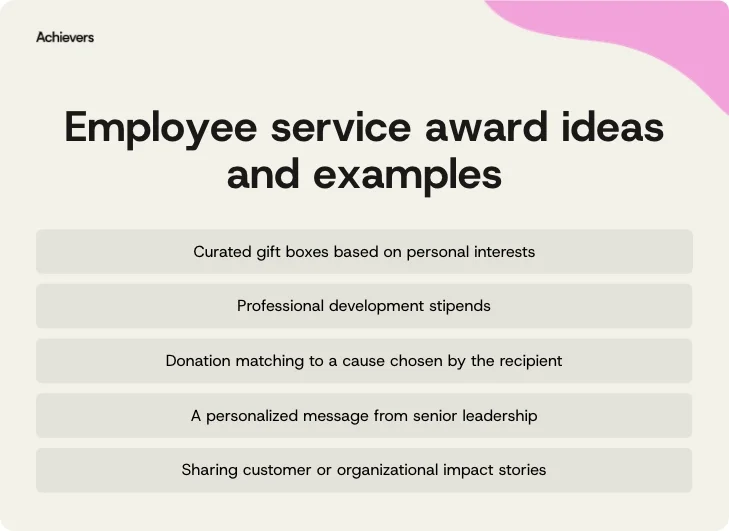
- Curated gift boxes based on personal interests: Personalized gifts show employees they are recognized as individuals.
- Extra PTO or experience days: Additional time away from work can help employees recharge while marking an important career milestone.
- Points-based rewards: Giving employees choice allows them to select a reward that feels personally meaningful and relevant.
10 years
- Travel or bucket-list experiences: Experiential rewards create lasting memories that reflect the importance of a decade of contributions.
- Professional development stipends: Tenured employees often value opportunities to continue growing their careers and skills.
- Personalized video tributes from leaders and peers: Video messages allow colleagues and leaders to recognize both achievements and long-term impact.
25 years
- Legacy awards tied to organizational impact: These awards recognize the employee’s lasting influence on teams, culture, or business outcomes.
- Donation matching to a cause of the employee’s choice: Charitable giving allows employees to connect their milestone to a cause they care about.
- Employee-selected milestone experience: A flexible budget that allows employees to choose a meaningful experience that reflects their interests and accomplishments.
Personalize the award message
Personalizing the recognition message helps employees understand why they are being recognized.
Examples include:
- A personalized message from senior leadership: Reference specific contributions, achievements, or moments that shaped the employee’s career and the organization.
- Recognition tied to a major project or milestone: Highlight work the employee led, problems they solved, or goals they helped achieve.
- Stories that connect tenure to organizational impact: Show how the employee’s contributions influenced customers, teams, or business outcomes over time.
- Reflections on growth and development: Recognize skills gained, career progression, leadership development, or mentoring contributions throughout their time at the company.
Include peers in the award celebration
Including peers in the celebration provides a more complete picture of an employee’s impact.
Examples include:
- Peer shoutouts tied to specific contributions: Invite colleagues to share examples of projects, support, or achievements that made a difference.
- Team celebrations focused on shared accomplishments: Connect the employee’s milestone to team successes and collaborative wins.
- Colleague stories and testimonials: Gather short stories that highlight mentorship, leadership, problem-solving, or teamwork.
- Digital recognition walls: Create a shared space where peers can leave messages, photos, memories, and examples of impact.
Connect the milestone to employee impact
Connecting the milestone to employee impact helps employees see the value of their contributions over time. Service awards should recognize what an employee accomplished during their tenure, not just how long they stayed.
Examples include:
- Highlighting major projects or business outcomes: Recognize initiatives the employee helped deliver and the results they achieved.
- Recognizing mentorship and leadership contributions: Acknowledge the influence they have had on teammates, direct reports, or future leaders.
- Sharing customer or organizational impact stories: Demonstrate how their work benefited customers, improved processes, or supported company goals.
What are the benefits of employee service awards?
1. Increased engagement through visible recognition
Employee service awards increase engagement through visible recognition because they make employee contributions impossible to overlook. Unlike day-to-day recognition, service awards create a dedicated moment to highlight an employee’s impact in front of peers, managers, and leaders. That visibility reinforces the value of an employee’s work and motivates stronger performance over time.
According to 2026 Achievers Workforce Institute data, 64% of below-average performers say feeling recognized would help them be more productive, while 58% say recognition would make them more likely to complete tasks. Service awards help create those moments of recognition at key milestones in the employee journey.
2. Strengthened confidence and belonging
Employee service awards strengthen confidence and belonging by showing employees that their contributions matter over the long term. Recognition helps employees see the value of their work and their place within the organization. When service awards highlight specific achievements and growth, they reinforce both accomplishment and connection.
3. Improve retention through reinforced commitment
Employee service awards improve retention because recognition reinforces an employee’s commitment to the organization. Milestone anniversaries are natural reflection points when employees consider their future, growth, and connection to their workplace. Recognizing those moments reinforces the value of staying and reminds employees that their work has had a lasting impact.
How Achievers approaches employee service awards
With Achievers, employee service awards are a part of a broader recognition strategy. Milestone celebrations live within employee recognition software, making it easier for organizations to connect years of service to real contributions, achievements, and employee impact. Organizations can manage awards, celebrations, communications, rewards, and recognition campaigns in one place, creating a more consistent experience for employees.
By bringing service awards into the same experience as recognition, Achievers helps organizations make milestone celebrations more visible, personal, and scalable.

Employee service awards FAQs
Key insights
- Employee service awards create the most value when they recognize what employees have contributed throughout their tenure.
- Personal and specific recognition makes career milestones more meaningful than the reward alone.
- Employee service awards have the biggest impact when they’re part of an organization's broader recognition strategy.