Table of contents
Create a culture that means business™
Schedule a demo with an Achievers solution expert today.


 Copy URL
Employee service awards have been part of working life for decades. In many organisations across Singapore, they still follow a familiar pattern: a certificate, a simple thank-you, or a small token tied to years of service.
But today’s workplace in Singapore looks very different. Employees are navigating a fast-paced, highly competitive environment shaped by digital transformation, regional mobility, and rising expectations. They’re not just looking for rewards — they want to feel supported, recognised, and connected in a meaningful way.
And for Singapore, Achievers Workforce Institute (AWI) data highlights a sharper connection gap:
- Only 25% of employees feel a strong sense of belonging at work
- Only 24% feel meaningfully recognised
- And just 9% say their organisation’s values are reflected in everyday behaviours
In dynamic markets like Singapore, where change is constant, this gap isn’t just an engagement issue, it’s a risk to retention and performance. Service awards can help bridge that gap, especially when they’re designed to create connection, not just mark time.
What is an employee service award?
An employee service award recognises tenure milestones, typically at 1, 5, 10, or more years. But in Singapore’s fast-evolving workplaces, that definition is no longer enough.
A modern service award should recognise:
- The contribution an employee has made
- How they’ve helped the organisation grow
- And how their work connects to broader business goals
Because in today’s environment, tenure alone doesn’t build loyalty; alignment and recognition do.
The real issue: Why service awards alone don’t solve engagement
Service awards don’t exist in isolation. They sit within the broader employee experience, and that experience is changing rapidly across APAC.
Employees are navigating:
- Ongoing transformation (especially digital and AI adoption)
- Evolving skills expectations
- And increasing pressure to adapt quickly
When employees don’t feel supported or informed during that change, connection breaks down.
And when connection breaks down:
- Work feels less clear and more transactional
- Collaboration becomes harder
- And engagement begins to drop
This doesn’t always lead to immediate turnover. Instead, it often shows up as:
- Reduced motivation
- Lower alignment with organisational priorities
- A growing openness to external opportunities
Recognition plays a critical role in countering this, which is why it’s one of the most effective ways to stabilise employees during change.
Why service awards matter in Singapore’s workforce
Singapore organisations operate in a unique environment:
- Highly competitive talent market
- Strong focus on performance and growth
- Increasing emphasis on continuous learning and adaptability
Employees often understand the organisation’s direction, but may not feel fully connected to how they contribute to it. That’s where service awards come in.
Placed correctly, they act as anchor moments to:
- Reconnect employees to their impact
- Reinforce recognition that may be inconsistent day to day
- And create a moment of clarity in fast-moving environments
What a modern service award should do
A service award should still recognise tenure, but today it needs to go further.
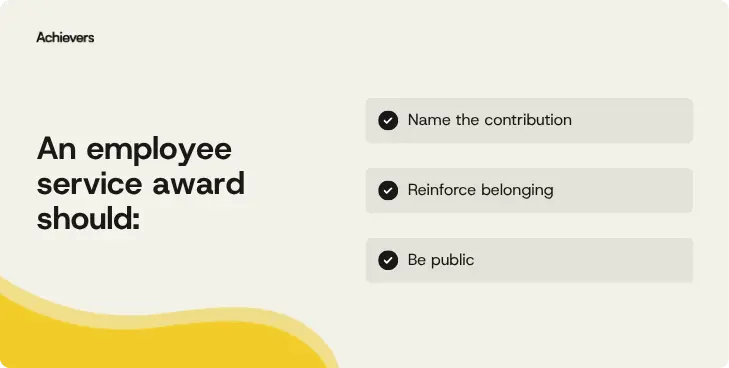
It should:
- Name the contribution
- Reinforce belonging
- Create a visible moment of appreciation
Here’s what this looks like in practice:
1. Name the contribution
Years of service don’t tell the full story, impact does.
Strong recognition clarifies:
- What the employee contributed
- How they supported their team or organisation
- Why their work mattered
This is what makes recognition feel specific and meaningful.
2. Reinforce belonging
In Singapore’s performance-driven environments, belonging can’t be assumed.
Employees need to feel:
- Connected to their team
- Aligned with organisational goals
- Supported in their long-term growth
A strong service award reinforces this connection, especially during times of change.
3. Make recognition visible
Recognition that isn’t seen has limited effect.
When service awards are shared, they:
- Reinforce organisational priorities
- Signal what success looks like
- Strengthen connection across teams
In high-performing cultures, visibility helps turn recognition into a shared standard.
What defines a modern service award program
The most effective programs reflect how people work today, not how they worked in the past.
High-impact programs:
- Recognise meaningful milestones
- Highlight individual contributions
- Offer relevant reward experiences
- Make recognition visible
Recognise earlier and more often
In Singapore’s fast-paced environments, waiting years to recognise employees is too late.
Modern programmes recognise:
- Year 1: Early engagement and retention
- Year 3: Growing contribution
- Year 5+: Sustained impact
Personalise the experience
Generic recognition reduces impact.
Instead, focus on:
- Clear, personalised messaging
- Recognition tied to real outcomes
- Alignment with organisational values
Offer meaningful reward choice
Singapore’s workforce values flexibility and relevance.
Effective options may include:
- Professional development and skills training
- Well-being or lifestyle-related rewards
- Flexible benefits
- Experience-based rewards
The goal is simple: make recognition feel relevant to individuals, not standardised.
Embed recognition into everyday work
Recognition shouldn’t feel like a one-off program.
It should:
- Be easy to deliver
- Show up regularly
- Align with daily workflows
Because consistency, not occasional recognition, is what drives engagement.
Selecting the right employee service awards partner
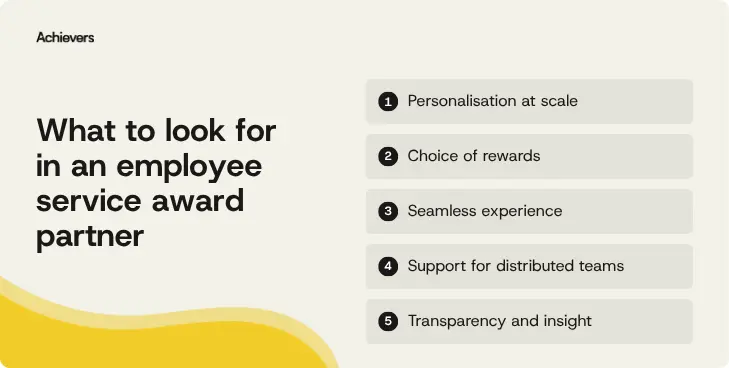
Choosing a partner comes down to one key question: Can this help us deliver consistent, meaningful recognition in a fast-moving environment?
In Singapore, where speed, efficiency, and scalability matter, this is critical.
Here’s what this looks like in practice:
1. Name the contribution
Years of service don’t tell the full story, impact does.
Strong recognition clarifies:
- What the employee contributed
- How they supported their team or organisation
- Why their work mattered
This is what makes recognition feel specific and meaningful.
2. Reinforce belonging
In Singapore’s performance-driven environments, belonging can’t be assumed.
Employees need to feel:
- Connected to their team
- Aligned with organisational goals
- Supported in their long-term growth
A strong service award reinforces this connection, especially during times of change.
3. Make recognition visible
Recognition that isn’t seen has limited effect.
When service awards are shared, they:
- Reinforce organisational priorities
- Signal what success looks like
- Strengthen connection across teams
In high-performing cultures, visibility helps turn recognition into a shared standard.
What defines a modern service award program
The most effective programs reflect how people work today, not how they worked in the past.
High-impact programs:
- Recognise meaningful milestones
- Highlight individual contributions
- Offer relevant reward experiences
- Make recognition visible
Recognise earlier and more often
In Singapore’s fast-paced environments, waiting years to recognise employees is too late.
Modern programmes recognise:
- Year 1: Early engagement and retention
- Year 3: Growing contribution
- Year 5+: Sustained impact
Personalise the experience
Generic recognition reduces impact.
Instead, focus on:
- Clear, personalised messaging
- Recognition tied to real outcomes
- Alignment with organisational values
Offer meaningful reward choice
Singapore’s workforce values flexibility and relevance.
Effective options may include:
- Professional development and skills training
- Well-being or lifestyle-related rewards
- Flexible benefits
- Experience-based rewards
The goal is simple: make recognition feel relevant to individuals, not standardised.
Embed recognition into everyday work
Recognition shouldn’t feel like a one-off program.
It should:
- Be easy to deliver
- Show up regularly
- Align with daily workflows
Because consistency, not occasional recognition, is what drives engagement.
Make service awards a driver of retention, not a checkbox
In Singapore’s fast-moving, high-performance workplaces, connection can’t be left to chance. Service awards create moments to recognise contributions, reinforce alignment, and strengthen belonging. When done well, they don’t just celebrate tenure, they help employees feel seen, supported, and valued.
With Achievers, you can turn service awards into meaningful moments that drive connection, performance, and long-term retention, not just milestones on a calendar.
Employee service awards FAQs
Key insights
- In Singapore’s high-performance workplaces, recognition is essential to maintaining alignment, clarity, and retention.
- Service awards are most effective when they anchor employees during change by reinforcing contribution and belonging.
- Consistent, visible recognition is what turns tenure milestones into meaningful moments that strengthen engagement.