Table of contents
Create a culture that means business™
Schedule a demo with an Achievers solution expert today.


 Copy URL
Employee service awards have been around for decades. In many organisations, they still look familiar: a certificate, a thank-you note, maybe a small gift tied to years of service.
But in Australia, the employee experience has shifted. Employees aren’t just looking for better benefits or flexibility. They want something more fundamental: to feel valued, supported, and connected, especially in fast-changing workplaces shaped by hybrid work, new technologies, and evolving expectations.
And across APAC, Achievers Workforce Institute (AWI) data highlights a growing gap:
- Only 21% of employees feel a strong sense of belonging at work
- Only 14% feel supported in adapting to new tools and ways of working
- Only 10% feel informed when organisational changes affect them
That’s not just an engagement issue. It’s a connection gap.
Service awards can help close that gap. Not by marking time, but by creating meaningful moments of recognition that bring people back to purpose.
What is an employee service award?
An employee service award recognises tenure milestones (typically at 1, 5, 10, or 20+ years). But in modern Australian workplaces, that definition is too narrow. A service award should do more than acknowledge how long someone has stayed.
It should recognise:
- The contribution they’ve made
- The relationships they’ve built
- And the role they play in shaping the organisation
Because in today’s environment, time alone doesn’t drive loyalty: connection does.
The real challenge: Why service awards often fall short
On paper, service awards are simple. In reality, they sit inside a much more complex employee experience.
Across APAC, employees are navigating:
- Constant change
- Evolving expectations
- And often, a lack of clarity or support
When connection is inconsistent, employees don’t just disengage, they disconnect.
- Work feels less meaningful
- Collaboration becomes harder
- And confidence in the organisation starts to dip
This doesn’t always show up as immediate turnover. More often, it shows up as:
- Reduced discretionary effort
- Weaker alignment with organisational goals
- Greater openness to leave
That’s why recognition matters. As AWI research shows, recognition is one of the most effective ways to rebuild connection by reinforcing belonging, clarity, and purpose at the moments employees need it most.
Why service awards matter more in Australia right now
Australian workplaces are increasingly distributed, fast-paced, and change-driven. That creates a unique challenge. Employees may understand what the organisation is trying to achieve, but feel disconnected from how they fit into it.
When connection is weak:
- People feel unsure where they stand
- Recognition becomes inconsistent
- And engagement starts to drift
Service awards help bridge that gap. They create a structured moment where organisations can pause, recognise contribution, and reconnect employees to their impact. In environments where everyday recognition can be inconsistent, these moments carry more weight.
What an employee service award should do today
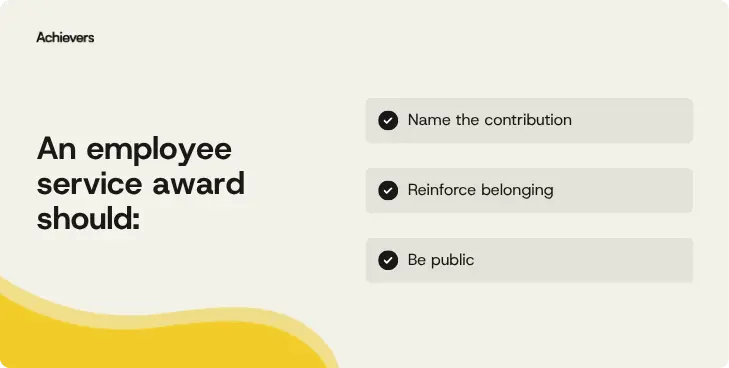
A modern service award still recognises tenure, but it should do three more important things:
- Name the contribution (not just the number of years)
- Reinforce belonging (so employees feel part of something meaningful)
- Create a visible moment of appreciation
Here’s what this looks like in practice:
1. Name the contribution
Tenure doesn’t tell the story: impact does.
Two employees might both reach five years, but their contributions will look very different.
Strong recognition answers:
- What did this person contribute?
- What did they make better?
- What difference did they make?
That’s what turns recognition into something meaningful.
2. Reinforce belonging
Belonging doesn’t come from time alone — it comes from connection.
Employees need to feel:
- Included
- Valued
- And part of something bigger
A strong service award reinforces that by linking the individual to:
- Their team
- The organisation’s purpose
- And their future
3. Make it visible
Recognition that isn’t seen has limited impact.
When service awards are shared:
- They reinforce organisational values
- They show what success looks like
- They create a shared experience across teams
That visibility turns individual milestones into cultural moments.
What defines a modern service award program
The most effective programs are designed for how people work today, not how they worked ten years ago.
High-impact service award programs:
- Recognise meaningful milestones
- Highlight individual contributions
- Offer relevant reward experiences
- Make recognition visible
Recognise earlier and more often
Long gaps between milestones create missed opportunities.
Modern programs recognise:
- Year 1: Early connection
- Year 3: Developing commitment
- Year 5+: Sustained contribution
In a fast-moving workforce, early recognition matters most.
Personalise the experience
Generic recognition weakens impact.
Instead, focus on:
- Tailored messaging
- Meaningful context
- Values-based recognition
Personalisation is what makes the moment feel real.
Offer reward choice
Australian employees value flexibility and relevance.
Effective reward options often include:
- Additional leave or flexibility
- Well-being-related benefits
- Development opportunities
- Experience-based rewards
Choice ensures recognition resonates with individuals, not just policy.
Make recognition part of everyday work
Recognition shouldn’t feel like a separate program.
It should:
- Show up regularly
- Be easy to deliver
- Integrate into existing workflows
Because consistency — not scale — is what builds lasting connection.
Choosing the right employee service awards partner
Choosing the right partner starts with one question: Can this help us deliver meaningful recognition consistently without adding complexity?
In Australian workplaces where teams are often distributed, hybrid, and navigating constant change, consistency isn’t just important, it’s what determines whether recognition actually lands.
The strongest partners don’t just offer flexibility. They make it easy to deliver personal, relevant recognition at scale in a way that fits how people really work today.
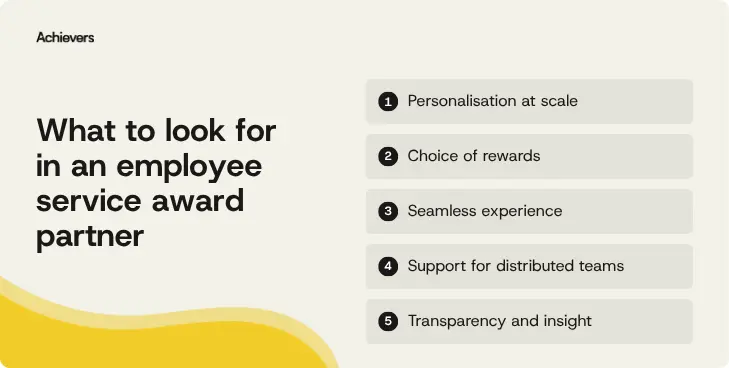
Here’s what to look for:
1. Personalisation at scale
Recognition should feel genuine, not generic.
Even in large or geographically spread organisations, employees expect recognition that reflects their individual contribution and experience.
Look for:
- Personalised messages tied to real impact
- Milestone moments that feel considered, not automated
- The ability to align recognition with your organisation’s values
Because when recognition feels standardised, it quickly loses meaning, and employees start to disengage from it.
2. Reward choice that fits Australian lifestyles
What employees value is changing, and one-size-fits-all rewards rarely resonate.
In Australian workplaces, effective programs often reflect real-life priorities, such as:
- Additional annual leave or flexible time off
- Well-being-focused rewards (mental, physical, or financial)
- Professional development or upskilling
- Experience-based rewards (travel, events, or local activities)
Choice matters because it gives employees control. It turns recognition into something personal, not just something provided.
3. A seamless, intuitive experience
If recognition is hard to deliver, it won’t happen consistently.
That’s especially true in fast-moving Australian workplaces, where managers are balancing hybrid teams, shifting priorities, and limited time.
Your platform should make it easy for:
- HR teams to manage milestones across the organisation
- Managers to recognise employees quickly and meaningfully
- Employees to access and redeem rewards without friction
The easier it is to use, the more often recognition happens. And it’s frequency is what builds connection over time.
4. Support for distributed and hybrid teams
Australia’s workforce is highly distributed across cities, regions, and remote locations.
Recognition needs to work just as well for:
- Office-based employees
- Frontline staff
- Remote and hybrid teams
Look for:
- Digital-first delivery that works across devices
- Visibility across locations and teams
- Integration into everyday tools (i.e., Teams, Slack, HRIS, etc.)
Recognition should meet employees where they are, not depend on where they sit.
5. Transparency and insight
Recognition should be more than visible, it should be measurable.
Strong partners provide:
- Clear reporting on program usage and participation
- Insight into recognition trends across teams
- Data to help you understand what’s working and where gaps exist
Because recognition isn’t just a cultural initiative, it directly impacts engagement, connection, and retention outcomes.
Why simplicity matters
Behind every successful program is something simple: it works without effort. If a platform is complicated, milestones get missed, recognition gets delayed, managers stop engaging with the process. And when that happens, employees notice.
Inconsistent recognition doesn’t just reduce impact, it reinforces the very gaps organisations are trying to fix. The easier it is to recognise people, the more consistently it happens. And consistency is what builds trust, connection, and belonging over time.
Implementation tips for lasting impact
Choosing the right partner is only the first step. How you embed service awards into your organisation will determine whether they actually drive results.
Do:
- Make the purpose clear: Help employees understand why service awards matter, not just what they are
- Enable managers to lead recognition: Give them tools, guidance, and confidence to deliver meaningful moments
- Automate the basics: Ensure milestones are tracked and never missed
- Connect to everyday recognition: Service awards should reinforce — not replace — ongoing appreciation
Don’t:
- Treat service awards as a standalone initiative
- Deliver recognition late or inconsistently
- Rely on generic messaging that feels impersonal
In Australian workplaces shaped by change, flexibility, and distributed teams, recognition only works when it’s easy, consistent, and meaningful. The right partner doesn’t just help you deliver service awards, they help you build a recognition experience that employees actually feel.
Make service awards a driver of retention, not a checkbox
In Australian workplaces where change is constant and connection can feel fragmented, employee service awards create moments matter more than ever.
See how a modern recognition strategy and the Achievers platform can help you build connection, strengthen culture, and retain your people at every stage of the employee journey.
Employee service awards FAQs
Key insights
- In Australia’s fast-changing workplaces, service awards help rebuild connection and clarity when everyday recognition falls short.
- Service awards drive retention by reinforcing belonging and recognising contribution, not just years of service.
- The most effective programs make recognition consistent, visible, and easy to deliver across distributed teams.