Table of contents
Create a culture that means business™
Schedule a demo with an Achievers solution expert today.


 Copy URL
Employee engagement in 2026 isn’t quietly declining in the UK — it’s becoming a serious business risk.
According to Achievers Workforce Institute’s 2026 Engagement and Retention Report: EMEA edition, fewer than half of UK employees see a long‑term future with their current employer, and a growing share are actively considering a move this year. That risk isn’t theoretical. It’s already reflected in how disconnected many employees feel from their organisations and how ready they are to act on it. In today’s labour market, disengagement isn’t just a culture issue. It’s a retention issue with direct implications for productivity, continuity, and performance.
The message behind the data is clear: when employees don’t feel appreciated, connected, or supported, they don’t just disengage — they start planning their exit. And those individual decisions quickly add up, creating pressure across teams, managers, and the wider organisation.
That’s why employee engagement has never been about free snacks or once‑a‑year team events. It’s about whether people feel seen, valued, and motivated to give their best — not because they’re obligated to, but because their experience of work gives them a reason to care.
The statistics we’ll explore in this blog come directly from the 2026 Engagement and Retention Report, built on original global research conducted by Achievers Workforce Institute, including UK employee and HR leader perspectives. This isn’t a roll‑up of third‑party benchmarks. It’s first‑party data designed to surface where engagement is breaking down and where UK organisations still have meaningful leverage to act.
Below, we break down the employee engagement statistics that matter most in 2026, and what they reveal about building a workplace where employees in the UK aren’t just showing up, but genuinely bought in.
What are employee engagement statistics?
Employee engagement statistics are data points that measure how employees feel about their work, their leaders, and their organisation and how those feelings show up in behaviour. They quantify levels of commitment, motivation, connection, and intent to stay, turning what can feel like a “culture problem” into something leaders can actually see, track, and act on.
These statistics typically come from employee surveys and workforce research, like the 2026 Engagement and Retention Report from Achievers Workforce Institute, which captures how UK employees experience appreciation, growth, connection, purpose, and leadership at work.
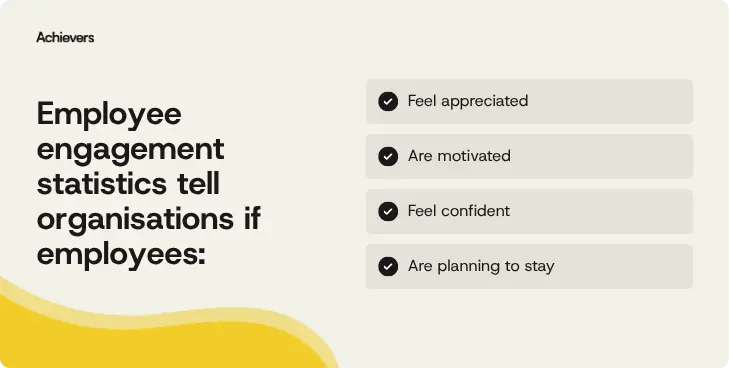
At their best, employee engagement statistics help organisations answer questions like:
- Do employees feel appreciated for their contributions?
- Are they motivated to go above and beyond in their roles?
- Do they feel connected to their manager, team, and company values?
- Are they planning to stay or quietly preparing to leave?
Employee engagement statistics reveal more than you think
Perhaps most importantly, employee engagement statistics reveal patterns. When you look beyond individual data points, a clear picture emerges of where the employee experience is working and where it’s falling short. These patterns highlight the gaps between what employees in the UK expect from work and what many organisations are actually delivering.
Used well, employee engagement statistics aren’t just metrics — they’re signals. They show where culture is thriving, where it’s breaking down, and where recognition, connection, or growth can make the biggest impact. In short, they give leaders the clarity they need to stop guessing about engagement and start shaping it — intentionally and consistently.
15 employee engagement statistics UK leaders need to know
If you want to understand what’s driving — or draining — engagement in the UK, you have to start with the data.
Here are 15 employee engagement statistics from the 2026 Engagement and Retention Report (UK) that reveal what’s working, what’s missing, and where organisations need to pay closer attention.
1. Only 25% of employees in the UK are engaged at work
Just one in four UK employees say they’re engaged. That means the majority of the workforce is either disengaged or emotionally disconnected — a serious risk for productivity, innovation, and retention.
2. Just 25% of UK employees feel appreciated at work
Recognition remains one of the most underused engagement drivers. Only a quarter of employees feel genuinely appreciated. Employees who feel appreciated are 12x more likely to find their work meaningful and are more likely to envision a long‑term career with their organisation.
3. 30% of UK employees plan to look for a new job in 2026
Nearly one‑third of UK employees are actively job hunting, while another 26% are undecided about staying. That puts more than half the workforce at risk of turnover.
4. Only 26% of employees in the UK see a long‑term career with their employer
Just over one in four employees can picture a future with their current organisation. When people can’t see growth, appreciation, or connection ahead, engagement fades long before they resign.
5. Employees who feel appreciated are 17x more likely to envision a long‑term career
Recognition doesn’t just motivate performance, it reshapes how employees think about their future. This is one of the strongest predictors of retention in the UK data.
6. Only 22% of UK employees feel they have access to growth opportunities
Career development is a core engagement driver, yet fewer than a quarter of UK employees believe their organisation provides the tools or opportunities they need to grow.
7. Employees with development opportunities are 2.5x more engaged
When employees see a path forward, engagement rises sharply. Access to development also makes employees 2.5x less likely to be job hunting.
8. Only 19% of UK employees feel connected to their manager
Managers are critical to engagement, yet fewer than one in five UK employees feel truly connected to their direct leader. That disconnect limits trust, feedback, and recognition.
9. Recognition from managers makes employees 2.8x more likely to feel connected
When managers recognise consistently, connection improves fast. Employees recognised by their manager are 2.7x more likely to feel supported in their growth.
10. Only 37% of UK employees find their work meaningful
Purpose matters, but it’s not guaranteed. Employees who feel appreciated are 12x more likely to find meaning in their work, reinforcing the role recognition plays in purpose.
11. Only 22% of UK employees feel they have the resources to do their best work
Engagement stalls when employees lack the tools, clarity, or support they need. Enablement isn’t separate from engagement — it’s a prerequisite.
12. Disengagement is putting UK organisations at serious retention risk
With job‑hunting and indecision affecting over half the workforce, disengagement represents a significant financial and operational threat for UK employers.
13. 75% of UK employees feel overlooked at work
Three‑quarters of employees feel unseen. That sense of invisibility erodes trust, motivation, and long‑term commitment.
14. Employees who feel appreciated are 56x more likely to feel connected to their organisation
Connection is one of the strongest predictors of engagement and recognition is the fastest way to build it.
15. Recognition, connection, and growth are the top engagement drivers in the UK
Across UK data, these three levers consistently shape engagement, retention, and performance. Organisations that invest in all three don’t just retain talent — they build cultures where people thrive.
What these UK engagement statistics are really telling us
When only 25% of employees in the UK are engaged and just 25% feel appreciated, disengagement isn’t a mystery, it’s a signal. Most employees aren’t switching off because they lack ambition or capability. They’re switching off because their effort goes unseen, their growth feels uncertain, and their connection to work weakens over time.
That’s the opportunity hiding in the data. UK employees who feel appreciated are 17x more likely to envision a long‑term career with their organisation. Recognition doesn’t just lift morale it fundamentally changes how people think about their future at work.
Engagement in the UK won’t be rebuilt through perks or annual initiatives. It’s rebuilt through everyday leadership moments: managers noticing effort, teams recognising progress, and organisations creating environments where people feel seen, supported, and able to grow.
That’s exactly what Achievers is designed to enable. We turn employee engagement statistics into action — enabling frequent recognition, stronger manager connection, and cultures where UK employees don’t just show up, but choose to stay, develop, and contribute.
Seen. Heard. Appreciated. That’s how engagement turns into results.
Employee engagement statistics FAQs
Key insights
- Only about a quarter of UK employees feel engaged or appreciated at work.
- Recognition is the strongest driver of meaning, connection, and retention.
- Engagement improves most when recognition, managers, and growth work together.