Table of contents
Create a culture that means business™
Schedule a demo with an Achievers solution expert today.


 Copy URL
Employee engagement in 2026 isn’t quietly declining in Singapore; it’s reaching a tipping point.
According to Achievers Workforce Institute’s 2026 Engagement and Retention Report: APAC edition, fewer than one in five employees across the region feel appreciated at work, and more than a third plan to job hunt this year. In Singapore specifically, fewer than one in six employees feel genuinely valued or supported. That disconnect isn’t theoretical. It’s already shaping how employees think about their future and how quickly organisations could lose critical talent if nothing changes.
The signal behind the data is consistent: when employees don’t feel appreciated, connected to purpose, or supported by their managers, they don’t simply disengage — they prepare to move on. And in a highly competitive talent market like Singapore’s, even small cracks in engagement can translate into outsized retention risk.
That’s why employee engagement has never been about perks or occasional initiatives. It’s about whether people feel seen, valued, and motivated to give their best, not because they’re expected to, but because their experience at work makes it worthwhile.
The statistics explored in this blog come directly from the 2026 Engagement and Retention Report: APAC edition, built on original research by Achievers Workforce Institute with input from employees and HR leaders across Singapore and the wider APAC region. This isn’t a roll‑up of third‑party benchmarks. It’s first‑party data designed to reveal where engagement is breaking down and where organisations still have clear, actionable leverage.
Below, we break down the employee engagement statistics that matter most in 2026 and what they reveal about building workplaces in Singapore where employees aren’t just showing up, but genuinely committed.
What are employee engagement statistics?
Employee engagement statistics measure how employees feel about their work, their leaders, and their organisation and how those feelings influence behaviour. They capture levels of motivation, recognition, connection, growth, and intent to stay, turning culture into something leaders can see and act on.
These insights come from research like the 2026 Engagement and Retention Report: APAC edition, which examines how employees in Singapore and across APAC experience appreciation, development, well-being, purpose, and leadership at work.
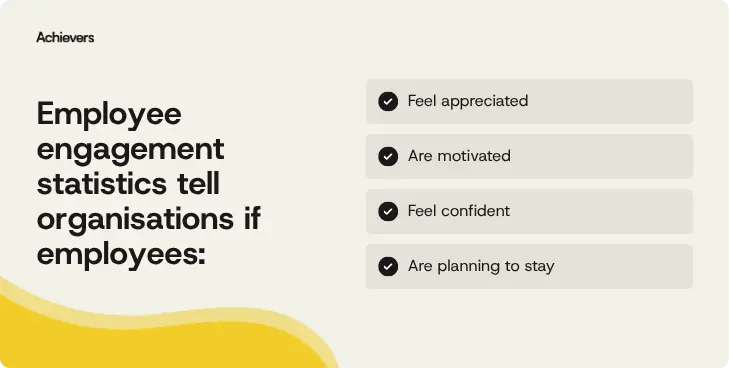
At their best, engagement data helps leaders answer critical questions:
- Do employees feel their efforts are noticed and valued?
- Do they see a future with the organisation?
- Are managers creating the conditions for success?
- Is engagement strengthening — or quietly slipping?
Employee engagement statistics reveal more than you think
When viewed together, engagement statistics reveal patterns, and in Singapore, those patterns point to mounting pressure on employees and rising expectations of employers.
High performance standards, fast‑paced change, and intense competition for talent mean that recognition, growth, and well-being can’t be afterthoughts. Used well, engagement statistics act as early warning signals, showing leaders where connection is breaking down and where investment can have the greatest impact.
15 employee engagement statistics leaders in Singapore need to know
If you want to understand what’s driving — or draining — engagement in Singapore, the data is clear.
Here are 15 employee engagement statistics from the 2026 Engagement and Retention Report: APAC edition, with a specific focus on Singapore.
1. Only 22% of employees in Singapore feel appreciated at work
Fewer than one in four employees feel genuinely recognised, making appreciation a major untapped engagement lever.
2. Just 25% say their work feels meaningful
Only a quarter of employees find meaning in their work — a concern in a market where purpose increasingly shapes retention.
3. 37% of employees across APAC plan to job hunt in 2026
With mobility high across the region, disengagement quickly translates into turnover risk for Singapore employers.
4. Recognition is infrequent for most employees
Across APAC, 58% of employees are recognised four times a year or less — far below what’s needed to sustain engagement.
5. Only 17% feel connected to company values
When alignment to values is weak, commitment and trust erode, even in high‑performing teams.
6. Just 19% feel their organisation supports their well-being
Wellbeing support remains limited, increasing burnout risk in an already high‑pressure work environment.
7. Only 15% feel supported in their development goals
Most employees don’t feel their organisation is actively supporting their growth ambitions.
8. In Singapore, only 15% have access to learning and development resources
Access to development tools and programs remains especially limited, despite strong employee ambition.
9. Just 14% see clear opportunities to grow their career
When career pathways are unclear, engagement drops and external opportunities become more attractive.
10. 18% feel most engaged when their skills are developing
Skill development is a powerful engagement driver, yet few employees are experiencing it consistently.
11. Recognition of skills would increase intent to stay
22% of employees in Singapore say recognition of their skills would increase their desire to stay, reinforcing the link between appreciation and retention.
12. Engagement gaps compound one another
Low recognition, limited growth, and weak well-being support are occurring together, accelerating disengagement.
13. Employees who feel recognised are significantly more engaged
While recognition levels are low, the APAC data shows it has an outsized impact on engagement, connection, and loyalty.
14. Growth remains one of the biggest missed opportunities
Despite strong ambition, development is not being activated at scale, putting future capability at risk.
15. Recognition, growth, and well-being are the top engagement levers in Singapore
Organisations that invest in all three are best positioned to retain talent and sustain performance.
What these employee engagement statistics are really telling us
When only 22% of employees in Singapore feel appreciated and just 25% find their work meaningful, disengagement isn’t about effort or ambition — it’s about experience. Most employees aren’t pulling away because they don’t want to contribute. They’re pulling away because their impact goes unrecognised, their growth feels stalled, and their connection to purpose is weak.
That’s where the opportunity lies. The data shows that recognition has an outsized impact on engagement and intent to stay. Employees who feel recognised are significantly more engaged and far more likely to commit their skills and energy for the long term. In a highly competitive talent market like Singapore, that difference matters.
Engagement won’t be rebuilt through occasional perks or annual programmes. It’s rebuilt through everyday leadership actions: recognising skills as they develop, supporting wellbeing consistently, and making growth pathways visible and real.
That’s exactly what Achievers is designed to enable. We help organisations turn engagement data into action, enabling frequent recognition, activating growth, and helping Singapore organisations build cultures where people don’t just perform, but stay, develop, and thrive.
Employee engagement statistics FAQs
Key insights
- Employee engagement in Singapore is low because most employees don’t feel recognised, supported, or able to grow.
- Recognition has the biggest impact, strongly influencing meaning, connection, and intent to stay.
- Organisations that prioritise recognition, development, and well-being are best placed to stabilise retention.