Table of contents
Create a culture that means business™
Schedule a demo with an Achievers solution expert today.


 Copy URL
Engagement doesn’t improve by accident. It improves when organisations invest in deliberate, well‑designed employee engagement programs that show people they’re seen, heard, and valued consistently.
In Singapore, that work matters more than ever. While workplace engagement increased last year, employee participation still trails the global average, according to ADP Research’s People at Work 2025 study. The message is clear: progress is happening, but not at the pace today’s workforce expects.
This blog breaks down the engagement programs that make a difference in Singapore, and how to put them to work with purpose.
Why engagement programs matter: The state of engagement and connection in Singapore
Singapore’s workforce is known for its drive and discipline, but beneath the surface, engagement and connection are under strain. Research from the 2025 Singapore State of Recognition Report and the 2026 APAC Engagement and Retention Report shows a growing gap between how hard people are working and how supported they feel at work. That gap has real consequences for performance, retention, and trust.
Here’s what the data tells us about the employee experience in Singapore:
- Only 24% of employees feel meaningfully recognised
- Just 25% feel a strong sense of belonging at work
- Only 15% say they are very engaged
- Roughly 73% are currently job hunting
- Just 11% feel regularly recognised by their manager
- Only 13% receive coaching from their manager
These numbers paint a clear picture. Effort is high, but reinforcement is low. This is where employee engagement programs come in. The right programs give managers the structure to recognise consistently, help employees see how their work matters, and turn everyday moments into signals of trust and value. Without them, engagement depends on chance. With them, it becomes a driver of business results.
Employee engagement programs are most effective when they provide actionable insight alongside employee feedback. Discover the connection between recognition and business results in Brandon Hall Group’s analysis of how recognition influences retention, performance, and workforce alignment.
14 employee engagement programs and strategies to shape Singapore’s workforce
The most effective employee engagement programs don’t try to be flashy. They focus on the moments that quietly shape the employee experience: how often people are recognised, how clearly expectations are set, whether growth and upskilling feels possible, and whether effort is acknowledged when it counts.
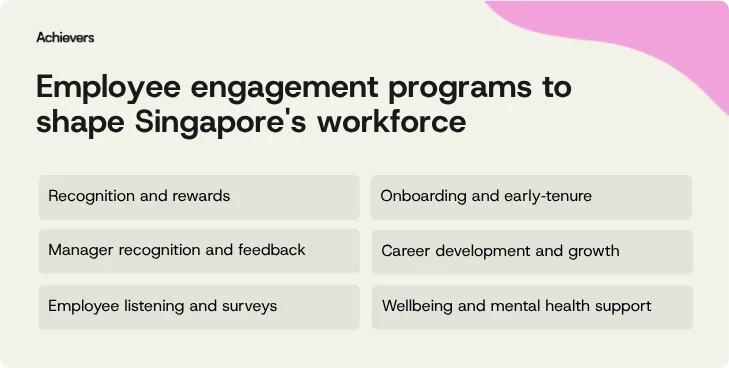
Here are the programs Singapore employers are using to turn engagement into a repeatable, measurable advantage:
1. Recognition and rewards programs
Recognition is the strongest signal an organisation can send, and one of the most underused. In Singapore, where only 24% of employees feel meaningfully recognised, a formal recognition and rewards program helps make appreciation consistent, fair, and visible. Recognition sets the message, and rewards turn it into something tangible that employees can see, feel, and value. When both are used together, they show people that their work truly matters.
Strategy tip: Design recognition criteria that are clear and transparent, and offer both public and private recognition options to respect hierarchy and cultural norms.
2. Manager‑enabled recognition and feedback programs
Managers shape the day‑to‑day employee experience, yet research shows only 15% of employees feel connected to theirs. A manager‑enabled program sets clear expectations around feedback and appreciation, helping recognition become part of everyday leadership, not something saved for performance reviews.
Strategy tip: Treat recognition as a leadership habit. Equip managers with prompts, training, and accountability so appreciation happens consistently, not occasionally.
3. Employee listening and engagement survey programs
Employees are more likely to stay engaged when they believe their voice matters. A structured listening program — combining annual engagement surveys with regular pulse checks — helps organisations understand where connection is breaking down and where action is needed.
Strategy tip: Share survey results openly and link follow‑up actions directly to employee input to build trust and credibility.
4. Structured onboarding and early‑tenure engagement programs
First impressions shape long‑term commitment. A strong onboarding and early‑tenure engagement program extends beyond orientation, helping new hires feel recognised, supported, and clear on expectations in their first months. Early recognition reinforces confidence and signals that contribution matters from day one.
Strategy tip: Include recognition moments at key onboarding milestones to acknowledge learning, progress, and early contributions, not just when they’ve completed a task.
5. Career development and growth programs
When growth feels unclear, engagement starts to disappear. A career development program gives employees visibility into how they can learn, stretch, and progress even when promotions aren’t immediate. Paired with recognition, growth conversations become more motivating and more human, signalling long‑term investment rather than short‑term output.
Strategy tip: Recognise effort and skill development along the way, not just outcomes, to reinforce momentum and commitment.
6. Wellbeing and mental health support programs
Wellbeing has moved from a perk to a performance requirement. A structured wellbeing program helps employees manage workload, stress, and mental health in a way that’s supported by policy and leadership. When wellbeing is recognised and reinforced, employees are more likely to sustain performance without burning out at work.
Strategy tip: Help managers spot strain early and recognise healthy behaviours, not just high output, to reinforce balance as part of success.
7. Flexible work and work‑life integration programs
Flexibility supports engagement only when it’s clear, consistent, and fair. A thoughtful flexible work program helps employees balance their work and personal lives without worrying that flexibility will cost them visibility, trust, or opportunity. When expectations are clear and recognition continues to show up, flexibility feels supportive instead of risky.
Strategy tip: Recognise results and impact, not visibility, so flexible work doesn’t unintentionally disadvantage certain roles or teams.
8. Values‑based culture and behaviour reinforcement programs
Values shape culture only when they show up in everyday decisions. A values‑based engagement program uses recognition to spotlight behaviours that reflect what the organisation stands for. Over time, this builds consistency, belonging, and trust across teams.
Strategy tip: Measure outcomes, not presence, and keep recognition visible so people feel valued no matter where or when they work.
9. Inclusion and belonging programs
Belonging is built through consistent signals that people are respected and included, not something that’s built through one-off initiatives. An inclusion and belonging program focuses on fair access to recognition, voice, and opportunity across roles, generations, and working styles. When people feel they belong, engagement becomes easier to sustain.
Strategy tip: Review recognition patterns regularly to ensure appreciation is distributed fairly and doesn’t unintentionally reinforce bias.
10. Team‑based connection and collaboration programs
Strong teams are the foundation of engagement, especially in hybrid environments. A team‑based engagement program encourages shared goals, regular check‑ins, and collective recognition. This helps teams stay connected even when they’re not working in the same office or even in the same city. Recognition at the team level reinforces collaboration over competition.
Strategy tip: Balance individual recognition with team moments to strengthen connection without diluting personal contribution.
11. Employee resource groups (ERGs) and community programs
People feel more engaged when they feel they belong. ERGs give employees space to connect around shared experiences, interests, or identities, and to feel seen beyond their job title. When ERGs are supported with clear purpose, leadership sponsorship, and recognition, they strengthen connection without becoming performative.
Strategy tip: Recognise ERG leaders and contributors for the impact they create, not just their participation, to reinforce that this work matters.
12. Continuous improvement and innovation programs
Engagement grows when people believe their ideas count. A continuous improvement program encourages employees to share feedback, suggest changes, and challenge how work gets done without fear of being ignored. Recognition plays a key role here, reinforcing curiosity, initiative, and follow‑through.
Strategy tip: Recognise ideas at every stage, not just the ones that get implemented, to keep participation high and momentum going.
13. Engagement‑ready technology and tools programs
Good intentions fall apart without the right tools. An engagement‑ready technology program gives managers and employees an easy way to recognise, listen, and act, consistently and at scale. When engagement tools are intuitive and integrated into daily workflows, participation feels natural instead of forced.
Strategy tip: Choose tools that support frequent recognition and real‑time insight, not just annual reporting.
14. Integrated employee engagement platforms
The strongest engagement strategies connect recognition, listening, and insights in one place. An integrated engagement software platform helps organisations move from isolated initiatives to a system that reinforces engagement every day. When recognition data, feedback, and outcomes come together, leaders can see what’s working and act faster when it’s not.
Strategy tip: Use engagement insights to guide action, not just measurement, so programs evolve with your workforce.
How to implement an employee engagement program: a practical roadmap
Building engagement is about taking clear, intentional steps that turn insight into action, and action into impact. This roadmap keeps the focus on what matters most, while giving organisations room to adapt as they learn.
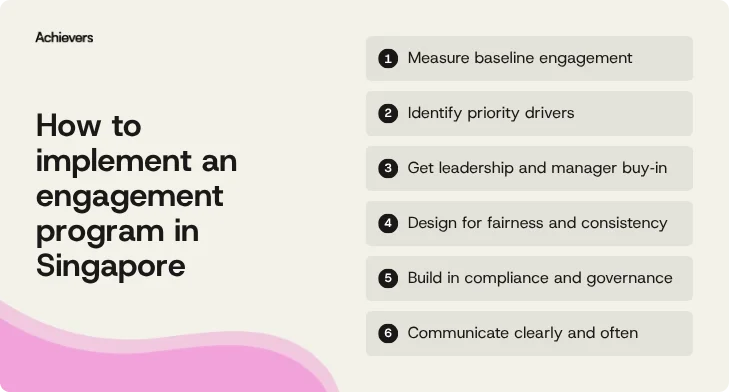
Measure baseline engagement
Start by understanding where engagement stands today. Use tools like pulse surveys and existing people metrics to identify how employees are feeling, not just how they’re performing. A clear baseline helps teams focus on the right problems instead of guessing where to start.
Identify priority drivers
Not every engagement issue needs to be solved at once. Look for the strongest signals in your data — recognition gaps, manager effectiveness, clarity, growth, or connection — and prioritise the areas that will have the biggest impact. Focus creates momentum, and momentum builds trust.
Secure leadership and manager buy‑in
Engagement programs only work when leaders actively support them. Bring leaders and managers into the process early, connect engagement to business outcomes, and clarify what’s expected of them. When managers understand their role, engagement becomes part of how work gets done.
Design programs with fairness and consistency
Employees notice when engagement programs feel uneven or unclear. Clear guidelines, shared criteria, and consistent access help build credibility and trust, especially in structured environments like Singapore. Fairness isn’t about treating everyone the same. It’s about being transparent and predictable.
Build compliance and governance into the program
In Singapore, engagement programs need to stand up to scrutiny as well as intention. Build in clear governance from the start, including how recognition decisions are made, how employee data is handled, and how programs align with fair employment practices. When compliance is thoughtfully integrated, engagement programs feel trustworthy rather than risky.
Communicate clearly and often
Even the best‑designed programs fall flat without clear communication. Explain the why behind each initiative, what employees can expect, and how success will be measured. Regular internal communications help engagement programs feel intentional, not performative.
Review, iterate, and improve
Engagement isn’t static, and programs shouldn’t be either. Revisit feedback, track outcomes, and adjust based on what’s working and what’s not. When employees see programs evolve in response to real input, confidence and participation grows.
This article provides general information only and does not constitute legal or tax advice. Requirements under local guidelines may vary. Consult qualified advisors and official agencies.
How to measure the success of employee engagement programs
Measuring program success is about understanding whether engagement is changing behaviour and driving outcomes that matter to the business.
Here’s where to focus your efforts:
- Retention and turnover trends: Track changes in voluntary turnover, internal mobility, and early‑tenure attrition to understand whether employees see a future with the organisation. Even small shifts can signal meaningful progress.
- Productivity and performance indicators: Watch for changes in goal attainment, performance ratings, or team output alongside engagement efforts — not as direct causation, but as reinforcing signals.
- Qualitative feedback from employees and managers: Comments from surveys, manager check‑ins, and employee feedback reveal how programs are experienced day to day. These insights help explain the “why” behind the data and guide smarter adjustments.
Together, these signals help leaders answer whether or not the program is working. When engagement programs are measured thoughtfully, the answer becomes easier, and more useful, than a simple yes or no.
Build engagement that delivers trust, retention, and results with Achievers
The programs outlined in this guide all point to the same truth. Engagement improves when recognition is consistent, visible, and embedded into how work gets done. Achievers brings those moments together in one enterprise‑grade platform, helping organisations turn recognition into a system that scales, adapts, and delivers results.
That impact is measurable. Achievers customers in Singapore consistently recognise more than 2x as often as users of other platforms, driving the highest engagement levels in the industry. When recognition, rewards, and insights work together, many organisations see up to 5x the impact on key business drives like engagement. That’s the result of shaping behaviour through frequent, meaningful recognition, backed by data and behavioural science.
Because when employees feel seen, heard, and appreciated, engagement follows. And when engagement is built with intention, results do too.
*Information and pricing in this blog post was sourced from each vendors website
Employee engagement programs in Singapore FAQs
Key insights
- Employee engagement improves when recognition is frequent, visible, and built into everyday work.
- The most effective engagement strategies combine recognition, manager enablement, growth, and listening into a system that shapes behaviour and drives results.
- When engagement programs are designed with intention and measured against real outcomes, they become a powerful lever for retention, performance, and culture.