Table of contents
Create a culture that means business™
Schedule a demo with an Achievers solution expert today.


 Copy URL
Employee connections are becoming harder to maintain in workplaces across Singapore. As teams move faster and expectations stay high, many employees are left without enough feedback, recognition, or clarity about where they stand. The result? Research from the APAC State of Recognition Report puts inclusion at 18%, with co‑worker connection and belonging at just 16%.
In a market shaped by structure and accountability, employee connection isn’t about adding more “culture moments.” It’s about helping people feel seen, supported, and fairly recognised in their everyday work. When connection is intentional, organisations build the trust, clarity, and resilience that keep people performing at their highest level.
This guide breaks down what employee connection really means, why it matters in Singapore, and 11 practical strategies leaders can use to strengthen it across their workforce.
What does “employee connection” mean in the workplace?
Employee connection refers to the strength of an employee’s relationship with three core areas of work: their people, their role, and their organisation. It reflects how connected employees feel to their managers and peers, how clearly they understand their purpose and contributions, and how aligned they are with organisational values and culture.
That connection is built on trust, belonging, clarity, and mutual accountability. When these are all present, employees are more likely to feel supported, confident in their role, and committed to shared goals (even in fast‑paced or high‑pressure environments).
Employee connection vs. employee engagement: What’s the difference?
Employee engagement describes how employees feel about their work, from their motivation and satisfaction, to their willingness to put in extra effort. Employee connection is what anchors people to who they work with, why their work matters, and where they belong within the company.
The two are closely linked. Connection shapes whether engagement lasts beyond a moment. When people have strong relationships with their managers and peers, understand their role and expectations, and feel fairly recognised, they are more likely to stay motivated, perform consistently, and trust the organisation.
What are the core pillars of employee connection?
Strong employee connection is built across three core pillars that work together to shape how employees experience work. When all three are in place, connection is stronger, more consistent, and easier to sustain.
1. Connection to people
This pillar focuses on relationships with managers, peers, and cross‑functional teams. Employees are more likely to feel connected when they trust the people they work with, receive regular feedback, and feel recognised for their contributions.
Everyday signals matter here. Consistent check‑ins, fair recognition, and respectful communication help employees feel valued and supported, not overlooked.
2. Connection to work
Connection to work comes from clarity. Employees need to understand their role, what’s expected of them, and how their work contributes to broader business goals. Growth opportunities, development conversations, and recognition tied to real outcomes reinforce that sense of purpose.
When employees see how their efforts matter, confidence and commitment tend to follow.
3. Connection to culture and organisation
This pillar reflects how aligned employees feel with the organisation itself. Shared values, fair treatment, and consistent practices all shape whether people feel they belong.
When culture shows up clearly — through inclusive behaviours, transparent decisions, and consistent standards — employees are more likely to trust the organisation and stay connected over time.
How leading organisations are building connection and breaking down silos
Research explains why employee connection matters during change. Organisations like Organic Valley and Bayhealth show what it looks like in practice. Across very different industries and workforce models, these teams are embedding recognition into everyday work to strengthen connection, break down silos, and keep people aligned, even as their organisations evolve.
Organic Valley
As a national cooperative with employees spread across offices, plants, and desk‑free environments, Organic Valley knew connection couldn’t depend on manual processes or office‑centric programs.
Partnering with Achievers helped Organic Valley turn recognition into an everyday habit that brought teams closer together. Employees could recognise one another freely, recognition was tied to the company’s cultural beliefs, and leaders gained better visibility into work happening across teams, roles, and locations. That visibility helped break down silos by spotlighting moments that might otherwise go unseen. Just as importantly, recognition became accessible to desk‑free employees, meeting them where work actually happens.
Connection started showing up where it mattered most. In the first few months, nearly 500 recognitions were sent to desk‑free employees, driven largely by peers and frontline leaders — a strong signal that participation was real and growing. Frontline employees also began earning cultural belief awards, marking a meaningful shift in visibility, inclusion, and shared pride across the organisation.
Bayhealth
With more than 5,000 employees across hospitals, outpatient centers, and clinical locations, Bayhealth knew connection had to scale beyond any single team or site.
Bayhealth worked with Achievers to turn appreciation into a shared responsibility. Leaders were trained to recognise work frequently, personally, and in ways that reinforced the organisation’s values. Recognition became visible across locations and specialties, helping teams see how their contributions connected to patient care and to one another.
The result? Recognition became a consistent, culture‑shaping force. 92% of leaders actively recognise their teams each month, with employees receiving an average of two to three recognitions monthly. Even through periods of intense change, their recognition metrics barely wavered. With a 97% platform activation rate and 75% of employees engaging monthly, Bayhealth has made connection consistent, scalable, and built into how work gets done.
11 strategies to build stronger employee connections in Singapore
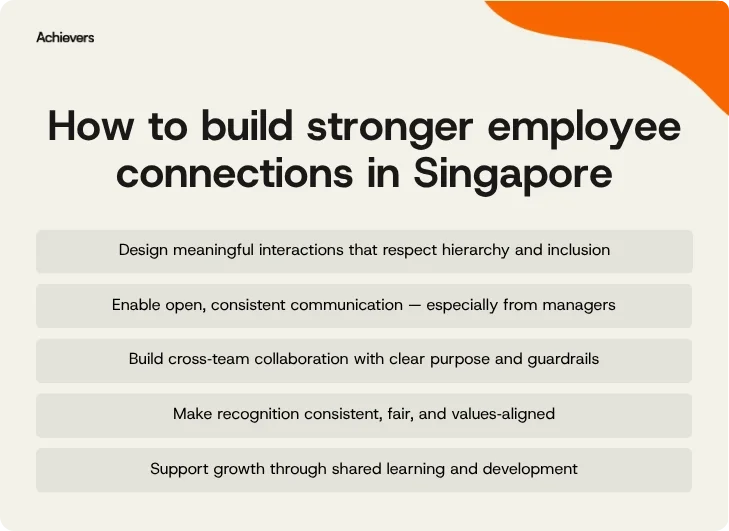
In Singapore, building employee connection takes deliberate actions that balance clarity, inclusion, and consistency, especially as organisations look to scale and teams become more dispersed across roles and regions.
1. Design meaningful interactions that respect hierarchy and inclusion
Create opportunities for employees to connect in ways that respect professional boundaries, cultural norms, and different comfort levels — like structured team sessions, manager‑led check‑ins, or focused collaboration time.
To make these interactions work, offer opt‑in formats instead of mandatory social activities, and design them so that participation isn’t limited to the most visible or vocal employees. When interactions are inclusive by design, more people feel comfortable being a part of them.
2. Enable open, consistent communication — especially from managers
Managers have the greatest influence on how connected employees feel day to day. Regular 1:1s, clear expectation‑setting, and consistent follow‑through help employees understand where they stand and what success looks like. In fact, AWI data tells us that when employees are recognised weekly, they’re 10x more likely to have those regular 1:1s.
Connection grows when communication is predictable and two‑way. Help managers learn how to share context, listen actively, and recognise progress, not just final outcomes, so employees feel supported rather than left guessing.
3. Build cross‑team collaboration with clear purpose and guardrails
Cross‑team collaboration can strengthen connection, but only when it’s intentional. Tie collaboration to clear goals, defined roles, and shared outcomes rather than informal networks that can unintentionally exclude others.
Clear guardrails around how teams work together, how decisions are made, and how contributions are recognised help collaboration feel fair and focused. When people understand why they’re working together and how success is measured, collaboration becomes a source of connection, not friction.
4. Make recognition consistent, fair, and values‑aligned
Recognition plays an important role in how connected employees feel, but only when it’s applied consistently. Focus on recognising behaviours and contributions that clearly link back to company values and goals, so employees understand not just that they’re recognised, but why.
Set clear criteria for recognition and make it visible across teams, not limited to a small group or a single manager’s discretion. Fair, frequent recognition helps employees feel seen and reinforces shared standards across the organisation.
5. Support growth through shared learning and development
Employee connection deepens when staff feel their growth is supported, not left to chance. Create opportunities for employees to learn together through coaching, mentoring, and structured development conversations, especially those led by managers.
When development is discussed regularly, and recognition highlights growth and progress, employees are more likely to feel invested in both their role and their future with the business.
6. Build trust through respectful, bias‑aware workplace practices
Trust directly affects connection, especially in structured and diverse workplaces where consistency really matters. Employees are more likely to feel connected when they believe decisions, feedback, and recognition are handled fairly and respectfully.
To support this, reinforce clear expectations, encourage managers to apply standards consistently, and create space for employees to speak up without fear. When employees can see fairness in everyday actions, not just policies on paper, they feel more secure in their workplace, more confident in their leaders, and more connected to the organisation.
7. Equip managers to coach, recognise, and connect consistently
Managers are the most consistent point of connection for employees, but many aren’t set up to play that role well. Support managers with clear expectations, simple tools, and shared standards for coaching, feedback, and recognition.
Consistency matters more than perfection. When managers are equipped to check in regularly, recognise progress, and have meaningful conversations, employees see connection as something they can rely on.
8. Take a structured approach to wellbeing and sustainability
Wellbeing supports employee connection when it’s treated as part of how work is designed, not something that’s added on last-minute. Focus on sustainable workloads, clear priorities, and realistic expectations, so employees can stay engaged without burning out at work.
A structured approach also helps managers have better conversations about capacity and support. When employees feel their wellbeing is taken seriously and handled consistently, they’re far less likely to look outside the company for opportunities.
9. Foster inclusion and belonging through everyday behaviours
Inclusion is built in the everyday moments. How meetings are run, how decisions are explained, and whose contributions are recognised all shape whether employees feel they belong in their role and at the company overall.
To strengthen connection, pay attention to the small, repeatable behaviours that signal inclusion — like inviting input from quieter voices, rotating visibility on projects, and recognising contributions across roles and teams. When managers model inclusive behaviours consistently, employees are more likely to feel comfortable speaking up, collaborating openly, and forming stronger connections with their colleagues.
10. Recognise milestones in ways that avoid “loss of face”
Milestones matter because they signal that progress and contribution are noticed, but how they’re recognised matters just as much. Recognition should balance visibility with respect, giving employees options for public or private acknowledgement.
To build connection, recognise key moments like work anniversaries, project completions, and role changes in ways that feel thoughtful and appropriate. Offering choice and being mindful of personal preferences helps recognition feel genuine, without putting anyone on the spot.
11. Design employee connections for hybrid, frontline, and desk‑based teams
Employee connection works best when it doesn’t depend on where someone works or how often they’re seen in person. To strengthen connection across different roles and work environments, organisations need practices and systems that reach employees wherever they are.
That often means using structured, integrated engagement software and tools that make internal communication, recognition, and feedback accessible across roles and locations. When connection is supported by consistent processes and shared platforms — instead of informal, office‑centric moments — more employees feel seen, involved, and valued, regardless of how or where they work.
The business impact of employee connection
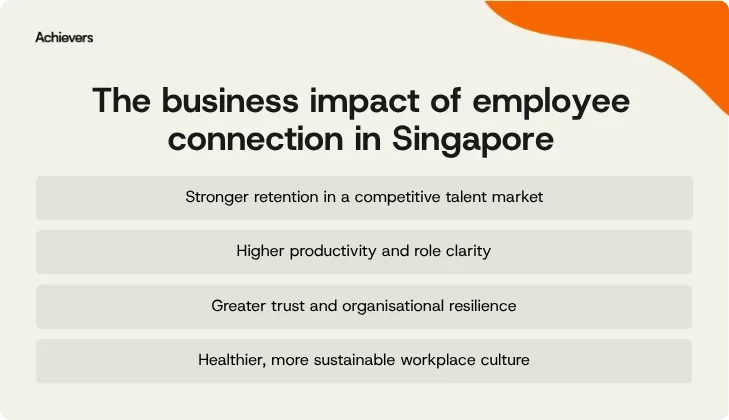
Stronger retention in a competitive talent market
Employees who feel seen, supported, and recognised are less likely to look elsewhere. Connection strengthens loyalty by reinforcing that employees matter and their contributions are valued. Recognition plays a key role here: when employees are recognised weekly, they’re 4.2x more likely to feel connected at work than those who are never recognised. That sense of connection makes staying feel worthwhile, even in a highly competitive job market.
Higher productivity and role clarity
Connection brings clarity. When employees understand their role, feel aligned to purpose, and receive regular feedback, they’re more confident in how they show up at work. Connection also supports inclusion in meaningful ways. A recent study found that 35% of Gen Z employees say being included in decision‑making helps them feel more connected.
Greater trust and organisational resilience
Consistent connection builds trust in managers and leadership. Regular communication, fair recognition, and clear follow‑through help reduce uncertainty and strengthen confidence, especially when companies are dealing with periods of change. Teams that trust their leaders are better equipped to adapt, collaborate, and stay focused when priorities shift.
Healthier, more sustainable workplace culture
Employee connection influences how consistently people experience the workplace. When fairness, inclusion, and recognition are applied in the same way across teams, employees know what to expect and how decisions are made.
In Singapore, consistency matters. When standards for feedback, recognition, and opportunity are clear and applied fairly, employees are more likely to trust leadership, feel secure in their role, and be ready to adapt as the organisation grows and evolves.
How to measure employee connection in Singapore organisations
Measuring employee connection helps organisations understand where connection is strong and where it’s breaking down.
What to measure
- Sense of belonging and trust: Look at whether employees feel respected, included, and confident in their managers and leadership. This is often an early signal of whether connection is strengthening or starting to break down.
- Recognition frequency and quality: Measure not just if recognition happens, but how often and how meaningful it feels. Inconsistent or infrequent recognition is a common contributor to weaker connection.
- Manager support and feedback: Assess whether employees receive regular check‑ins, guidance, and follow‑through from their manager. Manager behaviour is one of the strongest drivers of connection.
- Clarity of role and expectations: Understand how clear employees feel about their responsibilities, priorities, and how success is defined. Lack of clarity often shows up as disengagement before productivity and performance drops.
How to measure it
- Engagement and connection surveys: Use surveys to spot patterns across teams, roles, and locations, rather than focusing on individual responses.
- Regular pulse check‑ins: Short, frequent check‑ins like pulse surveys help track changes over time and catch issues early, especially during periods of change.
- Manager 1:1 feedback loops: Ongoing conversations between managers and employees provide context behind the data and help identify issues that surveys may miss.
How to act on the data
- Identify connection gaps across teams and roles: Look for differences in experience, not just overall averages, to understand where support is most needed.
- Equip managers with clear actions: Translate insights into practical steps managers can take, such as increasing check‑ins, clarifying expectations, or recognising progress more often.
- Track progress over time, not one‑off results: Employee connection improves through consistent effort. Reviewing trends over time helps organisations understand what’s working and adjust as needed.
Why fairness and governance shape employee connection
In Singapore, employee connection is closely tied to consistency, transparency, and merit‑based practices. Employees are more likely to feel connected when expectations are clear and when recognition, feedback, and opportunities are applied fairly across teams, not dependent on individual managers or informal processes.
Fairness plays a direct role in trust. When people understand how decisions are made and believe they’ll be treated consistently, they’re more likely to feel secure, engaged, and confident in where they stand.
How guidelines influence everyday employee experience
Singapore’s workplace frameworks provide important context for how fairness is expected to show up in practice. For example:
- The Tripartite Guidelines on Fair Employment Practices (TGFEP) emphasise respectful treatment, fair access to development, and merit‑based reward practices. These principles directly shape how employees experience recognition, opportunity, and trust at work.
- The Employment Act sets the foundation for fair treatment across different employee groups, reinforcing the importance of clarity and consistency in the workplace.
- The Workplace Fairness Act reflects growing expectations around fairness and transparency — signals many organisations are already responding to today.
This article provides general information only and does not constitute legal or tax advice. Requirements under local guidelines may vary. Consult qualified advisors and official agencies.
Building stronger employee connections starts with intention
If there’s one takeaway from this guide, it’s that employee connection shows up in the small, repeatable decisions organisations make every day. How managers communicate. How recognition is handled. How fair and consistent work feels across the business.
The strategies in this guide aren’t about doing more. They’re about doing a few things well, and doing them consistently. For leaders, the real opportunity is to step back and ask: Where does connection feel strong today, and where does it break down? Recognition is the best place to start.
Employee connection in Singapore FAQs
Key insights
- Connection depends on how consistently employees experience feedback, recognition, and expectations across teams.
- Managers shape employee connection more than any programme or policy.
- When employees feel connected, organisations see stronger retention, clearer role alignment, higher trust, and more resilient teams.