Table of contents
Create a culture that means business™
Schedule a demo with an Achievers solution expert today.


 Copy URL
In Australia, employee connection is under real pressure. Hybrid work, stretched managers, and constant change mean many employees are working alongside one another without ever feeling truly connected. And the data supports it. According to research from the Australia State of Recognition Report, 24% of employees say they have strong connections with their peers. That’s a clear warning sign that connection is slipping where it matters most.
Connection is how people stay engaged, resilient, and willing to contribute when work gets complicated (which, let’s be honest, it usually does). But it doesn’t sustain itself. It takes clear, practical strategies. That’s exactly what this blog is here to unpack.
Employee connection vs employee engagement: Why the difference matters
Employee engagement and employee connection are related, but they’re not the same. Engagement reflects how motivated and committed people feel to do their work and to do it well. Connection reflects whether they feel a sense of belonging, trust their leaders and peers, and understand where they fit.
In Australia, that distinction matters. While 23% of employees say they’re very engaged, 60% are still job hunting. That gap shows how people can be productive on the surface while quietly feeling disconnected, especially in workplaces where recognition is held back by a cultural hesitation to stand out or “make a fuss.” This dynamic, often linked to tall poppy syndrome, can make calling out achievement feel uncomfortable rather than encouraged, weakening connection over time and increasing the risk of change fatigue and turnover.
Common causes of employee disconnection in Australia today
Employee disconnection rarely comes down to one issue. These are some of the most common causes of disconnection found across Australia’s workforce:
- Hybrid and remote work eroding informal connection: With fewer spontaneous interactions, many teams have lost the everyday moments that once built trust and familiarity, and connection hasn’t been intentionally rebuilt in their place.
- Low frequency of manager‑led recognition: When recognition is rare or inconsistent, employees struggle to feel seen or valued, weakening their connection to both their manager and the organisation.
- Cultural hesitation around praise: Recognition can feel uncomfortable in the workplace, so it’s often avoided — even though saying nothing creates more distance than saying something.
- Compliance and process are taking priority over people: Heavy regulatory and reporting demands can push managers into task‑focused mode, leaving less time and energy for meaningful human connection.
- Unclear expectations during change and transformation: When priorities shift without enough explanation or reinforcement, employees stay busy but feel disconnected from direction, purpose, and decision‑making.
How leading organisations are building connection and breaking down silos
Research explains why employee connection matters during change. Organisations like Organic Valley and Bayhealth show what it looks like in practice. Across very different industries and workforce models, these teams are embedding recognition into everyday work to strengthen connection, break down silos, and keep people aligned, even as their organisations evolve.
Organic Valley
As a national cooperative with employees spread across offices, plants, and desk‑free environments, Organic Valley knew connection couldn’t depend on manual processes or office‑centric programs.
Partnering with Achievers helped Organic Valley turn recognition into an everyday habit that brought teams closer together. Employees could recognise one another freely, recognition was tied to the company’s cultural beliefs, and leaders gained better visibility into work happening across teams, roles, and locations. That visibility helped break down silos by spotlighting moments that might otherwise go unseen. Just as importantly, recognition became accessible to desk‑free employees — meeting them where work actually happens.
Connection started showing up where it mattered most. In the first few months, nearly 500 recognitions were sent to desk‑free employees, driven largely by peers and frontline leaders — a strong signal that participation was real and growing. Frontline employees also began earning cultural belief awards, marking a meaningful shift in visibility, inclusion, and shared pride across the organisation.
Bayhealth
With more than 5,000 employees across hospitals, outpatient centers, and clinical locations, Bayhealth knew connection had to scale beyond any single team or site.
Bayhealth worked with Achievers to turn appreciation into a shared responsibility. Leaders were trained to recognise work frequently, personally, and in ways that reinforced the organisation’s values. Recognition became visible across locations and specialties, helping teams see how their contributions connected to patient care and to one another.
The result? Recognition became a consistent, culture‑shaping force. 92% of leaders actively recognise their teams each month, with employees receiving an average of two to three recognitions monthly. Even through periods of intense change, their recognition metrics barely wavered. With a 97% platform activation rate and 75% of employees engaging monthly, Bayhealth has made connection consistent, scalable, and built into how work gets done.
11 strategies to improve employee connection in Australian workplaces
Improving employee connection starts with the fundamentals: clarity, leadership, and consistency. The strategies below focus on what actually moves the needle. Think practical actions leaders and organisations can apply day to day, without noise, hype, or unnecessary complexity.
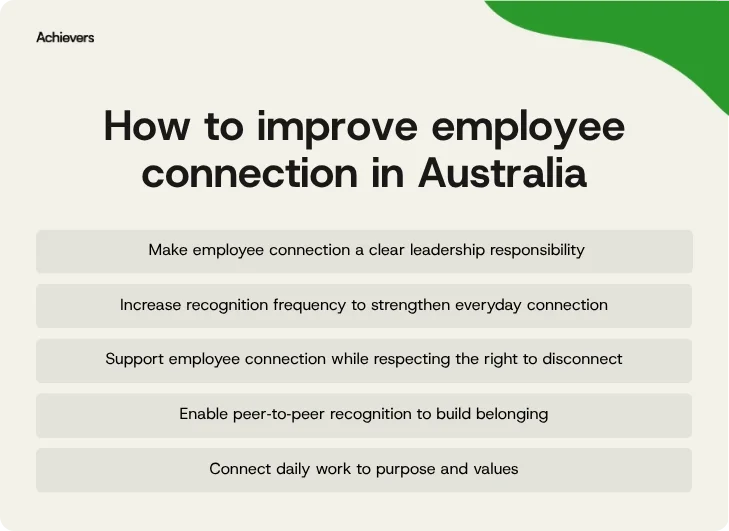
1. Make employee connection a clear leadership responsibility
Employee connection is shaped first by leadership. When leaders make it a priority, people feel supported, clear on expectations, and confident their work matters. When they don’t, connection erodes quickly, even in teams that still look productive.
Here’s what this looks like in practice:
- Making connection an explicit part of the leadership role and not an informal expectation
- Role‑modelling consistent, visible connection from senior leaders downward
- Embedding connection into leadership capability frameworks, performance conversations, and manager development
2. Increase recognition frequency to strengthen everyday connection
Recognition is one of the most direct ways employees experience connection. When it happens regularly, people feel seen, valued, and more connected to the work and the people around them. Small, timely moments of appreciation do more to build connection than infrequent, high‑profile gestures.
Here’s what this looks like in practice:
- Shifting recognition from occasional to frequent, everyday moments
- Focusing recognition on effort, behaviours, and progress, not just results
- Keeping recognition authentic and low‑key, rather than performative or over‑engineered
3. Support employee connection while respecting the right to disconnect
Supporting connection alongside the right to disconnect means being intentional about how and when communication happens. When recognition, feedback, and check‑ins are designed to fit within working hours, connection feels supportive rather than intrusive.
Here’s what this looks like in practice:
- Setting clear norms for in‑hours communication and recognition
- Using asynchronous tools so appreciation doesn’t depend on real‑time availability
- Reinforcing connection through regular, predictable rhythms
4. Enable peer‑to‑peer recognition to build belonging
Peer‑to‑peer recognition plays an important role because it strengthens connection where work actually happens: across teams, roles, and relationships.
When peer recognition is missing, belonging suffers. People may feel productive, but they don’t always feel seen by those they work alongside. That gap quietly effects connection.
Here’s what this looks like in practice:
- Normalising peer recognition as part of everyday work, not a special occasion
- Providing simple prompts or examples to reduce uncertainty about what to say
- Using easy, visible tools that make recognising peers feel natural, not forced
5. Connect daily work to purpose and values
Employee connection strengthens when people understand why their work matters, not just what they’re responsible for. When that link is missing, work can feel transactional, even when teams are busy and productive.
Here’s what this looks like in practice:
- Reinforcing purpose and values through everyday communication, not one‑off messaging
- Using recognition to highlight behaviours that reflect what the organisation stands for
- Making the link between individual contribution and broader goals visible and concrete
6. Improve connection through clarity and communication
When priorities, decisions, or expectations aren’t clearly communicated, employees may stay busy, but they’re left guessing how their work fits, what matters most, and what’s coming next.
Clear, consistent communication builds connection because it creates trust and direction. It helps people feel informed, involved, and confident navigating change, rather than disconnected from it.
Here’s what this looks like in practice:
- Communicating priorities and decisions clearly and consistently, not just once
- Creating space for two‑way communication and feedback, not just updates
- Reinforcing clarity during periods of change, so people understand what’s expected and why
7. Design connection strategies for frontline and shift‑based teams
For frontline and shift‑based teams, missed updates, uneven access to recognition, and limited visibility can make people feel disconnected, even when they’re critical to day‑to‑day operations.
Connection works best when it’s built into how work actually happens. That means ensuring frontline employees feel just as seen, informed, and valued as anyone else and not as an afterthought.
Here’s what this looks like in practice:
- Designing connection and recognition to fit shift patterns and on‑the‑floor realities
- Ensuring fair access to communication, recognition, and feedback across roles
- Making frontline contributions visible, not just operational
8. Use HR technology to support — not replace — human connection
When tools take over the message, recognition and communication can start to feel automated, impersonal, or easy to ignore.
Connection improves when technology is used to enable human behaviours, not substitute for them. Tools should make it easier for people to recognise one another, share feedback, and stay aligned, while keeping the human voice front and centre.
Here’s what this looks like in practice:
- Using technology to prompt and support recognition, not generate it
- Making recognition and feedback easy to give, visible, and timely
- Integrating connection tools into everyday workflows, rather than treating them as separate systems
9. Build psychological safety through recognition and feedback
Employee connection depends on people feeling safe to speak up, ask questions, and learn without fear. When psychological safety is missing, connection weakens because people start holding back.
Recognition and feedback play an important role here. When effort, learning, and curiosity are acknowledged, employees feel supported instead of judged. That sense of safety strengthens trust, wellbeing, and connection over time.
Here’s what this looks like in practice:
- Recognising effort, learning, and improvement, not just polished outcomes
- Encouraging questions, ideas, and constructive challenge
- Using feedback as a tool for support and clarity, not correction alone
10. Measure connection regularly and act on results
Like engagement or performance, connection can be tracked, understood, and improved, but only if organisations take it seriously.
Regular measurement helps surface where connection is strong, where it’s slipping, and what needs attention. Acting on that insight is what builds trust; asking for feedback without follow‑through does the opposite.
Here’s what this looks like in practice:
- Using pulse surveys and regular check‑ins to track connection over time
- Looking at signals like recognition frequency, trust, and belonging
- Closing the loop by sharing insights and taking visible action
11. Sustain connection through fairness and transparency
Connection breaks down quickly when it looks like there’s inconsistency or unfairness.
Sustaining connection means ensuring that recognition, opportunity, and communication are applied consistently across teams and roles. When fairness is visible, connection feels credible and durable.
Here’s what this looks like in practice:
- Being transparent about how recognition and decisions are made
- Ensuring connection and recognition are accessible across roles and locations
- Focusing on fairness and clarity, rather than merit-based narratives
How to measure and sustain employee connection over time
Sustaining employee connection means paying attention to the right signals and reinforcing the behaviours that matter, consistently. The organisations that do this well treat connection as something leaders actively maintain, not something HR revisits once a year.
Start by tracking the signals that reflect real connection, not just activity.
Three indicators matter most over time:
- Recognition frequency: How often people are acknowledged for their effort and contribution. Frequency matters because it shows whether appreciation is embedded in daily work, or if it’s limited to celebrating milestones and big moments.
- Trust: Whether employees feel confident in their leaders, understand decisions, and believe feedback will lead to action. Trust is a leading indicator of connection breakdown, not a lagging one.
- Belonging: Whether people feel included, valued, and part of something shared across teams, roles, and locations.
Building employee connection starts with leadership
Employee connection rarely breaks because people stop caring. Most of the time, it fades because everyday moments — recognition, clarity, leadership presence — get crowded out by urgency, process, and change.
When companies move beyond one‑off recognition moments and start designing connection into how work happens, people feel seen, trusted, and motivated to stay. Not because they’re told to, but because work finally feels human again.
Employee connection in Australia FAQs
Key insights
- Employee connection is built through everyday leadership behaviours.
- Frequent, meaningful recognition is one of the most practical and powerful ways to strengthen connection, trust, and belonging.
- Sustaining employee connection requires systems, habits, and accountability.