Table of contents
Create a culture that means business™
Schedule a demo with an Achievers solution expert today.


 Copy URL
Employee connection is getting harder to maintain in workplaces across the UK. Hybrid work is now the norm, teams are more spread out, and many of the everyday moments that once helped people feel connected have quietly faded. While most organisations invest in employee engagement, connection often breaks down in the day-to-day.
That disconnect has real consequences. According to the latest EMEA Engagement and Retention Report, only 21% of employees across the EMEA region feel connected to their manager, and just as few feel connected to colleagues. When people don’t feel connected, work can start to feel more transactional, collaboration becomes a bigger challenge, and retention feels more uncertain than ever.
Let’s look at what employee connection really is, why it matters more than ever in UK workplaces, and learn 11 practical strategies to help rebuild it in meaningful, sustainable ways.
What is employee connection?
Employee connection is the sense of belonging, trust, and shared purpose employees feel in their day‑to‑day work. It reflects how connected people feel to their role, their colleagues, their manager, and the organisation itself. Ultimately, employee connection is about feeling seen, supported, and confident that your work matters.
Employee connection vs. employee engagement
Employee engagement is often used as a catch‑all term, but it’s better understood as an outcome. Engagement reflects how motivated or committed employees feel.
Connection is the lived experience that fuels engagement. It shows up in relationships, communication, recognition, and trust. This is why strong engagement scores don’t always tell the full story, especially in workplaces where hybrid and flexible ways of working can hide deeper disconnects. People may be engaged on paper, but still feel isolated, overlooked, or uncertain about where they fit at work.
Understanding employee connection helps organisations look beyond scores and focus on what employees experience every day.
The four types of employee connection in the workplace
Connection isn’t one‑dimensional. It’s shaped by how people experience their work, their relationships, and the organisation around them. Understanding the different types of employee connection helps organisations see where gaps are forming and where to focus their efforts.
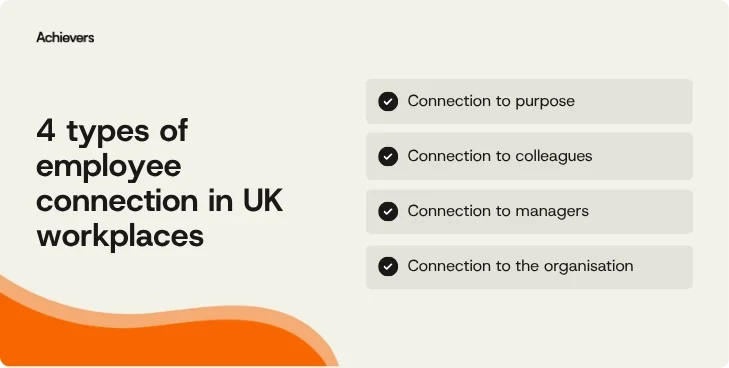
Connection to purpose
Connection to purpose is about feeling that your work matters. Employees are more likely to feel connected when they understand how what they do contributes to something meaningful and how their role supports broader organisational goals. In a study from MetLife, 30% of employees surveyed said they were more likely to accept a new job with a 15% lower salary and fewer employee benefits in return for a more meaningful work.
Connection to colleagues
Connection to colleagues reflects the quality of peer relationships, collaboration, and social trust at work. Strong peer connection makes it easier to share ideas, solve problems, and feel part of a team. This is especially important for hybrid, remote, and deskless employees who may have fewer informal opportunities to connect on a daily basis.
Connection to managers
Connection to managers plays a central role in how supported and valued employees feel at work. In EMEA, only 21% of employees feel connected to their manager. Managers shape clarity, trust, feedback, and recognition through everyday interactions. And in organisations where manager capability and consistency vary, this connection is often the strongest predictor of whether employees feel truly connected or whether they’re quietly disengaging.
Connection to the organisation
Connection to the organisation is about belonging, aligning with your company’s core values, and organisational identity. Employees are more likely to feel connected when they see fairness, consistency, and transparency reflected in how decisions are made and how people are recognised. When those signals are missing, connection weakens, even if other relationships feel strong.
How leading organisations are building connection and breaking down silos
Research explains why employee connection matters during change. Organisations like Organic Valley and Bayhealth show what it looks like in practice. Across very different industries and workforce models, these teams are embedding recognition into everyday work to strengthen connection, break down silos, and keep people aligned even as their organisations evolve.
Organic Valley
As a national cooperative with employees spread across offices, plants, and desk‑free environments, Organic Valley knew connection couldn’t depend on manual processes or office‑centric programmes.
Partnering with Achievers helped Organic Valley turn recognition into an everyday habit that brought team members closer together. Employees could recognise one another freely, recognition was tied to the company’s cultural beliefs, and leaders gained better visibility into work happening across teams, roles, and locations. That visibility helped break down silos by spotlighting moments that might otherwise go unseen. Just as importantly, recognition became accessible to desk‑free employees, meeting them where work actually happens.
Connection started showing up where it mattered most. In the first few months, nearly 500 recognitions were sent to desk‑free employees, driven largely by peers and frontline leaders — a strong signal that participation was real and growing. Frontline employees also began earning cultural belief awards, marking a meaningful shift in visibility, inclusion, and shared pride across the organisation.
Bayhealth
With more than 5,000 employees across hospitals, outpatient centers, and clinical locations, Bayhealth knew connection had to scale beyond any single team or site.
Bayhealth worked with Achievers to turn appreciation into a shared responsibility. Leaders were trained to recognise work frequently, personally, and in ways that reinforced the organisation’s values. Recognition became visible across locations and specialties, helping teams see how their contributions connected to patient care and to one another.
The result? Recognition became a consistent, culture‑shaping force. 92% of leaders actively recognise their teams each month, with employees receiving an average of two to three recognitions monthly. Even through periods of intense change, their recognition metrics barely wavered. With a 97% platform activation rate and 75% of employees engaging monthly, Bayhealth has made connection consistent, scalable, and built into how work gets done.
11 strategies to improve employee connection in UK workplaces
Connection is shaped over time by everyday moments, from how people communicate and collaborate, to how they recognise one another.
These strategies focus on practical ways to strengthen employee connection:
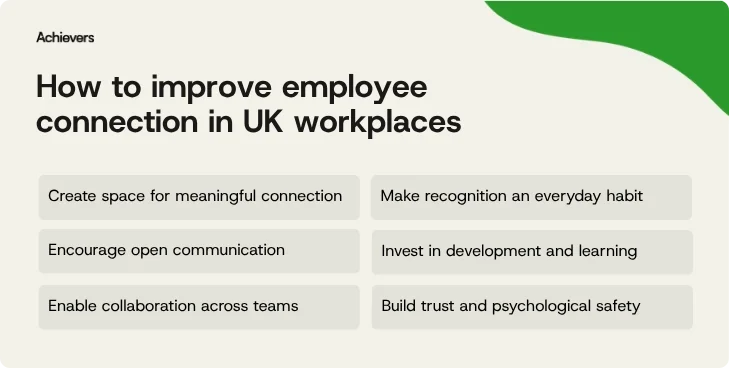
1. Create space for meaningful, human connection at work
Not every moment of connection needs to be formal or work‑driven. When interactions are purely transactional, relationships can feel shallow and remote. Over time, that makes it harder for trust and rapport to develop, especially in hybrid environments where informal connection doesn’t happen by default.
How to do it:
Make room for simple, low‑pressure interactions that let people show up as humans, not just job titles. This could mean building in informal check‑ins, encouraging non‑work conversation before meetings, or creating shared moments that aren’t tied to performance or output.
2. Encourage open, consistent communication
Employees want clarity, context, and transparency. When communication is inconsistent or unclear, people can start to fill the gaps themselves, often with assumptions that weaken trust and connection.
How to do it:
Focus on regular, predictable communication rather than inconsistent updates. Help managers share not just what’s happening, but why decisions are being made and how they affect teams. Open communication builds confidence, reduces uncertainty, and helps employees feel informed and included, even when change is underway.
3. Enable collaboration across teams and roles
Strong collaboration strengthens connection by creating shared ownership and visibility across the organisation. Without it, teams can quickly become siloed, making work feel fragmented and isolating.
How to do it:
Look for opportunities to bring people together around shared goals, cross‑functional projects, or problem‑solving efforts. Encourage collaboration that feels purposeful and relevant, not forced. When employees work together across roles and teams, they’re more likely to build relationships, see the impact of their work, and feel connected to the larger outcomes of the business.
4. Make recognition a visible, everyday habit
Recognition plays a powerful role in how connected employees feel, because it signals that their work is seen and valued. When recognition is infrequent, inconsistent, or limited to formal moments, employees can start to feel overlooked, even when they’re performing well.
How to do it:
Focus on ways to recognise that are easy, timely, and visible across the organisation. Tools designed specifically for employee recognition can help by making appreciation accessible to both managers and peers, and by creating shared visibility across teams. This visibility matters because it helps employees see how everyday contributions connect to organisational values, goals, and each other.
5. Invest in development and shared learning
Employees are more likely to feel connected when they see a future for themselves at the organisation. Opportunities to learn and grow signal long‑term investment, while shared learning strengthens bonds across teams and roles.
How to do it:
Focus on development that feels practical, accessible, and relevant to real roles. This might include mentoring or coaching moments, opportunities to learn new skills through projects, or visibility into how progress and development are recognised.
6. Build trust and psychological safety through fair practices
Connection can’t succeed without trust. When employees don’t feel safe to speak up, ask questions, or make mistakes, relationships weaken, and disengagement follows. In the UK, fairness and consistency play a particularly important role in shaping trust.
How to do it:
Reinforce clear, fair expectations and apply them consistently. Encourage managers to listen actively, use tools like pulse surveys to create regular moments of communication, and respond constructively to said feedback. Psychological safety grows when employees see that their input is respected and that recognition and opportunities are based on transparent, inclusive practices.
7. Use mentoring and coaching to strengthen relationships
Mentoring and coaching create space for deeper, more personal connections at work. They show employees that their organisation genuinely cares and is invested in their growth, not just their output. Without these relationships, employees can struggle to see clear paths forward or feel genuinely supported in their development.
How to do it:
Encourage mentoring and coaching experiences that feel accessible and relevant, instead of formal or exclusive. This can include peer mentoring, manager‑led coaching conversations, or sharing insights and expertise across different teams and departments. What matters most is consistency and intent. When employees have trusted people to learn from and talk to, connection strengthens naturally over time.
8. Support wellbeing to sustain connection
Connection is hard to maintain when employees are stretched, overstressed, or burned out at work. When wellbeing is overlooked, people may disengage simply to cope, pulling back from relationships and collaboration in the process.
How to do it:
Take practical steps to support sustainable workloads and realistic expectations. Encourage boundary‑setting, normalise time away from work, and ensure wellbeing support is visible and easy to access. When employees feel supported as people, not just as performers, they’re better able to stay present, connected, and engaged at work.
9. Embed inclusion and belonging into everyday culture
If employees don’t feel included or treated fairly, connection weakens, regardless of team dynamics or how many team-building activities you plan. Inclusion is closely tied to trust, consistency, and how fairly people feel they’re treated.
How to do it:
Focus on inclusion as something that shows up in everyday decisions and behaviours, not just strategies or statements. Ensure opportunities, recognition, and visibility are applied consistently across roles and teams. When inclusion is part of how work gets done, employees are more likely to feel safe, valued, and connected to the organisation.
10. Acknowledge milestones and moments that matter
Milestones mark progress, effort, and commitment. When they’re acknowledged, employees feel visible and appreciated, not just for what they deliver, but for the time and energy they’ve invested. Shared moments also help reinforce emotional connection to the organisation, giving people reasons to feel proud of where they work.
How to do it:
Pay attention to the moments that naturally matter to employees, such as onboarding, role changes, work anniversaries, project completions, and personal achievements. When employers recognise and celebrate employee milestones, they become touchpoints that strengthen connection and reinforce that employees belong at every stage of their journey.
11. Design connection for hybrid, remote, and deskless teams
Hybrid, remote, and deskless workforces experience connection differently. When connection is designed with only office‑based teams in mind, gaps form quickly. Employees who feel out of sight can start to feel out of mind, weakening trust and engagement over time.
How to do it:
Design connection around how work actually happens across roles, shifts, and locations. This means making internal communications, recognitions, and collaboration opportunities accessible regardless of where people work or when they’re on shift. When connection tools and practices fit naturally into different work environments, employees are more likely to feel included, visible, and genuinely connected to the broader organisation.
The role of managers in strengthening employee connection
Managers play a defining role in how connected employees feel at work. More than any programme or policy, how employees interact with their managers on a daily basis shapes trust, clarity, and their sense of belonging. In fact, 56% of workers cite poor management as the main reason for leaving a job, making manager connection an essential part of both engagement and retention.
Why managers are central to employee connection
Managers influence connection through everyday moments, including how work is discussed, how feedback is delivered, and how effort is recognised. Because managers translate business priorities into daily reality, they often become the strongest link between employees and the organisation as a whole.
Where manager‑employee connection often breaks down
Connection often slips because managers are juggling competing priorities, not because they don’t care. Infrequent or overly transactional 1:1 meetings can reduce conversations to task updates, rather than meaningful check‑ins. Limited feedback or recognition can leave employees unsure where they stand, while unclear expectations add to frustration and disengagement over time.
What connected managers do differently
Managers who build strong connection focus on consistency over perfection. They create clarity around priorities, recognise effort and progress visibly, and make time for regular, two‑way conversations. Just as importantly, they foster trust and psychological safety, creating environments where employees feel comfortable speaking up, asking questions, and being themselves at work.
How HR teams can enable managers to build connection
Supporting managers doesn’t mean adding more to their plate. The most effective HR teams focus on reducing admin burden, providing simple tools and prompts, and creating a shared language around recognition, feedback, and expectations. Technology also plays a role here. 23% of HR leaders say their tech investments must help managers be better managers, highlighting the need for solutions that make connections easier to build, not harder to maintain.
How to measure employee connection
While engagement surveys can highlight broader trends across the business, measuring connection requires a more in-depth approach, combining multiple signals that reflect how employees experience work day to day.
- Ongoing listening and check‑ins: Regular pulse surveys, short check‑ins, and open feedback channels help organisations stay close to how employees are feeling. These touchpoints make it easier to spot patterns, surface concerns early, and respond before disconnection deepens.
- Manager feedback loops: Managers are often the first to notice shifts in morale or connection. Encouraging consistent, two‑way feedback through one‑to‑ones and team conversations helps turn observation into insight. When manager feedback is paired with employee listening, organisations gain a fuller picture of what’s happening on the ground.
- Participation and relationship indicators: Looking at participation in recognition, collaboration, learning, or feedback activities can highlight where connection is strengthening or fading. Patterns in who is visible, who is recognised, and who engages with others often highlight connection gaps that surveys alone can’t capture.
Using people data responsibly in UK workplaces
Measuring employee connection must be handled with care, especially in UK organisations where expectations around data use are high. Under UK GDPR and the Data Protection Act 2018, employers are required to use employee data fairly, lawfully, and transparently, and only collect information that is relevant and necessary.
In the workplace, this means being open with employees about what data is being gathered, why it matters, and how insights will be used to improve the employee experience, not to monitor individuals. Data should focus on patterns and themes rather than individual behaviour, and access should be limited to those who need it.
Common barriers to employee connection and how to address them
Even the best‑intentioned organisations can struggle to build strong employee connection. In many cases, the issue isn’t a lack of effort, but a few key barriers that quietly hurt connection over time.
- Fragmented initiatives: When connection‑building efforts live in silos, employees experience them as disconnected and inconsistent. Recognition, communication, wellbeing, and development can all exist, but without alignment, they won’t reinforce one another. Addressing this starts with clarity. Look at how these efforts work together and identify opportunities to create shared goals, language, and ownership across teams.
- Over‑reliance on perks and reward schemes: Sure, the best perks and reward schemes can enhance the employee experience, but they don’t create lasting connection on their own. When connection is reduced to benefits or surface‑level incentives, it can feel transactional rather than meaningful. To close this gap, organisations need to focus on everyday experiences, such as recognition, feedback, and inclusion, that shape how employees feel about their work and relationships.
- Lack of visibility into the real employee experience: Without clear insight into how employees are actually experiencing work, connection gaps can go unnoticed until disengagement sets in. Annual surveys may hide issues that show up in daily interactions. Improving visibility means using multiple listening tools, looking at patterns in participation and recognition, and making space for honest dialogue that reflects real experiences, not just high‑level scores.
- Practical ways to identify and address connection gaps: The most effective organisations take a proactive approach. They combine regular listening with manager insight, review data for patterns instead of outliers, and act on what they learn. Closing connection gaps requires consistent attention, openness to feedback, and a willingness to adjust how work gets done to better support connection.
Your employees are the key to a connected company
Connection sits at the heart of workplace culture and performance. When people feel connected to their work, their colleagues, and their managers, they’re more likely to collaborate, contribute, and build a future right where they are.
For UK workplaces navigating change, hybrid work, and rising expectations, building connection is one of the most meaningful ways to create cultures people want to be part of. And it all starts with recognition.
Employee connection in the UK FAQs
Key insights
- How people communicate, collaborate, receive recognition, and feel supported each day has a greater impact on connection than any single programme or perk.
- Consistent communication, clear expectations, and visible recognition from managers are critical drivers of connection, engagement, and retention in UK workplaces.
- When recognition is regular, meaningful, and visible, it helps employees feel seen, valued, and connected to both their work and the organisation.