Table of contents
Create a culture that means business™
Schedule a demo with an Achievers solution expert today.


 Copy URL
Employee engagement in 2026 isn’t quietly declining in Australia, it’s becoming a serious organisational risk.
According to Achievers Workforce Institute’s 2026 Engagement and Retention Report: APAC edition, a growing share of employees across Australia are questioning their future with their current employer, with fewer than half seeing a long‑term career ahead. That risk isn’t abstract. It’s already reflected in how disconnected many employees feel and how prepared they are to act on it. In a tight labour market, disengagement isn’t just a culture concern. It’s a retention challenge with real consequences for continuity, capability, and performance.
The signal behind the data is consistent: when employees don’t feel appreciated, connected, or supported, they don’t simply disengage — they start planning their exit. And when those decisions scale across teams, organisations feel it through lost momentum, increased hiring pressure, and rising strain on managers and remaining employees.
That’s why employee engagement has never been about perks or one‑off initiatives. It’s about whether people feel seen, valued, and motivated to give their best — not because they’re expected to, but because their experience of work makes it worthwhile.
The statistics we explore in this blog come directly from the 2026 Engagement and Retention Report, built on original global research conducted by Achievers Workforce Institute, including responses from employees and HR leaders across APAC, Australia included. This isn’t a compilation of third‑party benchmarks. It’s first‑party data designed to surface where engagement is breaking down and where Australian organisations still have meaningful leverage to respond.
Below, we break down the employee engagement statistics that matter most in 2026 and what they reveal about building workplaces in Australia where employees aren’t just turning up, but genuinely committed.
What are employee engagement statistics?
Employee engagement statistics measure how employees feel about their work, their leaders, and their organisation and how those feelings translate into behaviour. They quantify motivation, connection, appreciation, and intent to stay, turning something abstract like “culture” into data leaders can act on.
These insights come from workforce research like the 2026 Engagement and Retention Report: APAC edition, which captures how employees across Australia experience recognition, growth, purpose, leadership, and well-being at work.
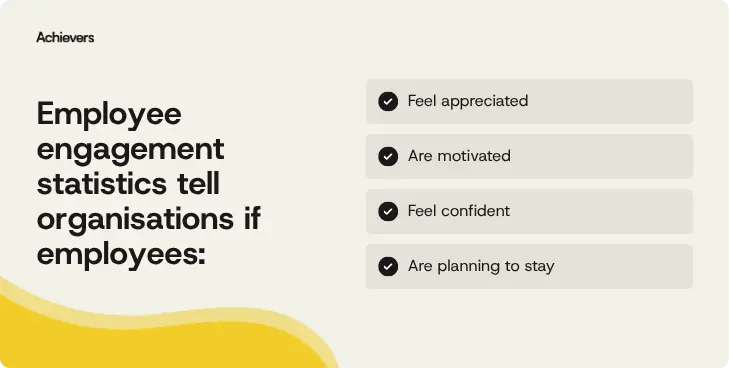
At their best, engagement data helps leaders answer critical questions:
- Do employees feel recognised for their contributions?
- Are they motivated to perform at their best?
- Do they feel supported by their manager and organisation?
- Are they committed or already considering their next move?
Employee engagement statistics reveal more than you think
When you look beyond individual numbers, patterns emerge. In Australia, those patterns point to growing gaps between what employees expect from work and what many organisations are delivering.
Used well, employee engagement statistics are more than metrics — they’re early warning signals. They highlight where recognition is missing, where connection is breaking down, and where lack of growth is pushing people to disengage. They give leaders clarity to move from reacting to turnover to shaping engagement deliberately and consistently.
15 employee engagement statistics Australian leaders need to know
If you want to understand what’s driving — or draining — engagement in Australia, the data is the best place to start.
Here are 15 employee engagement statistics from the 2026 Engagement and Retention Report: APAC edition, with a specific lens on Australia.
1. Only 18% of employees feel appreciated at work
Fewer than one in five employees across APAC feel genuinely appreciated. This lack of recognition is one of the clearest contributors to disengagement and turnover risk.
2. Just 25% of employees say their work feels meaningful
Only a quarter of employees find meaning in their work. When purpose is missing, motivation and commitment quickly erode.
3. 37% of employees plan to job hunt in 2026
More than a third of employees across APAC are actively looking for a new role, with another 28% unsure about staying, signalling a workforce in flux.
4. Recognition is infrequent for most employees
58% of employees are recognised four times a year or less. In fast‑moving workplaces, that’s not enough to sustain engagement or connection.
5. Only 17% feel connected to company values
When employees don’t feel aligned to organisational values, engagement and loyalty suffer, regardless of pay or role.
6. Just 19% feel their organisation supports their well-being
Well-being support remains weak, increasing the risk of burnout, disengagement, and long‑term attrition.
7. Only 15% feel supported in their development goals
Career development is stalling for most employees, leaving ambition unmet and engagement underpowered.
8. In Australia, only 20% have access to learning and development resources
Australian employees report limited access to the tools and programs needed to build skills and progress their careers.
9. Just 14% of Australian employees see clear opportunities to grow their career
When growth feels blocked, engagement fades and job hunting accelerates.
10. 26% of Australian employees feel most engaged when their skills are developing
Growth is one of the strongest engagement drivers, yet few organisations are activating it consistently.
11. Recognition of skills would increase retention
28% of Australian employees say recognition of their skills would increase their desire to stay, reinforcing the link between appreciation and loyalty.
12. Only 19% feel their organisation supports well-being
Without meaningful well-being support, performance pressure turns into burnout rather than productivity.
13. Engagement, connection, and growth are underperforming together
Across APAC — including Australia — recognition, growth, and manager connection are all falling short at the same time, compounding disengagement risk.
14. Employees who feel recognised are significantly more engaged
While recognition levels are low, the data shows it has an outsized impact on engagement, connection, and intent to stay.
15. Recognition, growth, and well-being are the biggest opportunities for Australian organisations
The APAC data makes one thing clear: organisations that invest in these three areas are best positioned to stabilise engagement and retention.
What these employee engagement statistics are really telling us
When only 18% of employees feel appreciated and more than one‑third plan to job hunt in 2026, disengagement in Australia isn’t subtle — it’s accelerating. Most employees aren’t pulling back because they lack drive. They’re pulling back because their contribution goes unnoticed, their growth feels stalled, and their connection to work weakens over time.
That’s where the opportunity sits. The same data shows that recognition has an outsized impact on engagement, loyalty, and intent to stay. Employees who feel recognised are significantly more engaged and far more likely to commit their skills and energy for the long term.
Engagement in Australia won’t be rebuilt through one‑off initiatives or surface‑level perks. It’s rebuilt through everyday leadership moments: recognising skills as they develop, supporting wellbeing consistently, and creating visible paths for growth.
That’s exactly what Achievers is designed to enable. We help organisations turn engagement data into action, making recognition more frequent, growth more visible, and cultures more human.
Employee engagement statistics FAQs
Key insights
- Employee engagement in Australia is low because most employees don’t feel recognised, supported, or able to grow.
- Recognition has the biggest impact, strongly influencing meaning, connection, and intent to stay.
- Organisations that prioritise recognition, development, and well-being are best placed to stabilise retention.