Table of contents
Create a culture that means business™
Schedule a demo with an Achievers solution expert today.


 Copy URL
Success at work doesn’t always come with applause or a grand finale. Sometimes it’s a project finally landing after weeks of steady collaboration. Sometimes it’s a tricky situation handled with care. And sometimes it’s simply a team showing up — again — and doing the work.
The issue isn’t effort.
It’s that we’re often too quick to move on.
In UK workplaces, where pace is high and expectations are rising, learning how to celebrate success — consistently and authentically — is one of the most effective ways to strengthen engagement and retention. Not just to celebrate the big milestones, but to celebrate the wins that happen every day.
According to the Achievers Workforce Institute’s 2026 Engagement and Retention Report – EMEA edition, only 25% of UK employees feel appreciated, even though many report a strong sense of purpose in their work. That disconnect between effort and recognition is where motivation quietly slips away.
Why does celebration at work matter?
Celebration at work is fundamentally about recognition. It’s about acknowledging effort, progress, and contribution — not just final results. When people feel seen, heard, and appreciated for the work they do, they’re more likely to stay engaged, repeat positive behaviours, and feel connected to their organisation and its goals.
This isn’t just an Achievers perspective. The CIPD’s research on employee engagement consistently highlights recognition and appreciation as core drivers of motivation, trust, and discretionary effort in UK organisations.
AWI data backs this up. Employees who feel appreciated are far more likely to feel engaged, connected to colleagues, and committed to staying. When you celebrate work, you’re reinforcing what good looks like — and encouraging more of it.
What does it really mean to celebrate success?
To celebrate success at work doesn’t mean waiting for an annual awards ceremony or a major delivery. In fact, the most effective celebrations are often the smallest.
It looks like:
- Recognising a team for reaching a milestone
- Calling out collaboration during a challenging period
- Thanking someone for stepping up when workloads were high
- Taking a moment to reflect on what went well — not just what’s next
Why does this matter? Because frequency matters more than scale.
Across EMEA, employees who are recognised weekly are 5.9x more likely to feel appreciated and engaged than those who are never recognised. Saving celebration for rare occasions misses the chance to reinforce behaviour in the moment — when it has the most impact.
Why it’s important to celebrate wins — especially the small ones
Big wins are easy to spot. Small wins are easier to miss — and far more common.
When organisations celebrate wins along the way:
- Momentum is maintained during long or uncertain projects
- Progress feels visible, not endless
- Employees feel encouraged to keep going
This is particularly relevant in the UK, where connection is fragile. The EMEA report shows that only 21% of employees feel connected to their colleagues, and just 20% feel connected to their manager. Small, frequent moments of celebration help bridge that gap by reminding people they’re part of something bigger than their to‑do list.
A simple framework for celebrating success at work
Not all celebration needs to be public. Not all recognition needs a budget. What it does need is intention. When celebration at work is thoughtful and well‑timed, it reinforces trust, clarity, and consistency — rather than feeling performative or uncomfortable.
Here’s what works well in UK organisations:
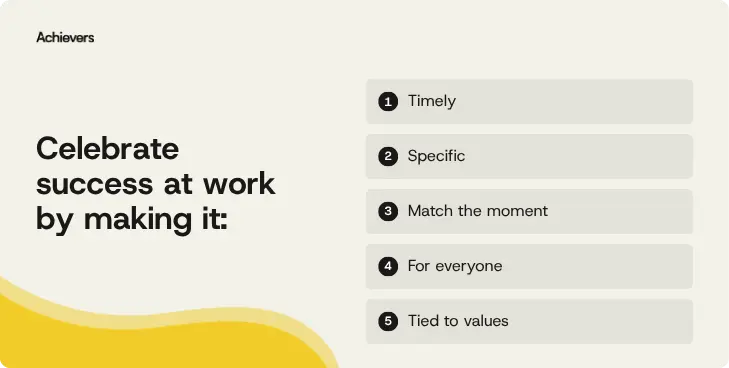
Make it timely
ecognition is most effective when it happens close to the moment of effort or achievement. Delayed appreciation loses relevance and weakens the connection between behaviour and recognition. Timely celebration helps employees understand that their contribution mattered when it mattered — reinforcing expectations and encouraging repeat behaviours.
What it looks like: A project lead sends a same‑day message after a client presentation, calling out how the team handled last‑minute changes and still delivered ahead of schedule — rather than waiting until the next quarterly review to acknowledge the effort.
Be specific
General praise has its place, but specific recognition delivers clearer impact. Explaining what someone did and why it made a difference removes ambiguity and builds confidence. Specific recognition helps employees understand which actions to repeat and how their work supports wider goals, rather than leaving them to interpret vague feedback.
What it looks like: Instead of saying, “Great job on the report,” a manager recognises an employee for “simplifying complex data into clear recommendations that helped leadership make a faster decision.”
Match the moment
Not every success needs a public announcement. Some wins benefit from being shared with the wider team; others are better acknowledged through a private message or one‑to‑one conversation. The key is choosing the approach that fits both the situation and the individual, rather than defaulting to the most visible option.
What it looks like: A major cross‑functional win is shared during a town hall, while a quieter contribution — like mentoring a new hire through a tough first month — is recognised privately in a one‑to‑one conversation.
Involve everyone
Celebration at work shouldn’t sit solely with managers. Peer‑to‑peer recognition plays an important role in building trust and connection, particularly in hybrid environments where managers may not see every contribution. When employees are encouraged to recognise each other’s efforts, appreciation becomes more frequent and more evenly distributed.
What it looks like: A teammate publicly thanks a colleague for stepping in to troubleshoot an issue outside their role, helping the team meet a critical deadline without escalation.
Tie celebration to values
When recognition is linked to organisational values, those values become tangible. Celebrating work that reflects collaboration, integrity, inclusion, or customer focus shows employees what “good” looks like in practice. Over time, this helps reinforce not just what success is — but how it’s achieved.
What it looks like: An employee is recognized not just for closing a deal, but for how they collaborated across teams and put long‑term customer relationships ahead of short‑term gains — explicitly linking the recognition to the organisation’s values.
This framework aligns closely with Acas guidance, which emphasises the role of trust, open communication, and recognition in building positive employee relations and healthy workplace cultures.
What gets in the way of celebrating success?
Most organisations don’t skip celebration because they don’t care. They skip it because they’re busy.
Deadlines pile up. Priorities shift. And recognition gets pushed down the list.
But here’s the risk: when appreciation disappears, so does belonging.
Across EMEA, employees who are recognised weekly are 14.5x more likely to feel a strong sense of belonging than those who are never recognised. Belonging isn’t a “soft” outcome — it’s a powerful predictor of engagement and retention.
Turning celebration into a habit, not a one‑off
The goal isn’t to celebrate occasionally. It’s to make celebration normal.
When recognition becomes part of everyday work:
- Employees know their effort won’t go unnoticed
- Managers reinforce expectations more clearly
- Teams build stronger relationships through shared wins
This matters because only 18% of employees say they have regular, meaningful interactions with their manager. Recognition is one of the simplest ways to strengthen those relationships — without adding more meetings to already full calendars.
How Achievers helps UK organisations celebrate success — every day
At Achievers, we believe recognition isn’t just about feeling good (though that’s a welcome bonus). It’s about shaping behaviour, strengthening culture, and driving real outcomes.
Our platform helps organisations:
- Celebrate success in real time
- Make appreciation visible across teams
- Recognise both big achievements and everyday wins
- Reinforce the behaviours that matter most
Because when people feel seen, heard, and appreciated, they don’t just work harder — they work better, stay longer, and show up with purpose.
If you’re ready to move beyond occasional applause and build a culture that truly knows how to celebrate success, Achievers is here to help.
Shape your workforce. Recognise. Reward. Drive results.
Celebrate success FAQs
Key insights
- In UK workplaces, a lack of consistent recognition is quietly undermining engagement despite strong employee effort.
- Frequent, everyday celebration of small wins is more effective than occasional recognition of major milestones.
- Timely, specific, and visible recognition is key to building connection, reinforcing behaviour, and improving retention.