Table of contents
Create a culture that means business™
Schedule a demo with an Achievers solution expert today.


 Copy URL
At its core, recognition is about the connection between effort and impact, people and purpose, work and outcomes. Rewards and recognition programmes exist to make that connection visible, consistent, and fair. When they work, people know what matters, why it matters, and how their contribution counts.
Right now, that clarity is missing for too many UK employees. People want to do great work, yet Achievers Workforce Institute data shows only 24% say they’re at their most productive, and fewer than a third feel their work clearly connects to business goals. Recognition isn’t reinforcing direction: it’s leaving a gap.
This guide cuts through the noise to show how UK employers can design and implement a rewards and recognition programme that’s fair, practical, and drives results.
What are rewards and recognition programmes in UK workplaces?
Rewards and recognition programmes are structured ways to show employees that their work is seen, valued, and aligned to what the organisation cares about. In the UK, that usually means recognition that feels fair, consistent, and genuinely earned.
Most programmes combine two elements:
- Recognition: This is the everyday appreciation. The thank‑you messages, public praise, peer shout‑outs, and visibility for good work. This builds connection, clarity, and an overall recognition-centric culture.
- Rewards: Tangible acknowledgements like points, vouchers, perks, experiences, or benefits. These add choice and value when applied thoughtfully.
Today, these elements are typically managed through recognition platforms, which bring structure, transparency, and scale to otherwise manual processes.
What are rewards and recognition programmes in UK workplaces?
Recognition is the act of noticing effort, calling out impact, and reinforcing what good work looks like in the workplace through thank‑yous, peer recognition, or visible appreciation. In UK workplaces, this ongoing feedback loop helps employees understand priorities and feel confident their contribution matters.
Rewards introduce tangible value to recognitions, such as points, vouchers, experiences, or benefits and they require clear rules and HMRC awareness. Rewards work best when they reinforce recognised behaviours, not when they attempt to replace salary progression, bonuses, or formal performance management.
When recognition provides meaning and rewards provide structure, that’s where impact happens.
Why invest in rewards and recognition programmes in the UK?
Rewards and recognition programmes give UK employers a practical way to reinforce what matters, recognise contribution, and step in before disengagement turns into attrition.
The current UK challenge: effort without feedback
According to research from the EMEA Engagement and Retention Report, many UK employees are working hard without feeling recognised or connected. Just 35% understand how their work contributes to their organisation’s mission, and only 25% say they feel appreciated at work. That disconnect creates real risk for engagement, belonging, and retention.
The same research shows what changes the picture: employees who are recognised weekly are 7.4x more likely to feel connected at work. Regular recognition closes the gap between effort and impact.
Business outcomes UK leaders care about
When recognition is consistent and well‑designed, it drives outcomes UK employers actually care about:
- Higher engagement and discretionary effort
- Stronger retention in a competitive labour market
- Better alignment between behaviours, values, and performance
- Healthier, more sustainable performance without pushing people toward burnout at work
Understanding the business value of recognition and rewards
Most organisations don’t start from zero when it comes to recognition and rewards. There’s usually something in place — a platform, a process, a budget — and a clear intention behind it: to drive performance, strengthen connection, and build the kind of culture that drives business results.
But that intention doesn’t always translate into impact. Even with the right pieces in place, it can be hard to see a clear connection between recognition efforts and the outcomes they’re meant to support.
In From platform to performance: Unlocking the business value of recognition and rewards, Emma Harvie, Global Head of Recognition and Rewards Insights at Achievers, explores where that gap comes from. The answer is simple: it’s not about doing more. It’s about understanding what’s driving results, and what isn’t.
Why most recognition strategies fall short of their ROI potential
Having a recognition platform in place doesn’t necessarily mean you have an effective recognition strategy. Programmes often launch with strong intent and early momentum, but without consistent reinforcement, recognition doesn’t show up as a regular, meaningful part of how work gets done.
And the data confirms it. According to research from Achievers Workforce Institute (AWI), 69% of organisations say they have a formal recognition platform, yet only 24% of employees feel meaningfully recognised.
As Emma explains, this is where many organisations fall short. Recognition is treated as something that exists, rather than something that needs to happen regularly to influence behaviour. Without that consistency, it becomes difficult to connect recognition efforts to the business outcomes that matter most.
From platform activity to real behaviour change
Measuring recognition activity can give the impression that a programme is working — logins are up, recognitions are being shared, reward points are being redeemed. But as Emma describes, activity alone doesn’t tell you whether recognition is actually influencing how people work.
What matters more is how often employees experience meaningful recognition. It’s that consistency that helps reinforce behaviours, build connection, and shape performance over time.
And when you look at the data, the difference is hard to ignore. AWI data finds that employees who are recognised weekly are 4x more productive, 3x more engaged, and 5x more likely to see a long-term career at their organisation.
It’s a shift in perspective: moving beyond what’s happening on the platform to understanding what’s changing across the organisation.
How rewards marketplaces unlock scale, governance, and impact
On their own, rewards can feel transactional. When they’re paired with meaningful recognition, they add a layer of value that helps reinforce behaviour long-term.
That distinction matters. Recognition creates the signal — it shows what good looks like. Rewards add reinforcement. Without that connection, rewards risk becoming disconnected from the behaviours they’re meant to encourage. But when they’re together consistently, the impact is undeniable.
Getting there, though, requires more than intention. It takes the right structure to deliver rewards consistently, fairly, and in a way teams can actually see.
How to design an effective rewards and recognition programme
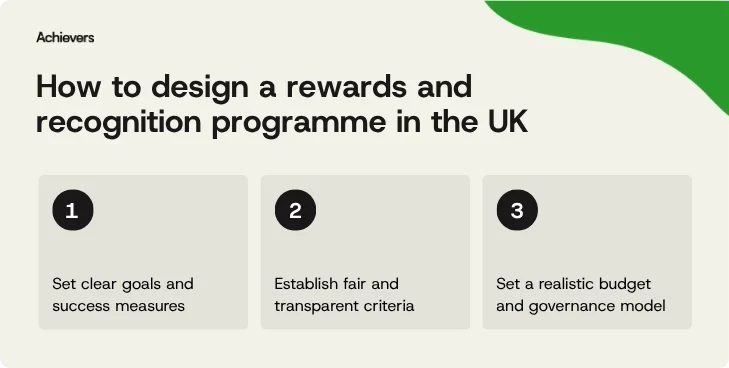
Step 1: Set clear goals and success measures
Start by defining what the programme is there to support. That could include company values, specific behaviours (like collaboration or customer focus), or outcomes such as innovation or quality. The key is alignment. Recognition should reinforce what your organisation already stands for, not compete with it.
Those goals should align with existing people, reward, and performance strategies. From there, decide how you’ll measure success. Engagement levels, participation rates, and retention trends are all helpful indicators that help show whether recognition is landing and where it needs adjustment.
Step 2: Establish fair and transparent criteria
Fairness is non‑negotiable in UK organisations. Clear criteria help remove ambiguity, reduce perceptions of favouritism, and reduce chances of bias. That means aligning with the principles of the Equality Act, so recognition doesn’t unintentionally favour some groups over others.
Set out what behaviours or contributions are recognised, who can recognise them, and how often. Write it down, share it openly, and apply it consistently across teams. When the rules are visible and predictable, recognition feels fair and people are far more likely to engage with it.
Step 3: Set a realistic budget and governance model
The strongest programmes balance frequency with value. That usually means regular, non-monetary recognition to reinforce everyday behaviours, paired with occasional higher‑value rewards for meaningful moments or to celebrate milestones.
Clear ownership matters too. Define roles across HR, finance, and line managers, and design the programme to scale, especially across hybrid, remote, and frontline teams. Recognition should feel consistent, no matter where or how people work.
Reward and recognition ideas for UK teams
The strongest rewards and recognition programmes don’t rely on a single approach. They use a mix of recognition and rewards that feel relevant, fair, and easy for people to engage with.
Monetary rewards
Monetary rewards are tangible rewards with a clear financial value. They’re used to mark meaningful contributions or moments, and should accompany, not replace pay, bonuses, or benefits.
Examples include:
- Points employees can redeem for vouchers, retail cards, or experiences
- Team or individual rewards for standout contributions or milestones
- Experiences such as dining, travel, or wellbeing perks
Non‑monetary recognition
Non‑monetary recognition is about appreciation rather than value. It focuses on acknowledging effort, impact, or behaviour in the moment, often with little or no cost.
Examples include:
- Public thank‑yous in team meetings or internal channels
- Personalised messages from managers that call out specific impact
- Opportunities to lead a project, mentor others, or work on professional development
Personalised and choice‑based rewards
Personalised and choice‑based rewards give employees control over how they’re recognised. This helps recognition feel relevant across different roles, preferences, and life stages.
Examples include:
- Reward catalogues with a wide range of options, from everyday essentials to experiences
- Letting employees choose when and how to redeem rewards
- Recognition that reflects individual preferences, roles, and life stages
Milestones and service awards
Milestones and service awards recognise key moments in the employee journey — from joining the organisation to long‑term contribution.
Examples include:
- Automated onboarding recognition to help new starters feel welcomed
- Work anniversaries paired with meaningful messages or rewards
- Recognition for achievements and growth, not just years served
How to successfully launch a rewards and recognition programme
Successfully launching a rewards and recognition programme isn’t about a big moment or milestone. It’s about setting expectations and building habits that last. Because that’s what helps scale recognition strategies to grow alongside the organisation.
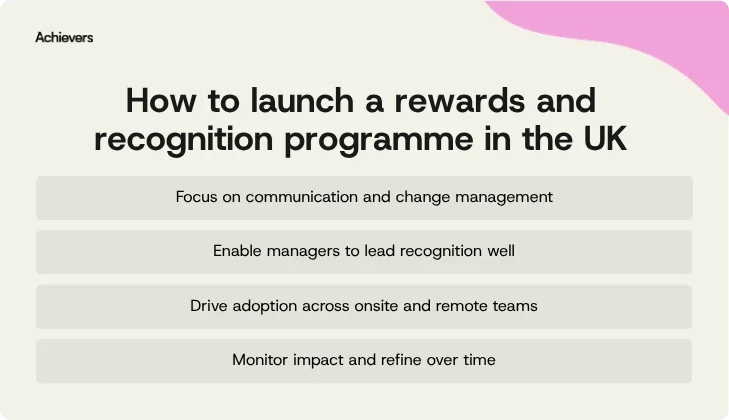
Here’s how to make it happen:
Focus on communication and change management
Use clear, practical language that explains why recognition matters, how it works, and what good looks like. Avoid hype or exaggerated language. Employees should understand how recognition fits into everyday work and what’s expected of them.
Enable managers to lead recognition well
Managers play a critical role in adoption. Teach them to recognise consistently and meaningfully, without turning recognition into a scripted exercise. Practical examples, clear checklists, and simple guidance go much further than templates or mandates.
Drive adoption across onsite and remote teams
Recognition should be easy to give and easy to see. Embedding it into everyday tools and workflows helps it become part of the rhythm of work, whether employees are onsite, remote, or frontline.
Monitor impact and refine over time
Use reporting and analytics to understand participation, recognition patterns, and alignment to values. These insights help identify gaps, reduce bias, and show what’s working and what’s not.
Legal, tax, and fairness considerations for rewards and recognition programmes
HMRC and reward taxation basics
As a general rule, rewards with a financial value may be subject to tax and National Insurance. HMRC guidance covers things like the trivial benefits rule and limits for staff events, but the safest approach is to avoid calling rewards “tax‑free.” Clear disclaimers — and a quick check with payroll or finance — go a long way.
Equality, bias, and inclusion risks
Recognition should follow the principles of the Equality Act 2010, meaning it’s applied fairly and consistently across the workforce. Clear criteria help reduce bias, while light monitoring of participation and outcomes helps ensure recognition is reaching everyone and not just the most visible voices.
Data protection and transparency
Because recognition programmes involve employee data, UK GDPR applies. Employees should understand what data is being collected, how it’s used, and what’s being reported.
Measuring the impact and ROI of rewards and recognition programmes
What to measure
Start with a small set of meaningful indicators that show how the programme is being used and experienced.
- Participation and frequency: Who is giving and receiving recognition, how often it happens, and whether recognition is happening across the organisation or limited to a small number of teams.
- Engagement and retention indicators: Trends in engagement survey results, retention rates, and employee sentiment over time, especially when recognition activity increases.
- Culture and values alignment: Whether recognition is reinforcing the behaviours and values the organisation cares about, not just outcomes or visibility.
Using insights to improve the programme
- Pay attention to recognition patterns: Review who gives recognition most often, who receives it, and which behaviours or values are being recognised repeatedly (or not at all).
- Pair reporting with employee feedback: Use pulse surveys or other feedback tools alongside programme data to understand how recognition feels, not just how frequently it happens.
- Watch for imbalance or bias: Spot trends that suggest recognition is consistently flowing to the same people or groups, and adjust guidance or manager support as needed.
- Make small, regular improvements: Update criteria, refresh examples, or adjust reward options based on what the data shows. Strong programmes improve over time, not all at once.
How Achievers helps UK organisations turn recognition into results
Designing a rewards and recognition programme is one thing. Sustaining it and proving it’s working is where many organisations get stuck. Achievers is built to support recognition in the UK and across EMEA.
Achievers supports organisations with:
- Consistent, frequent recognition across the organisation: Customers using Achievers see 2x higher recognition activity than other platforms, with recognition embedded into everyday tools like Workday, Microsoft Teams, and Zoom, so it’s easy to recognise in the moment.
- A rewards marketplace employees use and value: Employees can redeem points for thousands of options through a global marketplace, including UK‑relevant gift cards, everyday essentials, experiences, and charitable donations — driving high satisfaction and real perceived value.
- Clear insight into participation, fairness, and impact: Built‑in reporting shows who’s recognising, who’s being recognised, and which behaviours are being reinforced, helping HR leaders spot gaps, monitor equity, and confidently demonstrate and calculate ROI.
- Central governance with flexibility to scale: Achievers supports large, distributed, hybrid, and frontline workforces with consistent recognition rules, localised rewards, and central governance without manual workarounds.
Getting rewards and recognition right starts with intention
Getting rewards and recognition right isn’t about copying what another company is doing or adding more reward schemes to the mix. It starts with intention: being clear about what you want to reinforce, how recognition shows up day to day, and how it supports both people and performance.
If you’re ready to go deeper — from design to delivery to impact — there’s more to explore. Because when recognition works, it doesn’t just say thank you. It changes how work feels.
Rewards and recognition programmes FAQs
Key insights
- Effective rewards and recognition programmes create clarity by consistently reinforcing what matters, why it matters, and how employees’ work makes an impact.
- In UK workplaces, recognition drives engagement and retention when it’s fair, frequent, and embedded into everyday work.
- The strongest programmes combine meaningful recognition, thoughtful rewards, and measurable insight to ensure recognition is inclusive, trusted, and delivering real business value.