Table of contents
Create a culture that means business™
Schedule a demo with an Achievers solution expert today.


 Copy URL
Australian organisations are facing tight labour markets, rising expectations around wellbeing, and a growing need to build cultures that feel fair and genuinely human. That’s why rewards and recognition programs have never been more important. And not just as an added initiative, but as part of how organisations show people their work matters, every day.
And even though Australia is ahead of the curve, there’s still work to do. According to the Achievers Workforce Institute, Australia has the strongest recognition foundation across APAC, with 16% of employees receiving recognition weekly. Yet 24% say recognition still isn’t part of their organisation’s culture. The opportunity is clear: move from ad hoc appreciation to recognition that’s built into how work gets done.
This guide is designed to help you do exactly that.
Why Australian organisations invest in rewards and recognition programs
For businesses in Australia, the case for investing in rewards and recognition is clear. Recognition plays a direct role in how people experience work.
Here’s why leaders are investing:
Engagement and retention pressures
Australian organisations are seeing firsthand how quickly disengagement turns into attrition. When recognition is occasional, inconsistent, or only saved for major moments, employees are more likely to feel overlooked, even when pay and benefits are competitive. Over time, that lack of celebration hurts motivation and morale, weakens connection to the organisation, and increases the chances that people start looking elsewhere.
Because of that, these programs are seen as more than a way to improve turnover. They help reinforce progress, effort, and contribution in real time, which matters a lot more than a once-a-year thank you message.
Fairness, trust, and consistency
How recognition is delivered matters just as much as whether it exists in the first place. Employees expect recognition to be fair, transparent, and accessible regardless of role, location, or visibility. When recognition only happens within certain teams, relies too heavily on individual managers, or feels subjective, trust can quickly break down.
Ad‑hoc or manager‑only recognition programs can also create unintended bias, where the same people are recognised repeatedly while others are overlooked. Well‑designed rewards and recognition programs create shared standards, broader participation, and consistency across the organisation. More and more, recognition is being treated for what it really is: a powerful way to keep people engaged and staying put, not just something that looks good on a slide deck.
Wellbeing and sustainable performance
How recognition shows up in employees’ health and wellbeing matters just as much as how it shows up in productivity and performance. And that’s never been more important. According to The Leading Mentally Healthy Workplaces Survey Report, only 45% of employees feel their leadership team considers mental health as important as getting the job done.
When efforts are acknowledged and progress is noticed, employees are more likely to feel supported, safe to speak up, and confident in their contribution, especially during busy or high‑pressure periods.
When workloads, work burnout, and psychosocial risk are under growing scrutiny, recognition helps create balance. Not by masking pressure with rewards, but by reinforcing that effort isn’t invisible and challenges are understood. That’s something employee perks can’t do all on their own.
Common types of rewards and recognition programs in Australia
Monetary and non‑monetary recognition
Monetary rewards — such as gift cards, points, or bonuses — often help reinforce milestone moments or significant contributions. Non‑monetary recognition, on the other hand, focuses on acknowledgement itself: a timely thank‑you after a tough shift, public recognition in a team meeting, a peer‑to‑peer shout‑out tied to company values, or a personalised message from a leader recognising effort or progress. Many organisations in Australia use a mix of both.
At the same time, they’re also mindful that rewards and perks can come with tax and reporting considerations. That’s one reason non‑monetary recognition plays such a strong role. It’s flexible, inclusive, and easier to use consistently across the workforce.
Peer‑to‑peer and manager‑led recognition
Recognition programs typically combine peer‑to‑peer and manager‑led approaches. Peer recognition helps surface contributions that leaders may not always see, improving visibility and fairness across teams. It also reinforces a shared sense of ownership over culture, rather than placing recognition solely in the hands of managers.
Managers still play a critical role. They help set expectations, connect recognition back to values and goals, and reinforce what great work looks like. The strongest programs balance both.
Formal programs and everyday recognition
Most Australian organisations have some form of formal recognition, like annual awards or service milestones. These moments still matter, especially when they’re part of a wider approach to recognition. On their own, they’re often easily forgotten. When they sit alongside everyday recognition, they carry a lot more meaning.
But frequency matters more than scale. Small, timely acknowledgement, given consistently, builds stronger engagement and trust than the occasional high‑profile recognition award. When recognition becomes part of daily work, it feels genuine and human, not performative or reserved for special occasions.
Understanding the business value of recognition and rewards
Most organisations don’t start from zero when it comes to recognition and rewards. There’s usually something in place — a platform, a process, a budget — and a clear intention behind it: to drive performance, strengthen connection, and build the kind of culture that drives business results.
But that intention doesn’t always translate into impact. Even with the right pieces in place, it can be hard to see a clear connection between recognition efforts and the outcomes they’re meant to support.
In From platform to performance: Unlocking the business value of recognition and rewards, Emma Harvie, Global Head of Recognition and Rewards Insights at Achievers, explores where that gap comes from. The answer is simple: it’s not about doing more. It’s about understanding what’s driving results, and what isn’t.
Why most recognition strategies fall short of their ROI potential
Having a recognition platform in place doesn’t necessarily mean you have an effective recognition strategy. Programmes often launch with strong intent and early momentum, but without consistent reinforcement, recognition doesn’t show up as a regular, meaningful part of how work gets done.
And the data confirms it. According to research from Achievers Workforce Institute (AWI), 69% of organisations say they have a formal recognition platform, yet only 24% of employees feel meaningfully recognised.
As Emma explains, this is where many organisations fall short. Recognition is treated as something that exists, rather than something that needs to happen regularly to influence behaviour. Without that consistency, it becomes difficult to connect recognition efforts to the business outcomes that matter most.
From platform activity to real behaviour change
Measuring recognition activity can give the impression that a programme is working — logins are up, recognitions are being shared, reward points are being redeemed. But as Emma describes, activity alone doesn’t tell you whether recognition is actually influencing how people work.
What matters more is how often employees experience meaningful recognition. It’s that consistency that helps reinforce behaviours, build connection, and shape performance over time.
And when you look at the data, the difference is hard to ignore. AWI data finds that employees who are recognised weekly are 4x more productive, 3x more engaged, and 5x more likely to see a long-term career at their organisation.
It’s a shift in perspective: moving beyond what’s happening on the platform to understanding what’s changing across the organisation.
How rewards marketplaces unlock scale, governance, and impact
On their own, rewards can feel transactional. When they’re paired with meaningful recognition, they add a layer of value that helps reinforce behaviour long-term.
That distinction matters. Recognition creates the signal — it shows what good looks like. Rewards add reinforcement. Without that connection, rewards risk becoming disconnected from the behaviours they’re meant to encourage. But when they’re together consistently, the impact is undeniable.
Getting there, though, requires more than intention. It takes the right structure to deliver rewards consistently, fairly, and in a way teams can actually see.
How to design a meaningful rewards and recognition program
Designing an effective rewards and recognition program starts with intention. The goal isn’t to add more activity, but to create recognition that feels fair, relevant, and easy to sustain.
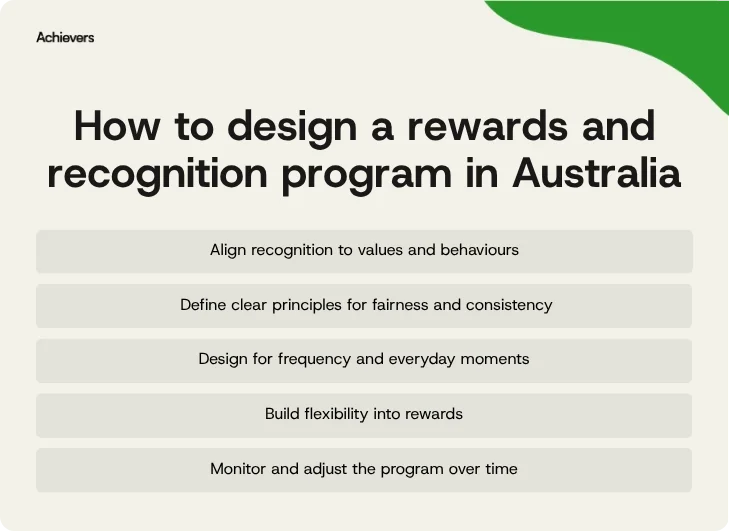
Here’s how to get started:
1. Align recognition to values and behaviours
Before deciding how recognition looks or who can give it, organisations need to be clear on what they’re recognising in the first place.
The most effective programs are tied to company values and the everyday behaviours that support them. That might mean recognising collaboration, safe decision‑making, customer focus, or learning from mistakes, depending on what your organisation wants to encourage more of.
These might include categories such as:
- Collaboration and teamwork, especially cross‑functional or cross‑site efforts
- Wellbeing and sustainability, such as supporting teammates, managing workload responsibly, or role‑modelling healthy ways of working
- Safety and accountability, particularly in frontline or regulated environments
Steps and strategies:
- Identify a small, clear set of behaviours that reflect your values and are relevant to day‑to‑day work.
- Use those behaviours consistently as the reason behind recognition, so employees understand why someone is being acknowledged.
- Provide simple guidance and examples to help managers and employees recognise behaviours in real time, not just their outcomes.
2. Define clear principles for fairness and consistency
Fair recognition doesn’t mean recognising everyone the same way. It means making sure recognition is accessible, transparent, and applied consistently across the organisation.
Problems often show up when recognition is left entirely to individual discretion. Some teams recognise frequently, others rarely. Some roles are highly visible, while others are overlooked entirely. Over time, that inconsistency can hurt trust and make recognition feel subjective or even political.
Steps and strategies:
- Set clear guidelines for who can recognise, what can be recognised, and how often recognition should happen.
- Design recognition so it works across different roles, locations, and work patterns, including frontline, shift‑based, and hybrid teams.
- Encourage broader participation, so recognition isn’t dependent on a single manager or team.
- Review recognition activity regularly to spot gaps or patterns where certain groups may be under‑recognised.
3. Design for frequency and everyday moments
When it comes to recognition, how often it happens matters just as much as how it’s delivered. The most effective rewards and recognition programs are designed to support regular, everyday acknowledgement. That includes recognising progress, effort, and outcomes when work is actually happening, not just at the end of projects or during major company-wide events.
Steps and strategies:
- Encourage recognition that’s timely, specific, and tied to real work, not just major outcomes.
- Make it easy for recognition to happen in the flow of work, so it doesn’t feel like an extra task.
- Support both public and private recognition, recognising that different moments — and different people — call for different approaches.
- Reinforce regular recognition through simple prompts, reminders, or check‑ins. Consider giving your managers a recognition checklist to help keep them accountable.
4. Build flexibility into rewards
Flexibility is what helps a recognition program work for different people, roles, and stages of life. That means giving people choice, and using rewards as optional reinforcement, not the centrepiece of recognition. While acknowledgement should always be the foundation, flexible rewards can help reinforce moments that matter most to employees.
Steps and strategies:
- Offer a range of reward options so employees can choose what feels most relevant to them, rather than assuming one reward works for everyone.
- Use rewards selectively, pairing them with moments that genuinely call for something extra.
- Keep recognition accessible even when rewards aren’t involved, so appreciation doesn’t depend on budget or approval cycles.
- Design rewards with simplicity in mind, making it easy to participate without creating administrative friction.
5. Monitor and adjust the program over time
As businesses grow, teams change, and priorities shift, recognition needs to evolve with them. But monitoring doesn’t need to be complex. The goal is just to understand whether recognition is happening consistently and how employees are experiencing it.
Steps and strategies:
- Track basic participation patterns, such as how often recognition is happening and whether it’s spread evenly across teams and roles.
- Look for gaps or trends, such as groups who are recognised frequently and others who are rarely acknowledged.
- Gather simple feedback from employees and managers about what feels meaningful, confusing, or easy to use.
- Revisit recognition criteria periodically to make sure they still reflect current priorities and ways of working.
- Make small adjustments over time rather than waiting for a full overhaul.
Rewards, tax, and compliance considerations in Australia
When rewards form part of a recognition program, businesses need to account for local regulations. This doesn’t mean recognition should feel complex — just that it should be designed with awareness.
At a high level, organisations should keep the following in mind:
- Fringe Benefits Tax (FBT): Some rewards may be considered fringe benefits and subject to FBT. Whether tax applies depends on the type of reward and how it’s provided, so treatment can vary based on circumstances.
- Workplace relations framework: Recognition programs operate alongside Australia’s workplace system, which is governed by the Fair Work Act 2009, including the National Employment Standards (NES), industry awards, and agreements. Recognition should support fairness and consistency, not substitute or alter core entitlements.
- Employee data and privacy: Digital recognition platforms often involve collecting and reporting on employee information. Organisations should be mindful of how data is used, stored, and shared to maintain trust and meet privacy expectations.
Quick compliance check before launching rewards:
- Have you confirmed which rewards may trigger FBT?
- Are rewards clearly separate from pay, entitlements, and awards?
- Is participation fair and consistent across roles and locations?
- Do employees understand how recognition data is used and stored?
This information is general in nature and does not constitute legal or tax advice. Organisations should seek guidance relevant to their specific circumstances.
How to measure the success of a rewards and recognition program
Measuring a rewards and recognition program doesn’t mean complex dashboards or advanced analytics. The goal is to understand whether recognition is happening, who it’s reaching, and how it’s shaping the employee experience over time.
Engagement and participation indicators
One of the clearest signs a program is working is whether people are actually using it. Basic participation indicators can reveal a lot about how recognition shows up day to day.
Look for signals including:
- How widely the program is adopted across the organisation
- How often recognition is happening, not just whether it exists
- Whether participation is spread across teams, roles, and locations, rather than concentrated in a few areas
Retention and workforce outcomes
Recognition data can also provide useful context around retention and engagement trends. While recognition alone won’t explain why people stay or leave, it can highlight important patterns.
For example, organisations often look at:
- Whether teams with consistent recognition experience lower turnover or greater stability
- How recognition aligns with key lifecycle moments such as onboarding, role changes, or major projects
- Where recognition activity drops, which can act as an early warning sign of disengagement or manager burnout
Using insights to improve the program
Measurement your program has the most impact when it leads to action. Over time, recognition data can help organisations spot gaps, reduce bias, and refine how the program works.
This might include:
- Identifying under‑recognised teams or roles and adjusting to reduce bias or disengagement risk
- Reviewing whether recognition is reinforcing the right behaviours to support business priorities
- Making small, targeted changes that improve consistency and adoption without increasing spend
Choosing a rewards and recognition platform for Australian organisations
A rewards and recognition platform is what turns a program from an idea into something employees experience every day.
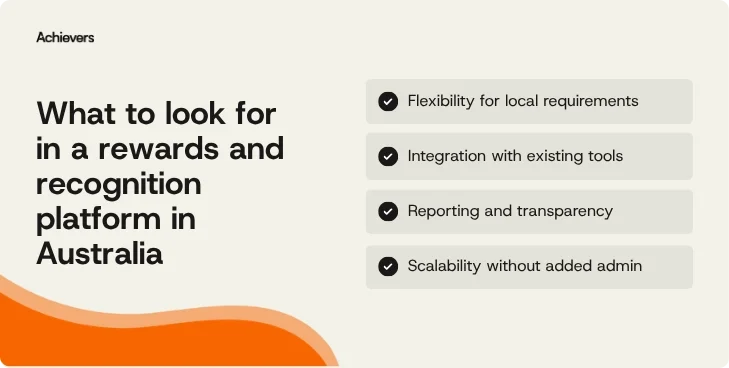
Here’s what to consider when choosing yours:
- Flexibility for local workplace requirements: Recognition needs to work for different roles, locations, and ways of working — while still aligning with local expectations around fairness, transparency, and compliance. A flexible platform makes it easier to adapt recognition as priorities change, without needing to redesign the program each time.
- Integration with existing tools: Platforms that work alongside existing HR systems and collaboration tools help recognition show up where work is already happening. When recognition fits naturally into daily workflows, it’s easier to use, easier to see, and more likely to stick.
- Reporting and transparency: Having clear visibility into participation and recognition patterns helps organisations understand what’s working and where adjustments might be needed. The focus isn’t on complex analysis; it’s on insights that keep recognition fair, consistent, and meaningful.
- Scalability without added admin: As organisations grow, recognition should scale with them. The strongest platforms support both consistency and local relevance, while keeping administration light so teams can focus on recognition itself — not managing the system behind it.
Why organisations in Australia choose Achievers
Achievers is designed for organisations that want recognition to drive real behaviour change at scale. Our approach is backed by measurable outcomes, not just good intentions.
Organisations choose Achievers because:
- Customers using Achievers see 2x higher engagement compared to other recognition vendors, driven by industry‑leading recognition frequency
- Organisations that activate advanced programs and features achieve up to 5x greater impact on engagement, productivity, and retention
- Recognition happens where work already gets done, with native integrations across tools like Microsoft Teams, Outlook, Slack, and Workday
- A global rewards marketplace spanning nearly 190 countries allows organisations to scale recognition while supporting local relevance
- Program success is supported by a dedicated customer strategy team and thousands of proven campaigns, helping organisations translate recognition into measurable results
Design an R&R program that builds long-term impact
Designing a strong rewards and recognition program is an important first step. But real impact comes from how consistently it shows up — and Achievers is built to make that consistency possible, scalable, and measurable across the organisation.
It’s time to turn recognition into something employees experience every day, not just something they talk about.

Rewards and recognition programs in Australia FAQs
Key insights
- The most effective rewards and recognition programs focus on reinforcing everyday behaviours aligned to values.
- Consistency and fairness matter more to employees than reward value.
- When supported by the right platform, recognition becomes easier to scale, measure, and link to real business outcomes.