Table of contents
Create a culture that means business™
Schedule a demo with an Achievers solution expert today.


 Copy URL
Feeling safe at work shouldn’t be a luxury. And yet, for many Australians, it still is. Poor mental health costs Australian businesses up to $39 billion each year in lost productivity and workforce participation.
That’s more than a wellbeing issue, it’s a performance one. When work‑life balance breaks down, and people don’t feel safe to speak up, stress rises, engagement slips, and performance suffers.
So how do you actually build a company culture where everyone feels valued and heard? In this blog, we’ll break down what psychological safety really means, why it’s good business, how countries are tackling it head-on, and how you can create a workplace where people feel safe to show up as themselves.
What is psychological safety (and why does it matter so much)?
Psychological safety is the not-so-radical idea that people should be able to speak up at work without fear of being shut down, sidelined, or penalised. When employees feel safe to ask questions, admit mistakes, and share ideas — even the wild ones — teams collaborate better, innovate more, and stress less.
It’s not just good for culture; it’s good for business. And in some places, it’s now the law. In Australia, new legislation effective July 2024 classifies industrial manslaughter — including from psychological harm — as a criminal offense, with fines up to AUD 18 million and prison terms of up to 25 years. If that sounds serious, it is — and it’s part of a broader movement to address psychosocial hazards in the workplace.
Bottom line: psychological safety fuels performance, retention, and trust. The best workplaces know that, and they’re succeeding because of it.
11 ways HR leaders and managers can build psychological safety
Creating a culture of psychological safety isn’t just good for your people — it’s good for business. When employees feel safe, supported, and heard, they don’t just survive at work, they thrive. And so does your organisation.
So how do you make it happen? Here are 11 practical ways to start building a workplace where everyone feels safe to speak up, step forward, and stick around.
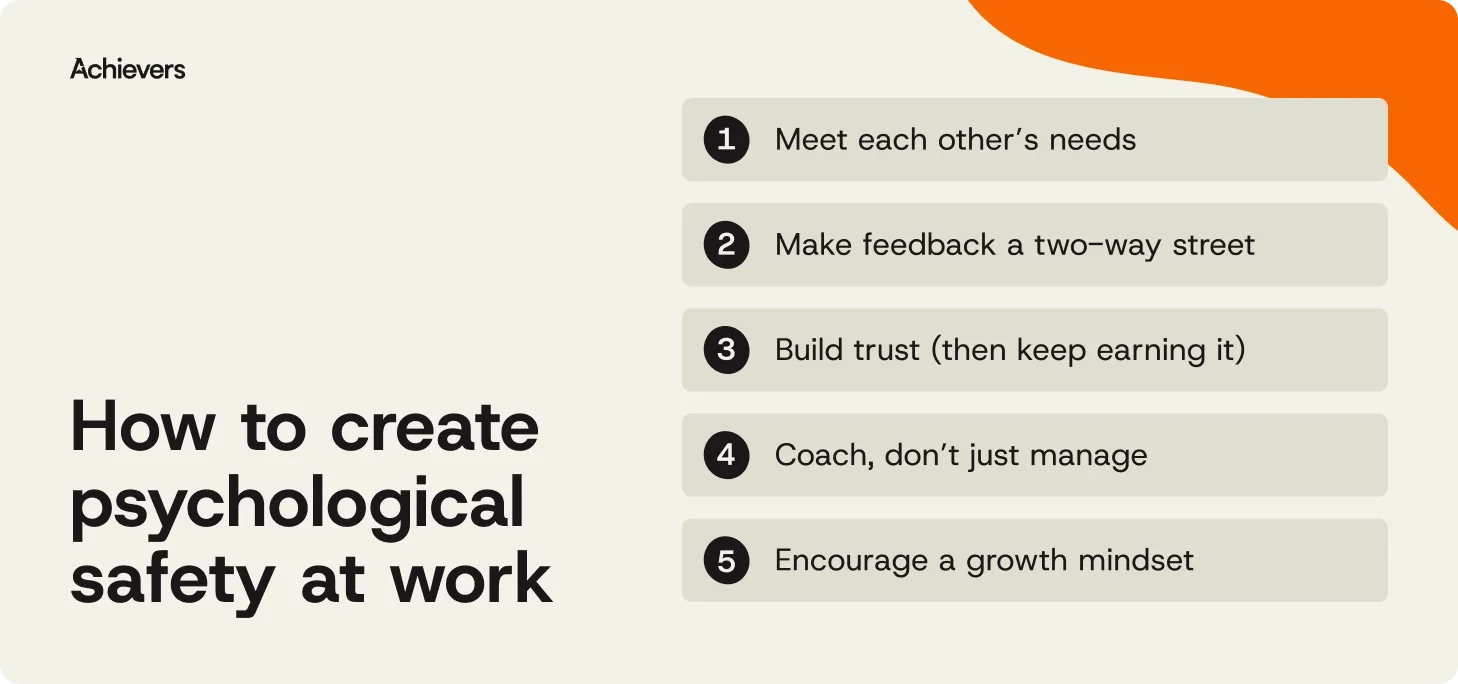
1. Meet each other’s needs
Meeting each other’s needs starts with asking rather than assuming what your team requires. Too often, managers make decisions without consulting their direct reports. Take the time to ask what your employees need in terms of communication, meetings, and feedback. And don’t stop there. Employees’ needs change, so keep checking in.
Acknowledging hard work, providing growth opportunities, and ensuring everyone’s voice is heard all contribute to creating a safe, motivating environment. There’s no one-size-fits-all approach.
2. Make feedback a two-way street
Feedback only works if it flows both ways and actually leads to action. Asking employees for input but doing nothing with it? That’s how employees become disengaged.
Build trust by listening, responding, and co-creating solutions. Start with pulse surveys — they’re quick, timely, and cut through recency bias to give you the full picture. When employees see their voices leading to real change, they’re more likely to keep sharing. And that’s when the magic (read: results) happens.
3. Build trust (then keep earning it)
Trust is what builds performance and productivity at work. When employees trust their managers, they’re more engaged, motivated, and less likely to mentally check out at work. And in Australia, only 27% of employees currently trust their manager. That means there’s work to do.
Real trust takes more than good intentions. It needs consistent actions: honesty, empathy, follow-through, and giving people the autonomy to own their work. Skip the top-down approach — empower instead. When employees feel trusted, they don’t just do their jobs — they lean in and show up.
4. Coach, don’t just manage
Coaching builds trust, boosts confidence, and helps employees grow. All essentials for psychological safety.
Coaching is about showing up, listening actively, and helping people connect their work to their goals. Encourage leaders to swap micromanagement for mentorship. When managers take time to coach, employees feel seen, supported, and more likely to stick around. And that’s a win for everyone, not just HR.
5. Encourage a growth mindset
Everyone — from interns to execs — has room to grow. Fostering a growth mindset helps employees see challenges as chances, not career-ending catastrophes. When people feel safe sharing missteps or unfinished work, they’re more likely to learn, collaborate, and push boundaries.
Build a culture where experimenting is encouraged, not penalised. Celebrate learning just as much as results. Because when people believe they can improve, they do. That momentum fuels stronger teams, smarter decisions, and yes, fewer exit interviews.
6. Create space for bold ideas
Innovation doesn’t happen in a vacuum — it happens in environments where people feel safe enough to speak up, even if their idea sounds a little “out there.” In fact, According to the Australian Workplace Psychological Safety Survey Report, only 24% of workers feel safe to take interpersonal risks at work.
To foster real creativity, leaders need to welcome fresh thinking, respectful debate, and the occasional wild idea. Encouraging bold thinking signals trust and drives better business outcomes. Because when employees believe their ideas won’t land them in hot water, they’re far more likely to deliver game-changing ones.
7. Show appreciation often
Frequent recognition does more than boost morale. It builds trust and psychological safety.
With the right recognition platform, it’s easy to send an acknowledgement or thank-you message in real time. Whether it’s a shoutout for a big win or a quiet thank-you for a job well done, frequent appreciation fosters connection, reinforces the right behaviours, and reminds people their work actually matters. Because it does.
8. Nip negativity in the bud
Left unchecked, negativity can chip away at trust, strain relationships, and undermine psychological safety across a team.
When someone’s energy starts pulling the team down, ignoring it only gives the problem room to grow. Instead, lead with curiosity rather than judgment. A thoughtful check‑in can uncover what’s really going on — whether that’s personal pressure, unclear expectations, or breakdowns in communication. Addressing the root causes with empathy and intention shows you care about both the person and the organizational culture.
9. Lead with empathy (and mean it)
Real empathy is the difference between hearing words and actually listening for meaning. Start small and stay human. Reflect back what you’ve heard, pay attention to your presence, and show genuine interest in the person in front of you. These signals may seem subtle, but they carry weight — helping people feel respected, seen, and safe to speak openly.
And don’t underestimate appreciation. Appreciation and empathy reinforce each other, building trust, strengthening collaboration, and making work feel a little more human.
10. Make decisions with your team, not just for them
Psychological safety ranks just behind pay and flexibility for employees. So, involve your team in decisions that impact them. Ask for input, review feedback together, and be transparent about how choices are made. It builds trust, boosts engagement, and strengthens the team dynamic. Plus, it helps avoid the dreaded “why didn’t anyone tell me?” moments. When employees feel heard and informed, they’re more likely to stay committed, and less likely to mute the next meeting invite.
11. Empower managers to lead with confidence
Psychological safety starts with managers. Equip leadership with tools and training in communication, empathy, and conflict resolution. Give them access to pulse surveys and anonymous feedback to spot issues early and respond with care. When managers feel confident leading hard conversations, teams feel safe speaking up. And when every idea, question, or concern is met with curiosity (not judgment), trust builds, and so does performance. Better leaders, better culture, better results.
How to check the pulse on psychological safety
You can’t fix what you don’t measure — and psychological safety is no exception. But before you break out the spreadsheets, remember: this is about people, not just metrics. Here’s how to approach it with care (and a little curiosity):
- Start with clarity: Make sure your team understands what psychological safety is — and why it matters.
- Create a safe space to assess: Confidentiality is key. No one shares honestly if they’re worried it’ll come back to bite them.
- Pick your tools: Use pulse surveys, anonymous feedback forms, or a trusted index like the Psychological Safety Index.
- Listen and observe: One-on-ones, group chats, open-ended questions — it’s about conversation, not interrogation.
- Watch team dynamics: Body language often says more than words. (A silent Zoom square speaks volumes.)
- Dig into the data: Look for trends, blind spots, and areas to improve.
- Share what you learn: Feedback goes both ways — let your team know what surfaced and what’s next.
- Build a plan together: Co-create solutions, set goals, and take action as a team.
- Keep the loop going: Follow up regularly. Psychological safety isn’t a one-and-done — it’s ongoing.
- Support with training: Offer tools and development for leaders and teams.
- Model it daily: Show what psychological safety looks like in action — because culture starts at the top (and spreads sideways).
When in doubt, listen more, judge less, and keep the door — and your mind — open.
Make psychological safety part of your culture
The best workplaces don’t just talk about psychological safety — they live it. And when employees feel safe, valued, and heard, they show up as their best selves (and tend to stick around).
Creating that kind of culture doesn’t happen by accident. It takes consistent feedback, everyday recognition, and tools that make both feel natural — like Achievers.
Ready to build a workplace where people want to work (and stay)? Let’s make it happen.

Psychological safety at work FAQs
Key insights
- Psychological safety drives trust, innovation, and stronger team performance.
- Employees thrive when they feel heard, valued, and empowered to speak up.
- Frequent recognition is a powerful lever for building a safe, connected workplace culture.