Table of contents
Create a culture that means business™
Schedule a demo with an Achievers solution expert today.


 Copy URL
In Singapore’s high‑performance workplaces, effort is rarely in short supply — but recognition often is. That’s why rewards and recognition (R&R) programs matter more than most leaders realise.
The proof? A recent survey found that a lack of recognition or appreciation is one of the top three factors discouraging employees in Singapore across Gen Z, millennials, and Gen X. And according to Achievers Workforce Institute (AWI) research, 23% of employees in Singapore say recognition would inspire higher productivity.
Recognition isn’t about gestures or perks. It’s about reinforcing the right behaviours, at the right moments, in ways employees actually value. But how do HR leaders design a program that works, fairly and at scale? This guide shows you how to do exactly that.
In Singapore’s high‑performance workplaces, effort is rarely in short supply — but recognition often is. That’s why rewards and recognition (R&R) programs matter more than most leaders realise.
The proof? A recent survey found that a lack of recognition or appreciation is one of the top three factors discouraging employees in Singapore across Gen Z, millennials, and Gen X. And according to Achievers Workforce Institute (AWI) research, 23% of employees in Singapore say recognition would inspire higher productivity.
Recognition isn’t about gestures or perks. It’s about reinforcing the right behaviours, at the right moments, in ways employees actually value. But how do HR leaders design a program that works, fairly and at scale? This guide shows you how to do exactly that.
The difference between rewards and recognition
The terms rewards and recognition are often used interchangeably, but they play different roles in shaping employee behaviour, engagement, productivity and performance. Understanding the distinction is essential for designing a rewards and recognition program that works across Singapore’s workforce.
Recognition
Recognition is the act of acknowledging effort, contribution, or behaviour in a timely and meaningful way. It answers an important question for employees: Was my work seen, and did it matter?
Examples of recognition include:
- A manager calling out a team member for handling a difficult customer situation with care and professionalism
- A peer recognising a colleague for stepping in to support a project under tight deadlines
- Public praise for collaboration, innovation, or living organisational values
- A private thank‑you note after sustained effort during a busy period
It doesn’t need to be grand or expensive. What matters most is clarity, authenticity, and consistency.
Rewards
Rewards are the tangible or experiential ways organisations reinforce recognition. They add weight to the moment, but they work best when they reinforce recognition rather than stand alone.
Examples of rewards include:
- Points that can be redeemed for vouchers, experiences, or merchandise
- Gift cards or digital rewards chosen by the employee
- Team celebrations or shared experiences tied to meaningful milestones
- Spot rewards for exceptional contributions
When rewards are used to complement recognition, they strengthen the behaviours organisations want to see more of. When they’re used without context, they risk feeling transactional or expected.
Incentives and benefits
Incentives and benefits serve different purposes altogether. Incentives and incentive programs are typically performance‑based and outcome‑driven, designed to motivate specific results over a defined period. Benefits, meanwhile, are fixed entitlements — such as leave, insurance, or wellbeing perks — that support employees but aren’t tied to day‑to‑day behaviour.
The benefits of a rewards and recognition program
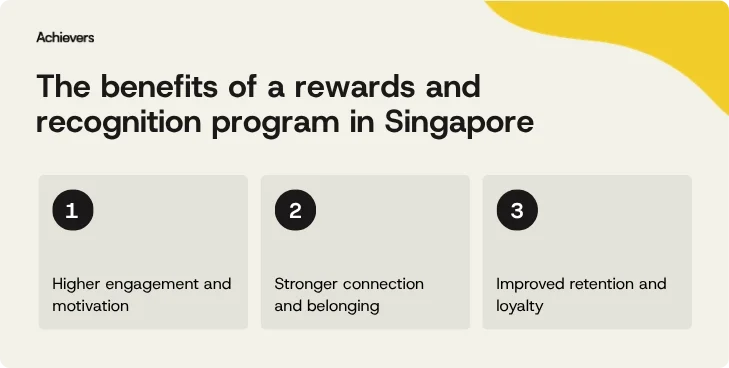
Research from the latest APAC Engagement and Retention Report makes one thing clear: the benefits of a rewards and recognition program go way beyond appreciation.
Higher engagement and motivation
Recognition directly influences how engaged employees feel in their roles. When employees are recognised weekly, they are 15x more likely to feel appreciated and engaged than those who are never recognised. That appreciation reinforces effort, builds momentum, and helps employees sustain performance over time, especially in environments where expectations, demand, and pace are high.
Stronger connection and belonging
Recognition also shapes how employees experience culture. Employees who are recognised weekly are 4.2x more likely to feel connected at work and 21x more likely to feel a sense of belonging than those who are never recognised. These outcomes matter in Singapore, where collaboration, trust, and alignment often determine whether teams move quickly or stall.
Improved retention and loyalty
Recognition plays a clear role in whether employees choose to stay. Nearly 24% of employees say removing rewards would impact retention, highlighting how closely appreciation is tied to loyalty. When recognition is frequent and fair, employees are more likely to remain committed, even during times of change, pressure, or uncertainty.
Recognition works best when it’s part of the employee’s everyday experience. When embedded into how work gets done, it reinforces effort, strengthens culture, and helps organisations keep the people they can’t afford to lose.
Key components of a successful rewards and recognition program
An R&R program is only as successful as the components that make up its system. Each component plays a specific role in ensuring recognition happens regularly, reaches the right people, and reinforces the behaviours the organisation wants to see more of.
Peer‑to‑peer recognition
Peer‑to‑peer recognition allows employees to recognise one another directly for contributions they see every day. This matters because much of the work that drives results — helping a teammate, solving a problem, stepping in when it counts — often happens outside a manager’s line of sight.
As part of a program, peer recognition increases frequency and reach. Simple guardrails, like linking recognition to company values or behaviours, help keep it meaningful and equitable. When structured well, peer recognition strengthens collaboration without turning into a popularity contest.
Manager‑led recognition
Manager‑led recognition plays a central role in any rewards and recognition program. It helps employees understand what good performance looks like and how their work connects to team and business priorities.
Strong programs don’t assume managers will “just know” how to recognise well. They set clear expectations and make it easy for managers to recognise effort, progress, and impact regularly. When recognition becomes part of how managers lead, it brings clarity instead of mixed signals.
Public and private recognition
Public recognition helps reinforce shared values and makes positive behaviours visible to others. Private recognition allows for more personal appreciation, especially for sensitive or behind‑the‑scenes work.
A well‑designed program includes both options, giving managers the flexibility to recognise in a way that fits the moment while still staying consistent and intentional.
Rewards and customisable choices
Within a rewards and recognition program, rewards exist to support recognition, not replace it. They help reinforce those meaningful moments of appreciation.
Offering a range of reward options, such as points, vouchers, or experiences, gives employees choice and helps rewards feel relevant. Clear program guidelines keep rewards tied to recognised behaviours, so they add value without becoming transactional or expected.
Milestone and moment‑based recognition
Milestone and moment‑based recognition ensures the program recognises progress over time, not just standout results. This includes moments like onboarding, project completion, learning milestones, or periods of sustained effort.
By building these milestones and celebration moments into the program, organisations create natural opportunities to recognise contribution throughout the employee journey. It helps employees see that their work adds up and that it’s noticed along the way.
Understanding the business value of recognition and rewards
Most organisations don’t start from zero when it comes to recognition and rewards. There’s usually something in place — a platform, a process, a budget — and a clear intention behind it: to drive performance, strengthen connection, and build the kind of culture that drives business results.
But that intention doesn’t always translate into impact. Even with the right pieces in place, it can be hard to see a clear connection between recognition efforts and the outcomes they’re meant to support.
In From platform to performance: Unlocking the business value of recognition and rewards, Emma Harvie, Global Head of Recognition and Rewards Insights at Achievers, explores where that gap comes from. The answer is simple: it’s not about doing more. It’s about understanding what’s driving results, and what isn’t.
Why most recognition strategies fall short of their ROI potential
Having a recognition platform in place doesn’t necessarily mean you have an effective recognition strategy. Programmes often launch with strong intent and early momentum, but without consistent reinforcement, recognition doesn’t show up as a regular, meaningful part of how work gets done.
And the data confirms it. According to research from Achievers Workforce Institute (AWI), 69% of organisations say they have a formal recognition platform, yet only 24% of employees feel meaningfully recognised.
As Emma explains, this is where many organisations fall short. Recognition is treated as something that exists, rather than something that needs to happen regularly to influence behaviour. Without that consistency, it becomes difficult to connect recognition efforts to the business outcomes that matter most.
From platform activity to real behaviour change
Measuring recognition activity can give the impression that a programme is working — logins are up, recognitions are being shared, reward points are being redeemed. But as Emma describes, activity alone doesn’t tell you whether recognition is actually influencing how people work.
What matters more is how often employees experience meaningful recognition. It’s that consistency that helps reinforce behaviours, build connection, and shape performance over time.
And when you look at the data, the difference is hard to ignore. AWI data finds that employees who are recognised weekly are 4x more productive, 3x more engaged, and 5x more likely to see a long-term career at their organisation.
It’s a shift in perspective: moving beyond what’s happening on the platform to understanding what’s changing across the organisation.
How rewards marketplaces unlock scale, governance, and impact
On their own, rewards can feel transactional. When they’re paired with meaningful recognition, they add a layer of value that helps reinforce behaviour long-term.
That distinction matters. Recognition creates the signal — it shows what good looks like. Rewards add reinforcement. Without that connection, rewards risk becoming disconnected from the behaviours they’re meant to encourage. But when they’re together consistently, the impact is undeniable.
Getting there, though, requires more than intention. It takes the right structure to deliver rewards consistently, fairly, and in a way teams can actually see.
How to design a rewards and recognition program in Singapore
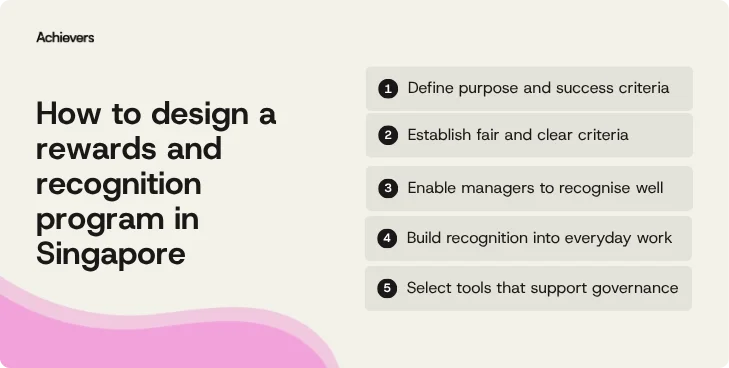
Designing a rewards and recognition program isn’t about adding more moments of appreciation. It’s about building a system people trust. These are the steps that help drive real program impact:
Step 1: Define purpose, principles, and success criteria
A strong program starts by clearly identifying the behaviours and outcomes it exists to reinforce, such as collaboration, customer focus, learning, or living organisational values. When recognition is tied to these priorities, it stops feeling subjective and starts feeling intentional.
Defining guiding principles — like timeliness, specificity, and inclusivity — also helps create consistency in how recognition is given. Clear success criteria then offer a way to assess whether the program is shaping behaviour over time, rather than simply generating activity.
When everyone understands what recognition stands for, it becomes easier to give and a lot easier to trust.
Step 2: Establish fair and transparent criteria
Employees need to understand who can be recognised, for what, and how recognition decisions are made. Clear eligibility rules and shared standards across teams help prevent recognition from becoming uneven or overly manager‑dependent. Designing with transparency and bias awareness in mind also helps protect the program’s credibility as it scales.
When fairness is built into the program, recognition feels legitimate. And legitimacy is what keeps people engaged instead of quietly opting out.
Step 3: Enable managers to recognise well
Managers have a significant impact on how recognition is experienced, but without guidance, recognition is often inconsistent or delayed. Providing practical examples, simple prompts, and clear expectations helps remove guesswork and hesitation, making recognition easier to deliver in real moments of work.
When managers know what meaningful recognition looks like and feel confident delivering it, recognition becomes part of everyday leadership, not something saved for performance reviews or standout wins.
Step 4: Build recognition into everyday work
Programs that rely only on annual awards or major milestones miss the everyday effort that actually drives results. Designing recognition around regular behaviours — progress, persistence, teamwork, problem‑solving — helps turn recognition into a habit rather than an exception.
When recognition is closely tied to the work itself, it reinforces momentum and keeps appreciation timely, which is usually when it lands best.
Step 5: Select tools that support scale and governance
The right tools make recognition easy to give, visible across the organisation, and simple to track over time. They support consistency and governance without adding friction, which is especially important for hybrid and diverse workforces.
Tools also provide insight into how the program is being used, helping leaders understand whether recognition is reinforcing the behaviours it was designed to support or quietly missing the mark.
How to launch and sustain a rewards and recognition program
Preparing leaders and managers
Before the program goes live, leaders and managers need to understand their role in making it credible. Recognition lands differently when it’s modelled from the top and reinforced consistently by managers.
Effective preparation includes:
- Aligning leaders on why the program exists and the behaviours it’s designed to reinforce
- Clarifying expectations around recognition frequency and quality
- Ensuring managers understand recognition is part of leadership and not an optional extra
When leaders are prepared, they add legitimacy to the program.
Setting expectations for recognition behaviours
Clear expectations remove friction and uncertainty. People are far more likely to participate when they know what “good” recognition looks like.
Set expectations by being explicit about:
- The types of behaviours and contributions the program exists to recognise
- How often recognition should happen (regularly, not just occasionally)
- The principles that guide recognition, from timeliness to personalisation
When expectations are clear, recognition becomes easier to give and more consistent across teams.
Leadership modelling from day one
What leaders do at launch matters more than what they say. Early, visible recognition from leaders signals that the program is real and worth paying attention to.
Strong leadership modelling looks like:
- Recognising others publicly and thoughtfully early on
- Calling out behaviours, not just outcomes or significant wins
- Showing that recognition is encouraged at every level
Those first examples set the tone, and they tend to spread faster than any launch email.
Communicating the program clearly
Clear communication helps employees understand how the program fits into their day‑to‑day work. The goal is confidence, not hype.
Effective communication covers:
- What the program is designed to do
- How recognition works in practice
- How rewards (if included) are connected to recognition
Clarity upfront prevents confusion later, and saves everyone a lot of follow‑up explaining.
Launching with credibility and momentum
A credible launch prioritises visibility over volume. It shows recognition happening, rather than just talking about it.
Strong launches focus on:
- A small number of clear behaviours or moments
- Visible recognition across roles and teams
- Early participation that feels authentic
The goal isn’t a flawless launch. It’s one that feels believable.
Sustaining participation over time
After launch, participation needs structure to stay active. Without it, recognition tends to fade into the background.
Sustained programs are supported by:
- Regular reminders or prompts
- Seasonal or business‑aligned moments
- Gentle nudges tied to what’s happening at work
- Consistency tends to outperform novelty every time.
Measuring the impact of your rewards and recognition program
Measuring impact ensures your R&R program keeps working for the people it’s meant to serve. These are the metrics worth measuring:
Participation and adoption
Participation is the clearest signal of whether recognition is becoming part of everyday work. When adoption is strong, it usually means the program feels accessible and relevant. When it’s uneven, it often points to gaps in design, enablement, or visibility.
What to do:
- Look at who’s giving recognition and who’s receiving it to make sure participation isn’t concentrated among a small group.
- Check whether recognition mostly flows manager‑to‑employee, or whether peers are actively recognising one another too.
- Watch for teams or roles that rarely appear because that might mean they need more visibility, support, or easier ways to participate.
Engagement and belonging indicators
Recognition influences how employees experience work day to day. It shapes whether people feel appreciated, connected to others, and clear on what good work looks like. Tracking these indicators helps show whether or not recognition is connected to engagement.
What to do:
- Track whether employees report feeling appreciated, supported by their manager, and clear on what good performance looks like.
- Look for increases in recognition frequency alongside improvements in confidence, collaboration, and sense of belonging.
- Review recognition themes to see what’s being reinforced most often, such as teamwork, learning, customer care, or living company values.
Retention and intent‑to‑stay
Retention data helps connect recognition to longer‑term outcomes. While recognition isn’t the only factor that influences whether employees stay, it often plays a meaningful role in how connected and committed people feel over time.
What to do:
- Compare retention trends across groups with higher and lower recognition frequency.
- Use intent‑to‑stay or job‑search indicators, where available, to understand how recognition influences decisions over time.
- Treat recognition data as an early signal. It’s more useful for prevention than post‑exit analysis.
Performance and behaviour alignment
Recognition data reveals what the organisation is truly reinforcing. Over time, patterns in recognition show which behaviours are being encouraged most consistently and whether those behaviours align with company priorities and values.
What to do:
- Compare recognition reasons with stated values and business priorities.
- Look for gaps between what leaders say matters and what recognition rewards in practice.
- Adjust guidance if recognition is only outcome-focused, instead of the behaviours that drive those outcomes.
Using data responsibly
How recognition data is used matters as much as what’s measured. When data is handled thoughtfully and transparently, it builds trust and makes insights more reliable.
What to do:
- Use insights to support managers and teams, not to police them.
- Be open about what’s being measured and why.
- Share high‑level insights and changes so employees can see the program improving.
- Treat measurement as a feedback loop — learn, adjust, and keep going.
Governance and compliance considerations in Singapore
Good governance keeps a rewards and recognition program credible over time. In Singapore, this is what organisations should consider:
Fairness, transparency, and auditability
Recognition has a direct impact on how employees perceive fairness at work. Clear governance helps ensure recognition is applied consistently and can be explained if questions come up.
In practice, this means:
- Clear, documented criteria for what gets recognised
- Consistent application across teams and managers
- The ability to review recognition patterns over time
Auditability doesn’t mean policing recognition. It means the organisation can stand behind how and why recognition decisions are made.
Alignment with tripartite guidelines and workplace fairness expectations
Singapore’s TAFEP framework places strong emphasis on fair, merit‑based employment practices. Recognition programs should support those principles, not undermine them.
That’s why effective programs:
- Focus on behaviour and contribution, not visibility or personality
- Encourage consistent recognition across roles and teams
- Use data to spot patterns that may unintentionally favour some groups over others
When recognition aligns with fair employment practices, it strengthens trust and supports a more inclusive workplace culture.
Data privacy and security
Recognition programs involve employee data, which means PDPA considerations apply. The goal is to handle data responsibly, collecting only what’s needed and protecting it appropriately.
Typically, good practice includes:
- Limiting access to personal data based on role and need
- Using aggregated or anonymised data for reporting where possible
- Being clear about how recognition data is used to improve the program
Handled well, data governance supports insight without compromising employee confidence.
Rewards, tax, and reporting considerations
When recognition includes rewards, additional governance comes into play. Some rewards may be treated as benefits‑in‑kind, depending on their type and value.
To avoid issues later:
- Be aware of which rewards may have tax implications
- Involve payroll and finance early when introducing or changing reward types
- Keep reward handling consistent across teams
This article provides general information only and does not constitute legal or tax advice. Requirements under local guidelines may vary. Consult qualified advisors and official agencies.
Achievers: Rewards and recognition in practice
Designing and running a rewards and recognition program is one thing. Making it work consistently — across teams, regions, and moments that matter — is another. That’s where Achievers comes in.
Our platform is built to help organisations move from intention to impact, turning recognition into a way to build the kind of culture that drives better business results.
How Achievers enables frequent, meaningful recognition
Achievers is designed to make recognition easy to give, easy to receive, and easy to repeat, without adding friction to everyday work.
With Achievers, organisations benefit from:
- The highest recognition frequency in the industry, driving 2x program usage compared to other providers
- Flexible monetary and non‑monetary recognition, so appreciation isn’t limited by budget
- Recognition embedded directly into the flow of work through software integrations with tools employees already use, including Workday, Slack, and the Microsoft ecosystem
- Dedicated customer support team available in 200+ languages
- Access to thousands of proven campaigns and frameworks, backed by AWI research, to help you scale your recognition strategy
Designed for fairness, visibility, and global consistency with local relevance
Achievers is built for scale. Supporting more than 4.3M employees across 164 countries, our platform balances global consistency with local relevance, including rewards, language, and fulfilment.
Key features and capabilities include:
- A global rewards marketplace spanning nearly 190 countries, with locally relevant options and no hidden markups
- Purchase power parity to support equity across regions
- Built‑in visibility and governance to help organisations monitor fairness and participation
Start building your R&R program
A great rewards and recognition program isn’t about grand gestures. It’s about recognising the right moments, in the right way, often enough that people actually feel it. When recognition is clear, fair, and part of everyday work, it stops feeling like an initiative and starts feeling like how things are done.
If you’re ready to move from planning to practice, the next step is seeing what that looks like in action.
Rewards and recognition programs in Singapore FAQs
Key insights
- Effective rewards and recognition programs focus on reinforcing the right behaviours consistently, not occasionally.
- In Singapore, programs succeed when they’re designed with fairness, transparency, and governance built in from the start.
- When recognition is frequent, meaningful, and easy to deliver, it becomes a powerful driver of engagement, belonging, and retention.