Table of contents
Create a culture that means business™
Schedule a demo with an Achievers solution expert today.


 Copy URL
You don’t often get space to talk honestly about AI — not the tools, not the hype, but the human questions underneath it all. The ones about accountability, trust, and what actually changes for people when technology moves faster than culture. When the conversation starts there, the focus shifts quickly. Away from spectacle. Away from shortcuts. And toward what it really means to lead through uncertainty.
What becomes clear is how little this moment is about technology itself. There’s no fixation on platforms or features. No assumption that the answers are clean or finished. And no appetite for treating responsible AI as a box‑ticking exercise. Instead, the attention stays where it belongs: on leadership, culture, and the everyday decisions that determine how change is felt — or resisted — inside organisations.
The framing is simple, and slightly uncomfortable. Organisations are sitting at a generational inflection point. AI can be used to cut cost and headcount, or it can be used to create capacity, improve the quality of work, and free people up to do better things. The difference isn’t the technology. It’s the intent behind it — and the signals sent while those choices are being made.
What follows are five takeaways that tend to stick, and why they matter right now for how organisations think about culture, trust, and recognition.
Nobody knows how to see culture in real time
This comes up again and again when leaders talk honestly about change.
You hear it in conversations about workforce fear and uncertainty — and how hard it is to design for something you can’t clearly see. You hear it when leaders reflect on the gap between stated values and lived experience. Organisations say a lot about who they are, but they struggle to prove it day to day.
Whenever the question comes up — how are you tracking culture as change unfolds? — the answers tend to be hesitant. Engagement surveys. Attrition data. Leader instinct.
All useful. All slow.
And slow signals are a problem when AI‑driven change is moving fast.
As a leader, you often know something is shifting. You can feel it. But you don’t always have a live view of what’s building trust and what’s draining it. That gap creates risk — not just technical risk, but human risk that sits upstream of adoption failures, model misuse, and governance breakdowns.
This is where recognition programs stop being a “people program” and starts looking like infrastructure. When recognition happens often, is clearly tied to values, and comes from across the organisation, it becomes a running feed of how work is actually getting done — a behavioural signal leaders, risk teams, and product owners can use to spot trust gaps early. What behaviours are being rewarded. What people notice. What matters when no one is watching.
When those signals shift, leaders have the opportunity to intervene early — adjusting rollout, oversight, or communication before risk compounds.
In a period of constant change, culture can’t be measured once a year. It needs to be visible all the time.
Values are everywhere in language, and nowhere in evidence
Values come up in almost every serious conversation about leadership and responsible AI.
You hear leaders anchor their thinking in them. Responsible AI frameworks start with values. Ethics assessments are built on them. And when leadership changes, values are often described as the one thing meant to endure.
And yet, when the conversation turns to evidence, it often stalls.
How do you know your values are showing up in daily decisions, not just strategy decks? How do you tell whether people actually experience them, rather than simply hearing about them?
Most organisations can’t answer that with confidence.
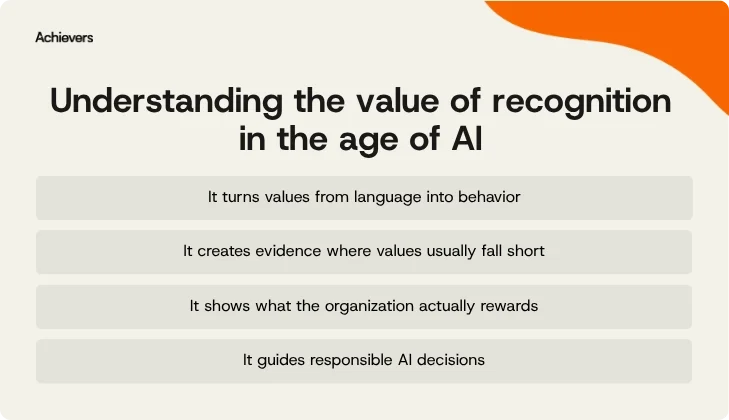
Values only matter if they shape behaviour. Recognition is one of the few mechanisms that makes that visible at scale. When people are recognised for specific actions that are clearly linked to stated values — consistently, and over time — values stop being abstract. They become observable patterns.
That matters even more in an AI context. Values guide what gets automated, what gets redesigned, and where human judgement still sits. If you can’t see values playing out in everyday work, you’re effectively flying blind while making decisions that affect jobs, trust, and identity.
There’s a gap here. And it isn’t theoretical. It’s measurable. The organisations that close it are better equipped to make sound calls under pressure.
Trust and transparency are not optional during AI change
One insight consistently cuts through the noise when leaders talk about responsible AI and transformation. Progress rarely hinges on a breakthrough model or a single system. More often, it hinges on communication — clear, early, and honest conversations with your workforce about what’s changing and why.
You see the same pattern across very different organisational contexts. Uncertainty without communication creates disengagement. Most leaders know this. And yet many still hesitate to speak until every detail is locked down.
The problem is that silence doesn’t stay empty.
During periods of transformation, people watch closely. They look for signals. Are we still valued? Is our work still relevant? Are we being told the truth?
Recognition is one of the clearest signals you have available. It shows people they are seen while change is happening around them. It reinforces contribution as roles shift. It helps anchor identity when work is being redefined.
That’s what makes recognition a trust mechanism, not a morale booster. When leaders treat it as optional during transformation, they shouldn’t be surprised when trust erodes — quietly and quickly.
Human capability is being talked around, not built
There’s a tension that comes up quickly when leaders talk honestly about responsible AI.
You see AI uplift roles everywhere. Centres of excellence. Product owners. Specialists. Entire operating models built around accelerating capability on the technology side. But there are far fewer roles — or systems — focused on lifting human capability at scale.
And yet, there’s broad agreement on what matters more than ever. Judgement. Critical thinking. Communication. Collaboration. Curiosity.
The challenge is that very few organisations have a clear answer for how those capabilities actually get built, reinforced, and sustained across thousands of people.
This is where behaviour matters more than intent.
People don’t develop capability through strategy statements. They develop it by practising behaviours that get noticed and reinforced. Recognition, when used deliberately, does exactly that. It shows people what good looks like — not once, but repeatedly. Over time, it shapes norms.
If you want more curiosity, you need to recognise curiosity. If you want better judgement, you need to call it out when it shows up. If you want collaboration to survive automation, you need to make it visible.
This isn’t about being nice. It’s about designing a culture of recognition on purpose, rather than hoping it emerges on its own.
The “should we” question is being skipped
There’s one framing that tends to linger when leaders reflect on responsible AI.
You’re usually very good at asking “can we?” and “how do we?” when it comes to AI. Far fewer leaders consistently ask “should we?” — and even fewer do it in a structured way that carries real accountability.
Some organisations are starting to address this through formal ethics assessments: scored frameworks that deliberately gate work before it proceeds. They’re not perfect. They do slow things down. And that’s the point.
The parallel for workforce decisions is uncomfortable, but hard to ignore.
When you automate work, redesign roles, or restructure teams, are you assessing the likely impact on trust and culture before you act? Or are you waiting to see what happens to engagement and attrition after the fact?
Recognition and engagement data are early signals — complementing model metrics, audits, and controls by showing how people respond while change is still underway. They show how people are responding while change is happening — not months later. Used well, they help you anticipate consequences instead of reacting to damage once it’s already done.
That’s a conversation worth having at senior tables. Responsible leadership isn’t only about ethics frameworks and guardrails. It’s about whether you’re willing to look directly at the human impact of your decisions before momentum takes over.
Many organisations now use formal impact or ethics assessments to gate AI work before it proceeds — mapping risk, measuring impact, and deciding what mitigation looks like before momentum takes over.
What stays with you
What stands out most isn’t disagreement. It’s alignment.
Leaders already know that the hardest part of AI transformation isn’t the systems. It’s trust. It’s culture. It’s the experience people have while work is being reshaped around them.
They also know they don’t have great signals.
That’s where recognition sits — right at the centre of the gap. It makes values visible. It reinforces the capabilities organisations say they want. It builds trust when certainty is low. And it gives leaders a live view of what’s really happening, not just what gets reported later.
AI will change how work gets done. Responsible AI leadership determines whether people feel discarded or supported along the way.
The organisations that handle this well won’t be the ones with the most advanced tools. They’ll be the ones that pay attention, speak clearly, and recognise what matters — consistently and at scale.
Responsible AI FAQs
Key insights
- Responsible AI is less about the sophistication of the technology and more about the intent, signals, and choices leaders make as work changes.
- Trust, culture, and human capability can’t be managed after the fact — they need real‑time signals, with recognition acting as critical infrastructure, not a nice‑to‑have.
- Organisations that succeed with responsible AI are the ones that communicate early, measure what matters, and deliberately reinforce the behaviours they want to see.