Table of contents
Create a culture that means business™
Schedule a demo with an Achievers solution expert today.


 Copy URL
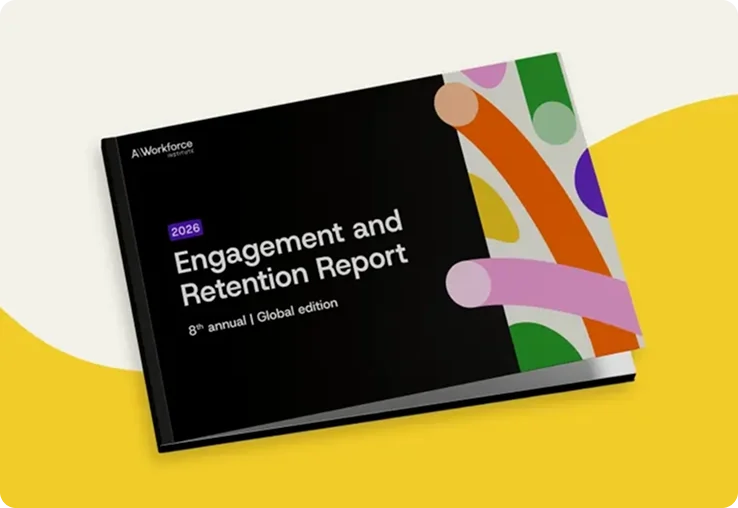
The employee engagement statistics that matter most in 2026 point to the same underlying issue: too many employees don’t feel connected enough to their work or workplace to commit for the long term. According to Achievers Workforce Institute’s (AWI’s) 2026 Engagement and Retention Report, current job-seeking behavior alone puts U.S. employers on track to absorb over $1 trillion in turnover costs next year if nothing changes.
For leaders, that makes appreciation, connection, and growth key places to look when identifying where engagement is breaking down and what needs attention within the organization.
What are employee engagement statistics?
Employee engagement statistics are data points that measure how employees feel about their work, their leaders, and their organization and how those feelings show up in behavior. They quantify levels of commitment, motivation, connection, and intent to stay, turning what can feel like a “culture problem” into something leaders can actually see, track, and act on.
These statistics typically come from employee surveys and original workforce research from sources like Achievers Workforce Institute, which captures how employees experience appreciation, growth, connection, purpose, and leadership at work.
21 employee engagement statistics leaders should know in 2026
About the research: The employee engagement statistics below come from two annual AWI research studies, each featuring proprietary data. The 2026 Engagement and Retention Report is based on responses from 2,500 employees and 1,500 HR professionals across eight global markets. The 2026 State of Recognition Report is based on a global survey of 3,000 employees.
Engagement and appreciation statistics
1. Only 26% of employees are engaged at work
Low engagement is a workforce-wide issue, not a problem limited to a small group of employees. When roughly three-quarters of employees fall outside the highly engaged group, organizations have significant room to improve the everyday experiences that shape commitment to work.
2. Just 25% of employees feel appreciated at work
Appreciation is directly associated with engagement, connection, belonging, career growth, and retention. That makes feeling appreciated an important indicator of the overall health of the employee experience.
3. With weekly recognition, employees are 3.1x more likely to be engaged at work
Recognition continues to be one of the most overlooked engagement drivers. AWI research shows that weekly recognition can directly improve engagement rates within an organization.
Engagement and retention statistics
4. 34% of employees plan to look for a new job
With one-third of employees planning to job hunt, retention risk is already present in the workforce. Employees looking for work also report lower engagement, appreciation, belonging, growth, and connection, making job-seeking intent an important signal of larger employee experience gaps.
5. Only 25% of employees envision a long-term career with their employer
Long-term commitment is weak when only one in four employees can picture a future with their current organization. Employers need to give employees reasons to stay before they enter the job market, particularly through appreciation, growth, connection, and meaningful work.
6. Employees who feel appreciated are 17x more likely to envision a long-term career
Appreciation has a strong relationship with long-term career intent. Employees are more likely to see a future where they feel their efforts are seen and valued by their managers and their colleagues.
Engagement and development statistics
7. Only 22% of employees feel they have access to growth opportunities
Limited career growth is both an engagement and retention problem. Employees without growth opportunities are more inclined to look for work, while those with opportunities to develop are more likely to see a long-term future with their employer.
8. Employees with development opportunities are 2.5x more engaged
Career development and engagement are closely connected. Employees who can build their skills and progress within the organization have more reason to invest in the work they are doing now and consider a future there.
9. Only 23% of employees feel they have the resources they need to do their best work
Employees cannot consistently perform at their best when they lack the resources needed to do their jobs, making access to tools and support an essential part of the engagement experience.
Engagement and manager impact statistics
10. Only 19% of employees feel connected to their manager
Manager connection is a significant engagement gap. Employees with strong manager connections also report higher appreciation, engagement, belonging, development opportunities, and long-term career intent.
11. Recognition from managers makes employees 2.8x more likely to feel connected
Manager recognition is strongly associated with employee-manager connection. Employees who receive regular appreciation from their manager also report more coaching, development support, and help connecting their work to the broader organization.
Engagement and employee connection statistics
12. Only 25% of employees feel their work is meaningful
Meaningful work depends on more than understanding an organization’s mission. Employees also need to see how their contribution matters and how it connects to the larger goals and values of the business.
13. Employees who feel appreciated are 56x more likely to feel connected to their organization
Connection is one of the strongest predictors of engagement, and recognition is the fastest way to build employee connection. Through recognition, employees see which of their efforts and behaviors reflect what the organization values, which leads to repetition.
14. 75% of employees feel overlooked at work
Three-quarters of the workforce feels overlooked, and that sense of invisibility directly undermines engagement, trust, and motivation. When staff don’t feel seen or aren’t acknowledged for doing good work, they don’t stay engaged for long.
Global employee engagement statistics
15. 32% of employees in North America feel most engaged when their skills are developing
Skill development is a clear engagement opportunity in North America. When employees can build capabilities and see progress in their careers, development becomes part of the engagement experience.
16. Only 23% of surveyed employees in EMEA report feeling very engaged at work
Low engagement in EMEA reinforces the need to connect employee experience initiatives to practical outcomes like regional staff retention, development, and performance.
17. 18% of surveyed employees in APAC feel very engaged at work
APAC’s low engagement rate can’t be treated as a single regional challenge. Expectations around hierarchy, public recognition, fairness, and individual versus collective acknowledgement vary by market, so engagement practices need to reflect how staff prefer to be recognized locally instead of applying one global approach.
Engagement statistics by industry
18. 19% of healthcare workers strongly agree they’re very engaged in the workplace
Low engagement in healthcare sits alongside persistent workforce pressures, including burnout, long hours, staffing shortages, and disconnection between frontline employees and leadership.
For healthcare employers, engagement depends on whether busy, often deskless employees feel their contribution is visible and valued while they manage demanding patient-care roles.
19. 20% of manufacturing workers report feeling very engaged at work
Manufacturing engagement has to account for the realities of frontline work. Employees may have limited access to workplace technology while organizations are also focused on safety, skills development, productivity, and retention, making consistent recognition and communication across shifts and locations especially important.
20. 26% of financial services employees strongly agree they are very engaged
Financial services has the highest engagement rate compared to the healthcare, manufacturing, and professional services industries. For staff in financial services, sustained engagement depends on feeling supported and valued consistently, not just rewarded for performance.
21. 23% of employees in the professional services industry strongly agree they’re very engaged
In professional services, employee experience and client success are closely connected because employees themselves deliver the expertise and relationships that clients expect. With only 23% strongly agreeing they are engaged, firms have room to strengthen how contribution and client impact are recognized across project-based teams.
Why do employee engagement statistics matter now?
Employee engagement statistics matter now they show how employees experience work, from feeling appreciated and connected to their managers to seeing opportunities for growth and a long-term future with their employer. Together, they help employers identify which parts of the employee experience are supporting engagement and which need attention.
What are the factors impacting today’s employee engagement statistics?
1. Recognition frequency and quality
Recognition impacts staff engagement most when it is frequent, specific, and connected to employees’ actual contributions. In the 2026 State of Recognition Report, employees who receive weekly recognition are 3.1x more likely to be engaged at work, while just 17% of employees currently receive recognition every week. The frequency gap matters because recognition delivered close to the work can reinforce the behaviors, priorities, and contributions an organization wants employees to repeat.
2. Growth and skill development
Growth opportunities give employees a clearer reason to invest in both their current work and their future with the business. Development becomes especially important as roles change, with proprietary AWI research showing that 39% of employees say learning new skills as AI becomes more integrated is a contribution they want recognized, making skill building both a development and visibility issue.
3. Manager support and recognition
Managers influence engagement through the signals they provide about performance, priorities, and progress. Yet original data from the State of Recognition Report found that only 19% of employees surveyed say they receive regular, meaningful recognition from their manager.
The same percentage also say that receiving coaching helps them perform better. Recognition, coaching, and development should be treated as connected parts of the manager experience instead of separate practices.
4. AI, clarity, and change at work
AI is becoming an engagement factor because adoption is moving faster than employee confidence and clarity. Only 19% of employees feel confident using new AI tools, 18% feel supported in adapting to AI and technology changes, and 18% have access to AI-enabled training, according to research from AWI’s 2026 State of Recognition Report.
When it comes to engagement in the workplace, introducing new technology is only one part of the process. Employees also need the skills, guidance, and reinforcement to understand how their work is changing.
Achievers is the source for the latest workforce engagement statistics
Achievers delivers the latest in workforce and staff engagement statistics and trends, helping organizations understand what employees experience at work and what employers can do about it.
Through proprietary research from the Achievers Workforce Institute (AWI), we study how recognition, growth, connection, and other workplace experiences relate to how employees engage with their work and organizations.
That research turns employee voices into current workforce engagement statistics and benchmarks leaders can use to understand what’s changing, where employees need more support, and which experiences deserve greater attention. The same workforce science helps shape the Achievers platform, turning what we learn about employees into insights that inform how we build and innovate for the workforce.
Employee engagement statistics FAQs
Key insights
- Employee engagement statistics are most useful when read together. Engagement, appreciation, growth, manager connection, and retention measure different parts of the employee experience, providing a clearer picture of where engagement is breaking down.
- The most valuable engagement statistics show what organizations can influence. Measures such as recognition frequency, development opportunities, and manager connection shift the focus from how engaged employees are to which workplace experiences can be improved.
- 2026 global employee engagement statistics reveal meaningful differences across regions and industries. Priorities range from skill development in North America to engagement challenges in APAC and the distinct realities of frontline healthcare and manufacturing work.