Table of contents
Create a culture that means business™
Schedule a demo with an Achievers solution expert today.


 Copy URL
Today’s employee recognition trends are making one thing clear: people want more than a paycheck and the occasional thanks. They want to be seen, regularly, specifically, and in ways that actually reflect the impact they’re making.
But most aren’t. Research from the 2026 State of Employee Recognition Report shows that only 17% of employees say they’re recognized weekly. And when recognition fades, so does everything else: engagement, trust, and the desire to stay. The good news? Employees who receive meaningful weekly recognition are 9x more likely to feel a strong sense of belonging, and more than twice as likely to be performing at their best.
Recognition, when it’s done right, is how leading organizations strengthen culture, reinforce what matters, and drive results from the inside out.
Here’s what’s shifting in 2026, and how to turn the latest employee recognition trends into action.
8 trends in employee recognition for 2026
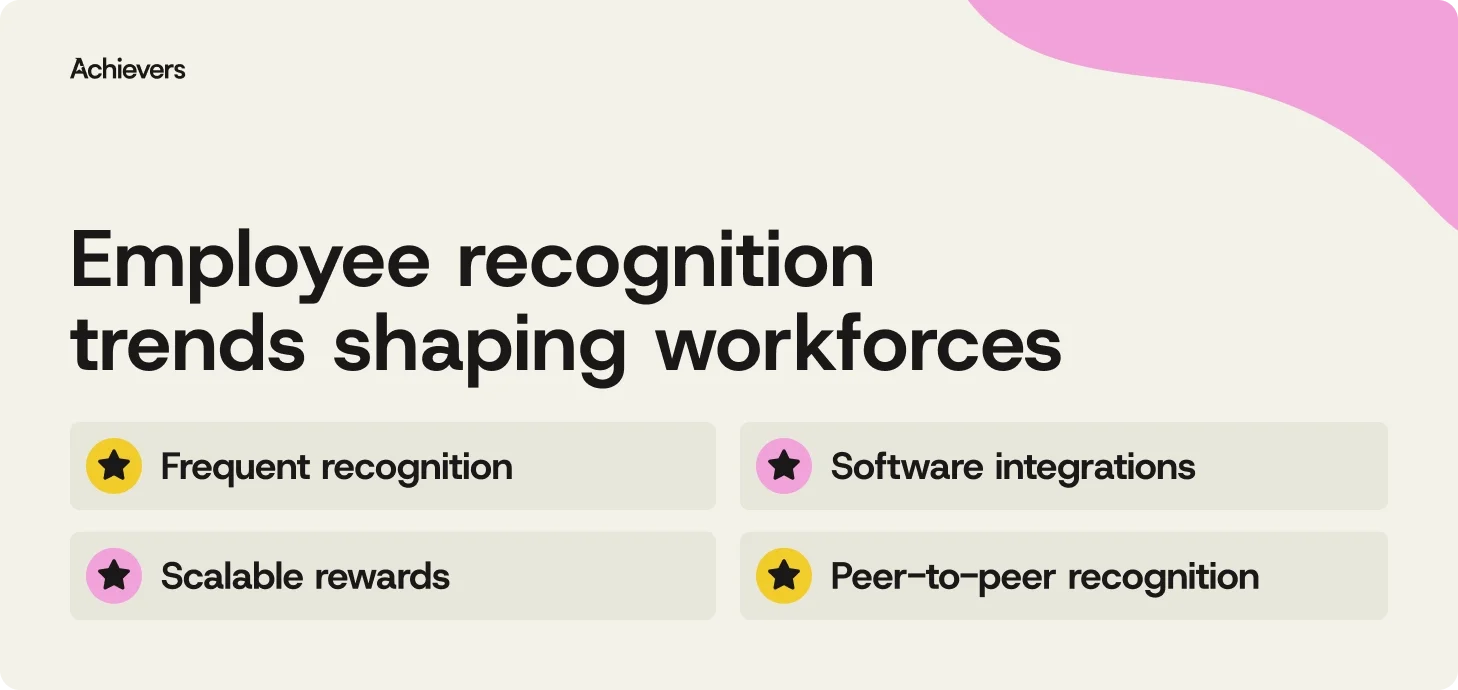
1. Frequent employee recognition
Annual reviews aren’t the moment of impact they used to be, and employees aren’t waiting around for praise. In 2026, regular recognition is the expectation, not the exception.
But it’s not just about the big wins. More companies are leaning into micro-recognition, celebrating everyday contributions, quick wins, and progress in real time. These smaller moments add up, reinforcing a culture where appreciation is always visible.
Research from the State of Recognition Report, from Achievers Workforce Institute (AWI), says employees who are recognized on a weekly basis are 2.6x more likely to be their most productive selves at work.
The best part? Frequent recognition doesn’t have to be complicated. Organizations are:
- Adding shoutouts to weekly team meetings
- Encouraging quick recognition through Slack, Teams, or email
- Building habits with manager prompts and mobile-friendly tools
2. Personal and purposeful recognition
A vague “great job” doesn’t land the way it used to. Employees want to know what they did well and why it mattered. Specific, thoughtful recognition reinforces the behaviors you want more of and makes it more likely they’ll happen again.
To build the habit of meaningful recognition:
- Train managers to tie praise to company core values, team goals, or outcomes
- Share examples of strong recognition moments
- Encourage a “what, why, impact” approach in every shoutout
3. Integrating recognition into tech stacks
One of the biggest shifts? Recognition isn’t living off to the side anymore. It’s happening in the apps people already use, without extra clicks or logins. When recognition is a part of how employees work and the programs they use, it becomes second nature.
Leading companies are:
- Integrating recognition into tools like Zoom, Slack, and Microsoft Teams
- Offering one-click mobile access to recognize on the go
- Making recognition feel less like a task and more like part of the culture
4. Offering scalable, personalized rewards
A branded mug might work for some. For others, it ends up in the back of a drawer. In 2026, rewards are personal, and that’s the point.
Here’s how to offer scalable, personalized rewards:
- When employees choose how they’re rewarded, the moment carries more meaning. Leading platforms are:
- Offering global marketplaces with millions of options (company swag is just the beginning)
- Supporting local and lifestyle-friendly redemptions
- Giving employees the freedom to choose their preferred reward, whether it’s a gift card, experience, or donation
Personalized rewards also help support remote and global teams, giving employees the flexibility to choose what’s meaningful, no matter where they’re working.
5. Adopting an accessible employee recognition platform
If recognition only works for your office workers, it doesn’t work at all. Modern programs are built for everyone, across devices, locations, and languages.
That means looking for a platform with:
- Mobile-first recognition capabilities that reach every worker, wherever they are
- Multilingual interfaces to support global teams
- Dashboards and reporting that track reach, usage, and impact
When recognition is truly accessible, it supports everyone, including the frontline and deskless workers who often get left out of traditional programs.
6. Peer-to-peer recognition
Peer recognition builds connection, boosts morale, and reinforces shared values across teams. In fact, research found that employees who are regularly recognized by their peers are are 33% more likely to feel a sense of belonging compared to employees who are not.
To build a culture of peer-powered appreciation:
- Open up recognition access to every employee
- Encourage team-based shoutouts and wins
- Spotlight peer moments publicly to build momentum
7. Promoting the company’s employee recognition program
Even the best recognition program needs a little spotlight. If employees don’t know where to find it, or why it matters, engagement suffers.
The fix? Treat your program like an internal campaign. According to AWI research, recognition frequency correlates directly with performance, retention, and belonging. but only when employees actually use the platform.
The most effective companies:
- Share regular updates on recognition trends, program milestones, and impact
- Spotlight recognition moments publicly; in town halls, newsletters, and on a digital platform
- Run challenges or campaigns that drive participation (think “most recognitions this month”)
- Equip leaders with talking points and templates so they can lead by example
- Recognize efforts around wellness, mental health, and work-life balance, showing employees that care is part of the culture
Because when recognition is visible, it’s more likely to be repeated. And when leadership models the behavior, others follow.
8. Using recognition data to drive decisions
Leading organizations track recognition frequency and sources (manager vs peer), compare trends across demographics and teams, and share insights with leaders to inform talent strategies. In fact, according to AWI’s 2026 Engagement and Retention Report, employees who feel appreciated are 17x more likely to see a long-term career at their company, making recognition data essential for engagement and retention efforts.
To make data actionable:
- Track recognition frequency and sources (manager vs. peer)
- Compare trends across departments, demographics, and time periods
- Share insights with leaders to inform culture and talent strategies
Future trends in employee engagement technology
1. AI in employee engagement technology
Instead of replacing human interaction, AI is helping employees engage more consistently by making it easier to recognize peers, and it helps leaders understand employee sentiment and engagement data. Research from the 2026 State of Employee Recognition Report shows 14% of employees say AI tools make recognition easier for managers or peers, suggesting early momentum.
Adoption also depends on how AI is introduced. According to IBM, employees adopt new business structures 34% more often when engagement is built into transformation. Looking ahead, AI is likely to play a behind‑the‑scenes role, helping engagement happen more often and with less friction.
2. Analytics and data as engagement signals
Engagement data, such as recognition activity and feedback patterns, helps organizations understand how employees experience work over time. This information provides insight into connection, participation, and engagement levels across teams and roles.
As analytics become easier to interpret, engagement data is going to be used regularly to communicate decisions related to culture, performance, and retention, instead of serving only as a reporting tool at set intervals.
3. Employee development through ongoing engagement
Employee development is becoming a stronger focus as employees look to build new skills and keep up with how roles are changing. Growth is no longer limited to training programs or review cycles. Recognition and feedback can highlight strengths, skills, and contributions as they happen, helping employees better understand how they’re growing through their day‑to‑day work.
As this shift continues, development is likely to feel more ongoing and visible. Engagement technology will increasingly support this by helping employees and leaders see progress over time, supporting development conversations and decisions throughout the year instead of relying only on formal reviews.
4. Wellbeing and psychological safety at work
Wellbeing and psychological safety are becoming more important as employees pay closer attention to how supported they feel at work. Feeling recognized and appreciated plays a big role in that, with 24% of employees saying recognition would help boost confidence during change, according to AWI research.
Looking ahead, engagement technology is likely to be used more deliberately to reinforce wellbeing through regular, everyday interactions. Recognition and feedback will help organizations spot early signs of stress or disengagement and reinforce positive behaviors that build trust and inclusion. Over time, these tools will play a larger role in shaping how supported and psychologically safe employees feel as part of their normal work experience
5. Continuous feedback and engagement
Feedback is becoming more frequent as employees look for clarity and direction while work is happening. Engagement technology helps to share recognition and feedback in the moment, helping employees understand what’s working and where they’re having impact.
Feedback is likely to feel more natural and ongoing. Engagement software tools will continue to support regular, lightweight feedback throughout the year, helping teams stay aligned as priorities change. Over time, feedback becomes part of everyday work, rather than something reserved for formal review cycles.
The platform built for today’s employee recognition trends
These trends reflect how recognition is actually evolving in the workplace. And putting them into practice takes the right tools.
Achievers is built for exactly that. Every part of the platform is designed to support what today’s employees expect: frequent recognition, meaningful rewards, and experiences that feel personal, not transactional.
With Achievers, you get:
- Seamless integrations with tools like Workday, Teams, and Slack, so recognition fits into the flow of work
- Manager nudges and built-in campaigns that help make appreciation a habit
- A global rewards marketplace with millions of options, so everyone finds something that matters to them
- Real-time insights to track what’s making a positive impact and what needs improving
It’s recognition that connects people to purpose and helps shape the culture you’re working toward, one moment of appreciation at a time.
Bring recognition trends to life in your organization
The trends shaping employee recognition in 2026 are about creating workplaces where people feel seen, supported, and connected to something bigger. When recognition is consistent, personal, and easy to give, it drives more than just morale. It drives performance, trust, and long-term loyalty.
The good news? You don’t have to tackle it alone. Whether you’re just getting started or looking to level up your current program, Achievers gives you the tools, insights, and support to build a recognition culture that sticks.

Employee recognition trends FAQs
Key insights
- Employees expect frequent, meaningful recognition, with weekly praise driving higher engagement and belonging.
- Recognition works best when it’s specific, integrated into workflows, and personalized.
- Recognition programs succeed when they’re inclusive, visible, and easy to access for everyone.