Table of contents
Create a culture that means business™
Schedule a demo with an Achievers solution expert today.


 Copy URL
Employee motivation is the fuel that powers performance, and for mid‑market organizations, there’s less room for wasted spend or guesswork. When teams are lean and budgets are closely watched, betting on the wrong motivators doesn’t just slow momentum. It also hits results, retention, and ROI.
Here’s the tricky part: motivation comes with an expiration date. What inspires your people today could feel stale tomorrow. For mid‑market leaders already juggling growth, change, and limited resources, slipping engagement is more than a warning sign — it’s a risk they can’t afford to ignore. Gallup recently found that employee engagement in the U.S. has slipped to just 31% — proof that momentum can fizzle fast if organizations don’t keep pace.
What is employee motivation?
Employee motivation is the commitment, energy, and creativity people bring to their work each day — and in mid‑market organizations, it directly determines how well teams perform — their productivity and performance — and how well they adapt and grow, without adding headcount.
The good news? Motivation isn’t random. It can be nurtured through the a combination of support and recognition. Raises and promotions matter, but teams rely just as much on flexible work, visible development, and everyday recognition — because they need motivation strategies that scale as the business grows.
8 strategies to improve employee motivation
Motivated employees are more engaged, more productive, and more likely to stay. The good news? Motivation isn’t guesswork. With the right mix of recognition, growth, and well-being, mid‑market organizations can create a work environment where employees feel valued — without overloading lean HR and people teams.
Let’s dive into the strategies designed to set you up for success:
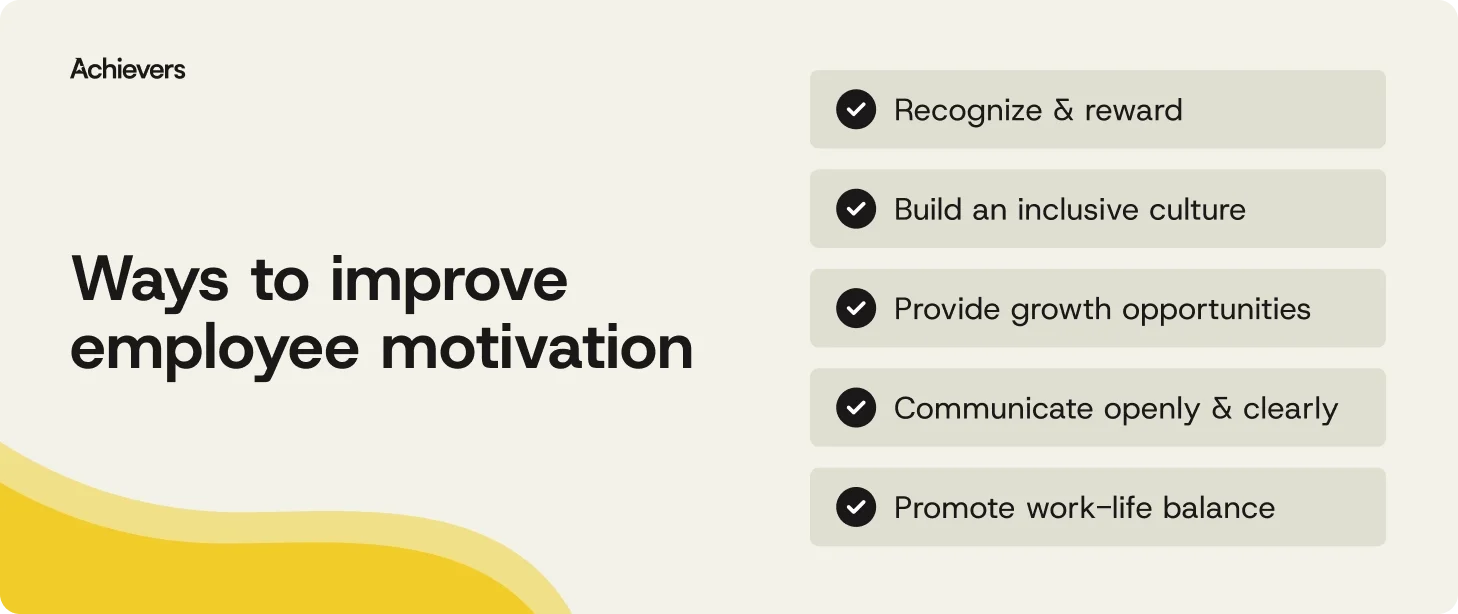
1. Recognize and reward often
One of the most powerful ways to motivate employees is through recognition. When people feel appreciated, they’re more engaged, more productive, and more likely to stay. For mid‑market organizations, the best programs make recognition easy and frequent — without adding admin work — through peer‑to‑peer recognition, manager tools, and rewards employees actually use.
According to Achievers Workforce Institute’s (AWI) State of Recognition Report, employees who are recognized at least once a month are three times more likely to trust their managers and two and a half times more likely to see them as effective leaders. Recognition builds trust, strengthens performance, and creates the kind of work environment where people want to give their best.
And if recognition only happens at review time? That’s not motivation — that’s paperwork.
2. Build a positive and inclusive culture
Company culture has a bigger impact on employee motivation than most leaders realize. A workplace built on trust, respect, and belonging gives people a reason to stay engaged and bring their best. When employees see how their work connects to company purpose, motivation naturally follows.
Recognition strengthens that culture. Public appreciation ties everyday actions to company values and shows employees they’re part of something bigger. Peer-to-peer recognition takes it further, creating a ripple effect that boosts motivation across teams.
But if culture only shows up in a mission statement on the wall, it’s not culture — it’s wallpaper.
3. Provide opportunities for growth
Nothing motivates employees faster than knowing their organization is invested in their future — even when budgets and teams are lean. When people see a clear path to build skills and move forward, they’re more engaged, more motivated, and less likely to scan the job boards on their lunch break.
And growth doesn’t always require a big budget. Mentorship, cross-functional projects, and short, targeted training can have just as much impact as pricey courses. The real motivator is knowing the company is serious about employee development — not just paying lip service in a handbook.
4. Communicate openly and clearly
Nothing undermines motivation faster than unclear communication. Employees need to know what’s expected of them, how their work connects to company goals, and where they stand. Clarity builds confidence — and confidence fuels motivation.
But communication isn’t a once-a-quarter town hall. It’s regular check-ins, open dialogue, and feedback that flows both ways. Tools like pulse surveys and Voice of Employee platforms help leaders listen, prioritize, and act quickly — without long approval cycles or complex change management.
If communication only travels one way — from the top down — it’s not really communication. It’s a monologue. And nobody’s motivated to stick around for that.
5. Promote work-life balance and well-being
Burnout and motivation don’t mix. Employees who feel stretched too thin are less engaged, less productive, and less likely to stay. Flex schedules, wellness benefits, and mental health support send a clear message: your people come first.
Balance doesn’t have to mean radical policy changes. It can be as straightforward as flexible schedules, realistic workloads, or access to wellness programs. The goal is to create a work environment where employees can bring energy to their jobs instead of running on empty.
6. Empower employees with autonomy
Micromanagement is a fast track to disengagement. Employees are more motivated when they have ownership of their work, the freedom to make decisions, and the trust of their leaders. Autonomy builds accountability and gives people the space to perform at their best.
The tricky part? Autonomy doesn’t mean managers disappear. Coaching, support, and clear guardrails keep employees confident without feeling abandoned. Think of it this way: managers should be spotters at the gym — there when needed, but not grabbing the bar every five seconds.
7. Offer meaningful incentives
Sure, standard benefits like health coverage and retirement plans are important, but they’re often expected rather than inspiring. People are more motivated when rewards feel personal, not generic.
That could mean implementing incentive programs like wellness stipends, flexible perks, or personalized rewards employees can actually use. The key is aligning incentives with what people value most. Otherwise, you’re handing out rewards no one asked for — which isn’t motivation, it’s noise.
8. Address employee concerns and act on feedback
Motivation fades quickly when employees don’t feel heard. But listening alone isn’t enough. Acting on that feedback is what really builds trust and keeps employees motivated.
In mid‑market organizations, closing the loop builds trust fast — and trust is often the difference between retaining talent and restarting the hiring process.
Key aspects of employee motivation
Intrinsic motivation
Intrinsic motivation is the drive employees get from doing work that feels meaningful — whether it’s solving a tough problem, hitting a personal milestone, or contributing to a team win. It’s the kind of motivation that sticks, even without a bonus attached.
Extrinsic motivation
Extrinsic motivation is powered by outside factors like recognition, rewards, or incentives. A timely thank-you or a points-based reward can go a long way. Skip it, and rewards quickly turn into just another line in the budget.
The link between motivation and engagement
The link between motivation and engagement is simple: motivation explains why employees act, and engagement shows how they follow through. Think of motivation as the spark, and engagement as the steady flame that keeps the work moving forward.
The impact of employee motivation on business outcomes
Employee motivation drives the outcomes mid‑market leaders care about most: stronger performance, faster execution, and lower turnover without increasing costs. Recognition is one of the most powerful motivators, and numbers back it up. According to AWI’s State of Recognition Report:
- Employees recognized weekly are 9x more likely to feel a strong sense of belonging
- They’re 6x more likely to see a long-term future with their company
- And they’re 2.6x more likely to be highly productive
Recognition also works like a health check for your workplace. When it drops off, engagement and trust usually do too — and that’s when retention risk starts climbing.
Achievers helps organizations turn everyday recognition into measurable outcomes, with the scale of an enterprise solution and the simplicity mid‑sized teams need.
- 2x the recognition frequency of other providers
- 5x greater impact on engagement and retention with high adoption
- A rewards marketplace with 3M+ options across 190 countries
- AI-powered insights that link recognition directly to business outcomes
Drive employee motivation and success with Achievers
When employees feel genuinely motivated, they bring more energy, creativity, and collaboration to their work; and that momentum carries the business forward.
That’s where Achievers comes in for organizations ready to grow without adding complexity. By making recognition part of everyday workflows, offering rewards that actually resonate, and delivering real-time insights, we help leaders nurture motivation in ways that last. The result? A culture where employees feel seen, heard, and supported every single day.
Employee motivation FAQs
Key insights
- Frequent recognition drives trust, engagement, and performance
- Motivation grows in inclusive, people-centered cultures
- Recognition directly boosts retention and productivity