Employee recognition success stories: 4 real-world examples from leading global organisations
Insights from the Harvard Business Review Analytic Services Report.
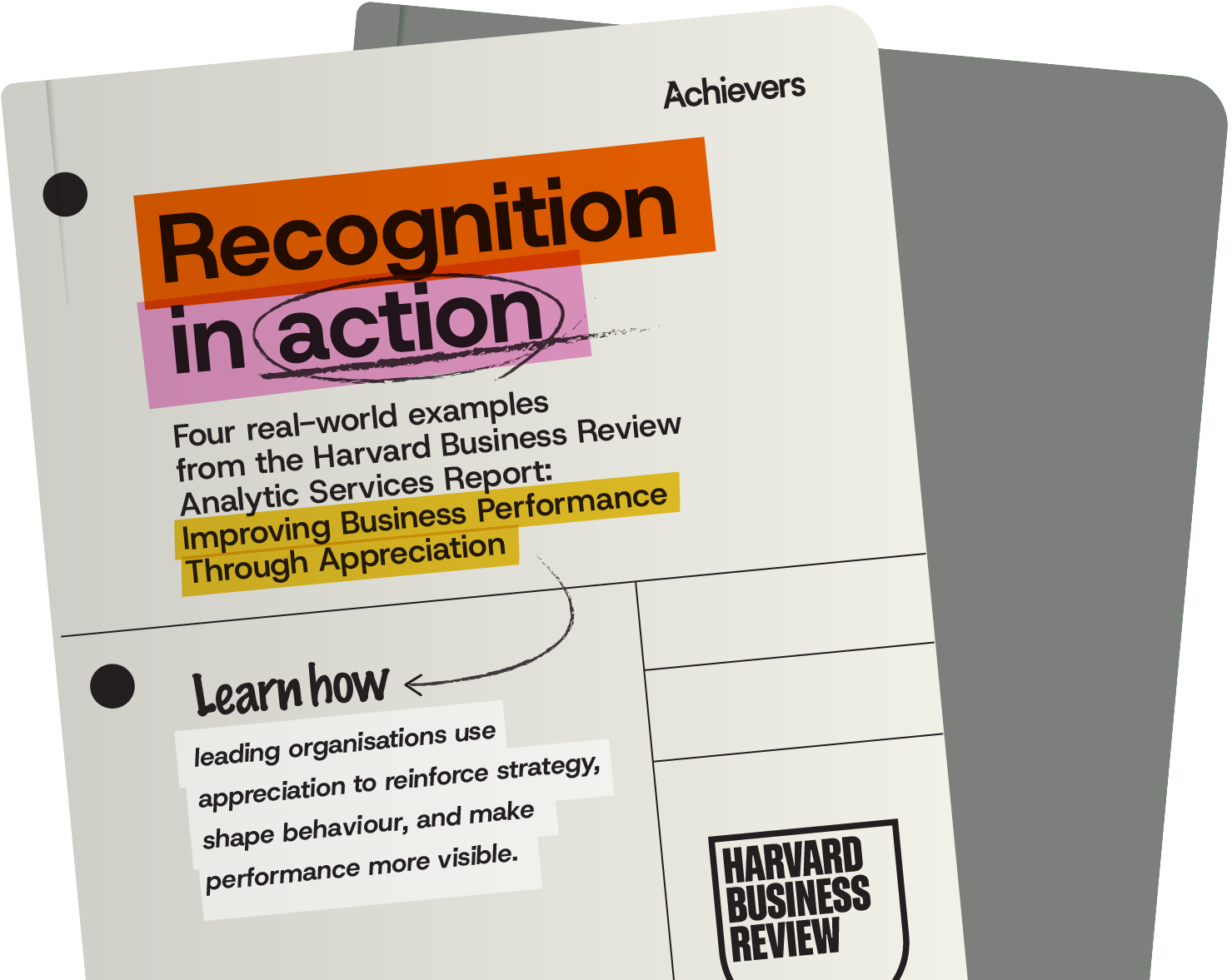
Learn how leading organisations use appreciation to reinforce strategy, shape behaviour, and make performance more visible.
About these employee recognition case studies
The four customer stories in this collection are based on interviews conducted with Achievers customers as part of the research process that informed the Harvard Business Review Analytic Services Report: Improving Business Performance Through Appreciation.
This report combines survey findings from 566 business leaders and practitioners with perspectives from executives and organisations using recognition strategically to support business performance. Workday, General Motors, Coles, and Kyndryl shared real-world examples that helped illustrate themes emerging from the research, including behaviour change, organisational alignment, employee engagement, technology adoption and performance visibility.
Employee recognition success stories backed by Harvard Business Review research
The stories that follow are expanded narratives inspired by those research conversations. While the report features each organisation as an illustrative example within the broader findings, this collection provides more room to explore how recognition is applied in practice.
How leading companies use employee recognition to improve business performance
- Workday: Using employee recognition to accelerate AI adoption
- General Motors: Aligning 160,000 employees with one recognition strategy
- Coles: Driving frontline engagement through recognition
- Kyndryl: Improving performance visibility with employee recognition
Together, the stories show appreciation operating as more than an employee experience initiative. It can also reinforce desired behaviours, clarify priorities, and support progress toward business goals.
For the complete research findings, download Improving Business Performance Through Appreciation from Harvard Business Review Analytic Services.
Employee recognition for AI adoption: Workday success story
How Workday uses employee recognition to encourage AI adoption
Every organisation wants employees to embrace new technology. The harder part is turning a strategic priority into something people actually do every day.
That challenge is especially relevant with artificial intelligence. Organisations can provide tools and training, but access alone does not establish new habits. Employees also need clear signals about which actions matter, what responsible adoption looks like and how new ways of working connect to business priorities.
The Harvard Business Review Analytic Services research found that 88% of leader organisations design their reward and recognition programmes to drive specific employee behaviours. Workday offers a practical example of that idea in action.
Using recognition to drive AI adoption and employee behaviour change
Workday has an ongoing “Everyday AI” initiative that encourages employees to use AI tools to become more productive. To support the initiative, the organisation introduced an “Everyday AI” category in its recognition platform, alongside a category for innovation. Recognition shared through the platform is tagged to a behaviour Workday has identified as strategically important.
That connection gives the strategy a visible presence in day-to-day work. Instead of AI adoption living only in leadership messages or training materials, employees can see examples of colleagues using new tools and contributing to the initiative. Recognition helps show what the priority looks like when it moves from intention to action.
How visible recognition reinforces strategic priorities
The report describes recognition as a kind of compass: a system that can direct attention, time, and energy toward what matters. At Workday, behaviour-based categories give employees a shared language for connecting appreciation to strategy.
The approach also makes strategically important contributions more visible across the organisation. Recognition can highlight experimentation, innovation, and productive uses of technology when those actions occur, creating a stream of concrete examples rather than relying on abstract instructions alone.
How employee recognition data improves performance visibility
Workday has also established a two-way integration between its recognition platform and its HR system. The integration resulted in a 70% year-on-year increase in the volume of employee feedback available to managers in the HR platform.
That additional feedback gives managers more visibility into accomplishments and contributions. Recognition is not only reinforcing behaviour in the moment. It is also creating a richer record of how work is happening across the organisation.
Key takeaways: Employee recognition and AI transformation
Workday demonstrates how recognition can support transformation by connecting a business priority to everyday employee behaviour. The “Everyday AI” category provides a practical way to celebrate adoption, make desired actions visible and keep the strategy present in the flow of work.
For organisations navigating AI-enabled change, the lesson is simple: a priority becomes more tangible when employees can see the behaviours behind it being recognised in real time.
Employee recognition for organisational alignment: General Motors success story
How General Motors unified 60+ employee recognition programmes
In a large organisation, recognition can multiply quickly. So can the messages it sends.
Different teams may celebrate different accomplishments. Local programmes may evolve independently. Over time, employees can encounter dozens of approaches that each point toward a slightly different version of what matters.
General Motors faced that challenge at scale. The company replaced more than 60 fragmented local recognition programmes with one cohesive approach for its workforce of approximately 160,000 employees.
The challenges of fragmented employee recognition programmes
Multiple recognition programmes can create many opportunities to celebrate employees, but they can also make organisational priorities less consistent. If one programme emphasises innovation, another service and another operational excellence, the workforce may receive competing signals about the behaviours the organisation most wants to reinforce.
The HBR Analytic Services research found a clear difference in programme design: 88% of leader organisations agree that their recognition program is designed to drive specific employee behaviours, compared with 28% of laggard organisations. The distinction is not simply how much recognition happens. It is how deliberately recognition is connected to strategy.
How a unified recognition programme improves organisational alignment
By moving to a single approach, GM created a common structure for recognition across the enterprise. A unified programme gives employees a more consistent view of the values and behaviours being celebrated, regardless of business unit or location.
That consistency matters in an organisation where people work across functions, geographies and teams. Recognition can translate broad priorities into visible examples of everyday action. When the system is unified, those examples are more likely to point in the same direction.
Using employee recognition during onboarding and new hire engagement
GM also uses recognition during onboarding. The company introduced a welcome-to-the-team card so leaders can share encouraging messages within a new employee’s first week. In a hybrid workforce, that early acknowledgement can help new hires feel integrated, valued and connected from the beginning.
The example reinforces a broader theme from the research: appreciation is most effective when it is timely, frequent and meaningful. It does not need to wait for a major milestone. It can begin with the first moments of the employee experience.
Key takeaways: Recognition as a driver of organisational alignment
GM’s consolidation illustrates how recognition can support alignment at enterprise scale. Replacing fragmented programmes with one approach does more than simplify administration. It creates a shared mechanism for showing employees which behaviours and priorities matter across the organisation.
For complex organisations, clarity is a performance advantage. Recognition can help create that clarity when every message reinforces the same direction.
Employee recognition for frontline employee engagement: Coles success story
How Coles achieved 3 million employee recognitions and 95% participation
Keeping employees connected is challenging in any organisation. It becomes even more complex when much of the workforce is spread across locations and rarely sits behind a desk.
Australian supermarket chain Coles has approximately 115,000 employees. Individual stores can feel like separate businesses, which makes shared culture and connection especially important.
Coles achieved 95% active participation on its recognition platform. Within 12 months of launch, the organisation reached one million recognitions. It has since recorded more than three million.
How employee recognition connects a distributed frontline workforce
A recognition platform creates another way to reach employees who are not deskbound. Appreciation shared in one location can become visible beyond that immediate store, helping individual contributions connect to the broader organisation.
Each recognition also carries information. It can show how employees are helping customers, supporting colleagues, or living company values. Across a distributed workforce, those examples provide a steady stream of stories about what good work looks like.
Why high employee recognition participation drives engagement
At 95% active participation, recognition is not limited to a small group of managers or employees. It becomes part of how the organisation communicates and reinforces culture.
The volume matters because repeated visibility can turn isolated moments of thanks into a shared organisational conversation. Employees see contributions from across the business, while recognition travels beyond the team or store where it originated.
The research found that leader organisations are more likely than laggards to report improvements in collaboration, productivity, customer experience and innovation or problem-solving. Coles provides an organisational example of the connection and visibility that can help recognition support those kinds of outcomes.
How reward choice improves employee recognition programme adoption
Coles employees can choose how to redeem the recognition points they earn. The most commonly selected reward is a Coles gift card. The element of choice matters: a reward that could once be perceived as benefiting the company is received differently when employees actively select it from a range of options.
That detail reflects another advantage of dedicated recognition technology. Among organisations using a platform, 41% cite the ability for employees to select the rewards most appealing to them as a benefit.
Key takeaways: Recognition for frontline engagement and connection
Coles shows how recognition can become more than a reward mechanism. At scale, it can create visibility, connect employees across locations and provide a shared channel for reinforcing culture.
More than three million recognitions represent millions of visible examples of contribution. For a frontline workforce, that can make the wider organisation feel closer and everyday work feel more connected to collective success.
Employee recognition for performance visibility and manager effectiveness: Kyndryl success story
How Kyndryl uses employee recognition to improve manager effectiveness and performance visibility
Recognition is often viewed through the employee experience lens. Kyndryl’s experience adds another dimension: recognition can also create useful insight for managers and the organisation.
Kyndryl intentionally ties its recognition programme to behaviours that drive business strategy and help the company serve customers. Improved engagement is a positive outcome, but the programme’s purpose is broader: reinforce the actions the organisation wants to see repeated.
Aligning employee recognition with business strategy
The approach reflects one of the report’s strongest themes. Recognition has greater strategic value when it is linked to specific behaviours and business priorities, rather than operating as a separate culture initiative.
At Kyndryl, appreciation helps employees see which actions support the company’s direction. The positive employee experience and the business signal work together: people feel recognised while the organisation reinforces the behaviours that matter.
How employee recognition improves visibility into employee contributions
Kyndryl’s recognition platform integrates with its HR system so recognition feedback automatically appears in the employee feedback section of the HR platform. Achievements shared through recognition become more visible to managers and can contribute additional context during talent and performance conversations.
That visibility helps address a familiar challenge. Managers do not always see every contribution, particularly when work crosses teams and functions. Recognition can capture examples of collaboration, customer impact and achievement closer to the moment they occur.
The connection between manager recognition habits and employee engagement
Kyndryl combined employee engagement survey data with recognition platform data and identified a potential relationship between manager recognition activity and engagement. Managers in the top 25% of recognition givers had higher engagement scores than managers in the bottom quartile. The organisation continues to monitor the trend.
The finding does not establish causation, but it offers a useful line of sight into how recognition behaviour and manager experience may move together. Leaders who recognise frequently also create more visibility into contributions across their teams.
Using employee recognition data to support performance conversations
Traditional performance information often centers on goals, formal feedback and manager observation. Recognition adds another source of context by recording contributions throughout the year. It can surface work that might otherwise be overlooked or forgotten by the time formal reviews occur.
For organisations seeking a more complete view of how work gets done, that additional layer of feedback can be valuable. It makes achievement more visible and helps managers connect everyday contributions to broader business priorities.
Key takeaways: Using employee recognition to improve manager effectiveness and performance visibility
Kyndryl demonstrates that recognition creates value in more than one direction. Employees receive appreciation, managers gain greater visibility and the organisation builds a richer picture of the behaviours supporting performance.
When recognition becomes part of the performance ecosystem, appreciation and insight reinforce each other.
About the research: Improving business performance through appreciation
Harvard Business Review Analytic Services surveyed 566 members of the Harvard Business Review audience in March and April 2026. Respondents qualified to participate if they had knowledge of their organisation’s reward and recognition programme and how it influences business performance.
The report combines the quantitative survey with perspectives from business executives, organisational leaders and subject-matter experts. It examines the execution gap between recognition’s perceived importance and its effectiveness, the role of strategic programme design, the business improvements organisations report and the ways technology can support frequent, meaningful appreciation.
The four narratives in this collection expand on organisational examples featured in the report. They are intended as a companion to the research, not as standalone case studies or independent evaluations of company performance.
Get the complete findings
After reading these four real-world stories, get the full Harvard Business Review Analytic Services report, sponsored by Achievers, for the data and perspectives behind these stories. Download your copy now.