Table of contents
Create a culture that means business™
Schedule a demo with an Achievers solution expert today.


 Copy URL
Employee perks in Singapore used to be fairly predictable. Pantry snacks. Company swag. Maybe a team lunch if targets were met.
Today, employee perks are expected to do far more.
Across Singapore, employees are thinking more critically about what work should feel like—and they’re increasingly prepared to leave when it doesn’t meet expectations. According to the Achievers Workforce Institute’s 2026 Engagement and Retention Report — APAC edition, only 15% of employees in Singapore feel appreciated at work, just 21% find their work meaningful, and fewer than one in five see a long‑term career with their employer. When appreciation is missing, engagement fades — and retention risk rises quickly.
That’s where employee perks come in. Not as symbolic extras, but as everyday signals of value.
When designed well, employee perks reinforce recognition, support well-being, and help employees feel connected to their work and organisation. When designed poorly, they feel superficial — noticed once, then dismissed.
Let’s focus on the employee perks that actually make a difference in Singapore workplaces.
What are employee perks?
Employee perks are the rewards, benefits, and experiences organisations offer beyond base pay and core benefits. But the most effective employee perks go well beyond occasional incentives or novelty items.
At their best, employee perks answer a simple but powerful question for employees: “Do you see my contribution—and do you value it fairly?”
When that answer is clear, perks stop feeling transactional and start shaping the employee experience in meaningful ways. In Singapore, modern employee perks are designed to:
- Recognise consistent effort and contribution, not just standout wins
- Support well-being, flexibility, and sustainable performance
- Reinforce organisational values through credible behaviours
- Improve how work feels day to day, not just at milestone moments
In other words, employee perks aren’t about adding fun for fun’s sake. They’re about creating an environment where people feel respected, supported, and appreciated — consistently, not occasionally.
Why employee perks matter more than ever in Singapore
Employee expectations have shifted—and so has the way organisations need to show value.
In Singapore, competitive pay and strong benefits are often assumed. What differentiates employers today is how often effort is recognised, whether well-being is genuinely supported, and if appreciation feels timely, fair, and credible.
Employee perks now play a critical role in turning appreciation into something employees can actually feel — not just hear during annual reviews. When perks reinforce recognition and are embedded into everyday work, they don’t just improve sentiment — they influence behaviour, motivation, and retention.
AWI research shows that when employees feel appreciated, they are significantly more likely to feel engaged and to see a future with their organisation. In Singapore’s competitive talent market, organisations can’t rely on compensation alone to retain high performers.
Employee perks help close the gap between effort and recognition—making appreciation visible, consistent, and real.
Best employee perks at a glance
With so many employee perks to choose from, it helps to focus on what consistently delivers impact. The most effective perks in Singapore share a common thread: they are practical, fair, and clearly linked to real contribution.
Here’s a snapshot of employee perks that matter most for Singapore organisations:
- Points‑based recognition programs: Allow employees to earn rewards for meaningful contributions and choose what matters most to them, combining recognition with fairness and flexibility.
- Peer‑to‑peer recognition: Enable colleagues to recognise one another’s efforts, strengthening trust and reinforcing appreciation beyond hierarchy.
- Manager spot awards: Give leaders the ability to recognise great work in the moment, reinforcing credibility by linking recognition directly to performance.
- Flexible working arrangements: Provide autonomy over when work happens, supporting well-being while maintaining accountability.
- Hybrid or remote work options: Reflect modern ways of working and help organisations remain competitive in attracting talent.
- Benefits navigation support: Make existing benefits easier to understand and use, increasing their perceived value.
- Learning and development stipends: Support continuous skill development aligned to both employee and business goals.
- Internal mobility opportunities: Make career growth visible internally so employees don’t need to leave to progress.
- Employee resource groups (ERGs): Create structured spaces for belonging and advocacy, supported with time and leadership backing.
- Experiential and lifestyle rewards: Offer meaningful experiences rather than generic items, reinforcing appreciation without excess.
32 employee perks powering culture and performance at work in Singapore
Today, employee perks play a critical role in supporting performance, retention, and culture across Singapore organisations. They don’t need to be flashy—just relevant, fair, and aligned to real work.
The right perks send a clear message: your contribution matters here. And in Singapore’s high‑performance environment, that message is what keeps employees motivated, committed, and willing to go the extra mile—especially during periods of change or pressure.
Here are 32 employee perks that help reinforce that message in ways employees genuinely feel.
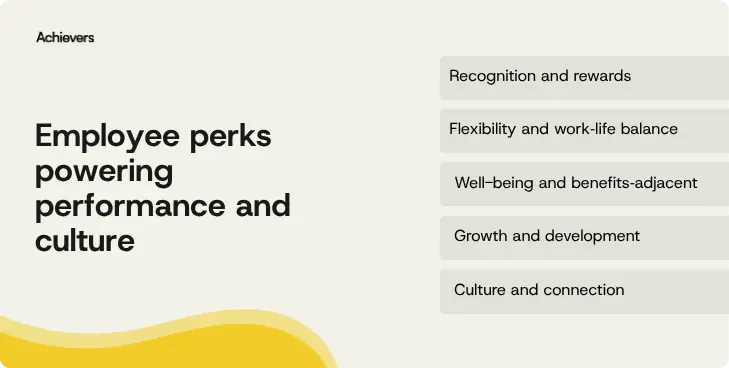
Recognition and rewards employee perks
Not all recognition‑led perks deliver the same impact. In Singapore, the most effective ones focus on credibility, fairness, and timing — who can give recognition, when it happens, and how clearly it connects to real contribution.
1. Points‑based recognition programs
Points‑based recognition allows employees to earn rewards for meaningful contributions and choose how they redeem them. This balance of recognition and choice supports fairness and personal relevance.
2. Peer‑to‑peer recognition
Peer recognition enables colleagues to acknowledge everyday effort that managers may not always see, reinforcing shared responsibility for appreciation.
3. Manager spot awards
Spot awards allow managers to recognise strong performance in the moment, strengthening trust by linking recognition directly to action.
4. Values‑based recognition
Values‑based recognition ties rewards to behaviours that reflect organisational priorities, helping employees see how expectations translate into action.
5. Personalised service milestone recognition
Personalised milestones recognise long‑term contribution and growth, reinforcing loyalty without relying on generic gestures.
6. Team‑based recognition
Team recognition rewards collective effort, reflecting how success is often achieved in Singapore’s collaborative work environments.
7. Celebration budgets for managers
Manager‑controlled budgets enable timely, authentic recognition without unnecessary bureaucracy.
8. Recognition tied to performance check‑ins
Embedding recognition into regular check‑ins ensures appreciation is ongoing and grounded in real performance.
Flexibility and work‑life employee perks
In Singapore’s high‑performance work culture, flexibility isn’t about doing less—it’s about working sustainably. With long hours and pressure still common, employee perks that give people greater control over how work fits into their lives play a critical role in preventing burnout and supporting consistent performance.
Well‑designed flexibility perks signal trust, respect, and realism about modern work demands.
9. Flexible working arrangements
Flexible schedules allow employees to adjust when they work to better manage personal responsibilities, commute demands, or peak productivity hours—without compromising accountability.
10. Hybrid or remote work options
Hybrid and remote options give employees greater autonomy over where work happens, helping organisations remain competitive in attracting talent while supporting focus and well-being.
11. Compressed work weeks or flexible leave options
Compressed schedules or alternative leave arrangements provide recovery time without disrupting output, helping employees sustain performance during demanding periods.
12. Meeting‑free focus time
Meeting‑free blocks protect uninterrupted time for deep work, reducing overload and signalling that productivity is measured by outcomes, not meeting volume.
13. Paid volunteer leave
Paid volunteer leave allows employees to support causes they care about during work hours, reinforcing purpose and social responsibility without penalising performance.
14. Caregiver support perks
Caregiver‑focused perks provide flexibility, resources, or financial support for employees managing eldercare or family responsibilities — helping retain experienced talent through life transitions.
15. Time‑off recovery after peak periods
Time‑off recovery perks recognise sustained effort after intense delivery cycles, allowing teams to reset before fatigue affects performance or engagement.
Benefits‑adjacent employee perks
Benefits‑adjacent employee perks extend the value of traditional benefits by making well-being, security, and growth easier to access in everyday life. In Singapore, where core benefits are often expected, these perks differentiate the employee experience by reducing friction and increasing perceived value.
16. Mental health support stipends
Mental health stipends help employees access counselling, therapy, or well-being tools discreetly — reinforcing that well-being is taken seriously, not treated as a talking point.
17. Benefits navigation or concierge services
Benefits navigation services help employees understand and use existing benefits more effectively, increasing uptake and reducing confusion.
18. Preventive health incentives
Preventive incentives encourage proactive care such as screenings or health checks, supporting long‑term well-being and reducing future health risks.
19. Financial well-being coaching
Financial coaching provides guidance on budgeting, savings, and long‑term planning — helping reduce financial stress, a common but often hidden driver of disengagement.
20. Education or tuition assistance
Education support helps employees pursue learning aligned to business and personal goals, reinforcing investment beyond their current role.
21. Retirement planning support
Retirement planning perks provide clarity and confidence around long‑term financial security, reinforcing organisational commitment to employees’ futures.
Growth and development employee perks
In Singapore’s competitive talent market, career growth is one of the strongest drivers of retention. Growth and development perks show employees that advancement is possible without leaving—and that skill development is recognised, not taken for granted.
22. Learning and development stipends
Learning stipends give employees flexibility to pursue relevant courses, certifications, or conferences—supporting continuous upskilling in a fast‑changing economy.
23. Certification reimbursement
Certification reimbursement supports role‑relevant skills development, building confidence and capability while aligning learning to business needs.
24. Mentorship programs
Mentorship programs connect employees with experienced leaders or peers, accelerating development and strengthening cross‑level relationships.
25. Internal mobility or gig opportunities
Internal gigs allow employees to explore new skills and projects without leaving the organisation, making growth visible and accessible.
26. Career pathing tools
Career pathing tools help employees understand potential progression routes, replacing ambiguity with clarity about what’s next.
27. Recognition for skill development
Recognising learning progress — not just outcomes — reinforces a growth mindset and shows that development efforts are valued.
Culture and connection employee perks
Culture and connection perks focus on how people experience work together, not just individual rewards. In Singapore’s diverse and fast‑paced workplaces, these perks help strengthen belonging, trust, and shared purpose.
28. Onboarding buddy programs
Onboarding buddies help new hires integrate quickly, improving early engagement and reducing time‑to‑productivity.
29. Purpose‑driven team initiatives
Purpose‑led initiatives focus on meaningful connection or contribution, avoiding forced fun while building authentic relationships.
30. Employee resource groups (with time to participate)
ERGs support inclusion, advocacy, and community — especially when employees are given time and leadership support to participate meaningfully.
31. Recognition rituals in team meetings
Recognition rituals embed appreciation into everyday work rhythms, normalising gratitude and reinforcing positive behaviours.
32. Experiential and lifestyle rewards
Experiential rewards—such as learning experiences, travel, or shared activities—create lasting memories and emotional connection beyond transactional rewards.
What the best employee perks programs have in common in Singapore
In Singapore, the most effective employee perks programs aren’t about flash or novelty. They’re practical, credible, and closely aligned to what employees value in a high‑performance, fast‑moving work environment.
Strong programs share a few defining characteristics:
- Clear intent: Employees understand why perks exist and how they support performance, well-being, or growth
- Leadership credibility: Leaders actively use and model recognition, rather than delegating it entirely to HR
- Fairness and consistency: Perks feel equitable across roles, teams, and seniority levels
- Ease and accessibility: Perks are simple to use and embedded into everyday work
- Continuous improvement: Programs evolve based on data and employee input, not assumptions
In Singapore, trust matters. That’s why the strongest programs are shaped by real employee feedback, not guesswork. Regular pulse surveys, structured check‑ins, and clear follow‑through help organisations understand what’s working—and where expectations are shifting.
Key metrics organisations in Singapore often track include:
- Perk and recognition participation rates
- Employee sentiment or engagement scores tied to recognition
- Usage patterns across teams, functions, or locations
If perks feel generic, they lose credibility. If they’re difficult to access, they won’t be used. And if they aren’t informed by feedback, employees quickly disengage.
Employee perks vs. benefits: What’s the difference?
Employee benefits: The foundations
Benefits such as healthcare coverage, CPF contributions, and paid leave provide stability and security. In Singapore, these are often seen as table stakes—important, but expected.
Employee perks: The differentiators
Perks shape the everyday experience of work. Flexibility, recognition, well-being support, learning allowances, and lifestyle rewards influence how employees feel about their organisation—not just what they receive.
Why the distinction matters
Benefits help employees feel protected. Perks help employees feel valued. Organisations that balance both are more likely to build loyalty in a competitive talent market where employees have options.
Common employee perks mistakes to avoid
Even well‑intentioned employee perks programs can fall short when they’re treated as extras instead of signals. In Singapore, the issue is rarely effort—it’s relevance and follow‑through. When perks feel disconnected from real work, they quickly lose impact.
Treating perks as symbolic gestures
Perks that only appear during annual events or major milestones feel performative rather than meaningful. In a results‑driven culture, appreciation needs to be timely and credible to matter.
Designing perks without fairness in mind
Perks that favour office‑based or knowledge workers can unintentionally exclude frontline or operational teams. When access isn’t consistent, perks undermine trust rather than build it.
Assuming one size fits all
Singapore’s workforce is diverse across life stages and priorities. Generic rewards may be easy to roll out, but without choice or flexibility, they often miss the mark.
Over‑optimising for cost instead of impact
Employees are quick to recognise when perks are designed for savings rather than sincerity. What matters most isn’t the price tag—it’s whether a perk feels thoughtful, relevant, and tied to real contribution.
Avoiding these mistakes isn’t about doing more. It’s about focusing on consistency over ceremony, fairness over convenience, and relevance over optics—so perks genuinely reinforce value.
Shape your workforce with meaningful employee perks
Employee perks don’t need to be extravagant to be effective—especially in Singapore. What matters most is that they’re credible, accessible, and aligned with how people actually work. When perks reinforce recognition, support well-being, and reflect real employee priorities, they move from nice‑to‑have to meaningful.
Achievers helps organisations in Singapore design employee perks that do exactly that—embedding appreciation into everyday moments, supporting holistic well-being, and bringing values to life through consistent, visible action. The result is a more human, more effective employee experience where people feel recognised, supported, and genuinely valued.
Shape your workforce with Achievers.
Employee perks FAQs
Key insights
- Employee perks are most effective when they make appreciation part of everyday work, not just milestone moments.
- The most effective employee perks reinforce recognition, flexibility, and values rather than surface‑level incentives.
- Well‑designed employee perks shape how work feels and support engagement and retention across Singaorean workforces.