Table of contents
Create a culture that means business™
Schedule a demo with an Achievers solution expert today.


 Copy URL
Different types of employee rewards help reinforce key behaviors, boost engagement, and drive real business results.
The trouble is, many rewards programs fall flat. Generic catalogs. Limited choice. Markups and fees that chip away at perceived value. When rewards feel impersonal or inaccessible, they don’t make an impact on people or business performance.
The types of rewards your organization offers should be thoughtful and tied to what actually matters to your people. That means flexibility, local relevance, and a strategy that connects recognition to real outcomes.
What are employee rewards?
Employee rewards are monetary and non-monetary benefits given to employees to recognize contributions and milestones, reinforce desired workplace behaviors, and to motivate future performance. They can include cash bonuses, gift cards, merchandise, travel, experiences, lifestyle benefits, and points-based rewards that employees can choose and redeem based on their preferences.
Why do different types of employee rewards matter now?
Different types of employee rewards matter because employees value different rewards, and a one-size-fits-all approach often fails to motivate a diverse workforce.
In fact, in the latest State of Recognition Report from Achievers Workforce Institute, which surveyed 3,000 employees globally, they found that employees gravitate toward practical, flexible reward options, including:
- 39% prefer brand-specific gift cards
- 26% prefer merchandise
- 25% prefer general-use gift cards
- 20% prefer travel rewards
Reward preferences are shaped by individual needs, life stages, locations, and personal interests, making choice and flexibility essential to a successful and scalable reward and recognition strategy.
Who is impacted most by different types of employee rewards?
Different types of employee rewards impact all employees, but they matter most to:
- Global and distributed teams, where local preferences, purchasing power, and cultural expectations differ.
- Multigenerational workforces, where employees at different life stages may prioritize different reward options, from gift cards and company swag to unique travel experiences.
- Frontline and deskless employees, who may have different needs and reward preferences than office-based workers.
- High-performing and high-potential employees, where personalized rewards can reinforce exceptional contributions and encourage continued performance.
- Organizations undergoing change, where rewards can help reinforce positive behaviors, support new technology adoption, and keep engagement up during periods of change.
When do different types of employee rewards work or fail?
Different types of employee rewards work when they match employee preferences, reinforce a specific milestone or achievement, and are delivered alongside meaningful recognition. They fail when rewards feel generic, disconnected from performance, or aren’t personalized to the specific employee.
Where do different types of employee rewards show up in an organization?
Different types of employee rewards show up in several areas of an organization, including:
- Employee recognition programs, where points, gift cards, merchandise, and experiences reinforce everyday contributions and company values.
- Performance and incentive programs, where cash bonuses, sales incentives, and achievement-based rewards recognize results and goal attainment.
- Service awards and milestone programs, where rewards celebrate tenure, career achievements, and major life events.
- Learning and development initiatives, where rewards encourage training completion, skill-building, and professional growth.
- Benefits and total rewards programs, where organizations use rewards to increase awareness, participation, and engagement with broader employee offerings.
How do different types of employee rewards work in practice?
Different types of employee rewards work in practice by recognizing and applauding different employee behaviors, contributions, achievements, and milestones, using a mix of reward types rather than relying on a single incentive for every situation. For example, points-based rewards are often used for everyday recognition, while cash, travel, or premium rewards are used to recognize exceptional performance, major business results, or significant career milestones.
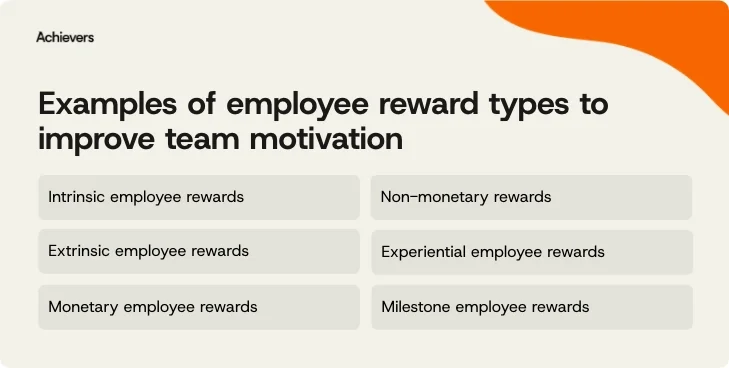
8 types of employee rewards to motivate teams
1. Intrinsic employee rewards
Intrinsic rewards are internal motivators that come from the work itself rather than from a tangible reward. They help employees feel a sense of accomplishment, purpose, growth, and pride in what they do. Because intrinsic rewards are tied to personal satisfaction, they can have a lasting impact on engagement and motivation.
Examples of intrinsic rewards:
- Feeling a sense of purpose in your work
- Developing new skills and capabilities
- Achieving a challenging goal
- Having autonomy over how work gets done
- Taking pride in a successful project or outcome
Benefits of intrinsic rewards:
- Encourage long-term motivation
- Support employee engagement and job satisfaction
- Reinforce a sense of purpose and personal growth
2. Extrinsic employee rewards
Extrinsic rewards are tangible incentives provided by an employer to recognize contributions, reinforce behaviors, or reward performance. Unlike intrinsic rewards, they come from an external source and often have a monetary or material value.
Examples of extrinsic rewards:
- Bonuses
- Gift cards
- Merchandise
- Travel rewards
- Promotions
- Salary increases
- Points-based rewards
Benefits of extrinsic rewards:
- Provides immediate reinforcement for desired behaviors
- Helps recognize accomplishments in a visible way
- Gives employees flexibility to choose rewards that are meaningful to them
3. Monetary employee rewards
Monetary employee rewards are financial incentives used to recognize great work, reward achievements, or motivate performance. Because they have immediate value, they’re often used to reinforce specific goals, accomplishments, or behaviors.
And though cash rewards are powerful, they’re not enough on their own. Combine them with meaningful, social recognition, and you’ve got a formula that motivates in the moment and builds long-term loyalty.
Examples of monetary rewards:
- Bonuses for hitting stretch goals or team targets
- Raises to recognize consistent high performance
Benefits of monetary rewards:
- Provide immediate recognition for results
- Help motivate goal achievement
- Reinforce high performance
4. Non-monetary rewards
Non-monetary employee rewards recognize employees without directly increasing their pay. These rewards often focus on personal growth, flexibility, wellbeing, or career development, helping employees feel valued beyond compensation.
Research from the latest Engagement and Retention Report found that lack of career progression is the #1 non-monetary reason employees consider leaving. Employees are looking for reasons to stay with their current company and grow in their roles.
Examples of non-monetary rewards:
- Extra PTO to recharge or celebrate personal wins
- Access to coaching, training, or new career opportunities
Benefits of non-monetary rewards:
- Support employee growth and development
- Improve work-life balance
- Increase engagement and job satisfaction
5. Experiential employee rewards
Experiential employee rewards give employees memorable experiences instead of cash or physical gifts. These rewards feel personal and can create lasting positive memories associated with recognition.
Examples of experiential rewards:
- Tickets to a concert or sports event
- All-expenses-paid retreat for top performers
- Weekend getaway booked through the Achievers Travel Store
- Team adventure experience, such as zip-lining or a cooking class
Benefits of experiential rewards:
- Create memorable recognition moments
- Support work-life enrichment
- Offer an alternative to traditional rewards
6. Milestone employee rewards
Milestone employee rewards celebrate important moments in an employee’s journey, from work anniversaries to major accomplishments. Recognizing these milestones helps employees feel appreciated for both their contributions and commitment.
Examples of milestone rewards:
- Custom gift or award for work anniversaries
- Thoughtful recognition tied to project outcomes or career growth
- Retirement gifts
- Career achievement awards
Benefits of milestone rewards
- Recognize long-term commitment
- Celebrate meaningful achievements
- Help employees feel valued and appreciated
7. Social employee rewards
Social employee rewards recognize employees publicly through appreciation, praise, or recognition from peers and leaders. While they may not have monetary value, they can have a significant impact on employee morale and belonging.
Social rewards are also good for retention: employees who are meaningfully recognized are 1.7x more likely to see a long-term career at their company, according to research from the 2026 State of Recognition Report.
Examples of social rewards:
- Peer recognition platforms or nomination programs
- Recognition in team meetings, newsletters, or internal channels
- Employee award nominations
Benefits of social rewards:
- Build a culture of appreciation
- Increase visibility for employee contributions
- Strengthen workplace relationships
8. Points-based employee rewards
Points-based employee rewards allow employees to earn points for achievements, contributions, or behaviors and redeem them for rewards they choose themselves. This flexibility makes points-based programs popular across diverse workforces.
Points-based rewards are personal, scalable, and constantly reinforcing the right behaviors.
Examples of points-based rewards:
- Tie points to core values like collaboration or innovation
- Learning or wellness challenge incentives
- Peer-nominated point rewards
- Redeeming points for gift cards, merchandise, travel, or charitable donations
Benefits of points-based rewards:
- Give employees meaningful choice
- Reinforce positive behaviors consistently
- Work across different roles, locations, and preferences
What are the best practices for employee rewards?
Employee rewards best practices include making rewards meaningful and impactful, with a plan that’s personal, timely, and tied to purpose.
Here’s how to make your rewards program actually work:
- Make rewards personal: Personal rewards are important because what excites one employee might land flat with another. Tap into what matters to each person, whether that’s time off, tech, or team recognition.
- Send timely recognitions: Make recognition timely, don’t wait until the next all-hands meeting. The closer the reward is to the moment, the more it reinforces the behavior.
- Tie rewards to something: Tie the type of reward to specific goals, values, or outcomes so it’s clear, consistent, and fair.
- Build R&R into your rhythm: Building recognition and rewards into your workplace rhythm makes recognition easier to give, instead of something people have to go out of their way to do. The best rewards software integrate seamlessly into the tools employees already use, like Slack, Teams, Outlook, or Zoom.
- Use your recognition data: Use your internal data to track engagement trends, reward redemption, and recognition frequency to see what’s resonating. Then tweak accordingly.
When your rewards are backed by real insights and tied to the right behaviors, they stop being perks and they start driving performance.
Making employee rewards work with your HR tech stack
To make all types of employee rewards work with your HR tech stack, you don’t need a dozen tools or a full-time admin team. When your recognition platform plays nicely with the rest of your workplace tools and software, everything runs smoother, from delivery to data to decision-making.
Here’s how smart integration can take your employee rewards strategy further:
Seamless integration into HRIS platforms
Seamless integration between the types of employee rewards you offer and your HRIS simplifies everything. No more manual uploads or disconnected systems, just one consistent, easy-to-use platform.
- Streamlined process: Performance incentives, milestone celebrations, and everyday recognition all in one place.
- Effortless data flow: Achievers syncs with top HR platforms like Workday to keep employee data consistent, save time, and cut down on admin work.
Automation for timely recognition
Automating timely recognition moments ensures your employees are celebrated when it matters most.
- Keep recognition frequent: With Achievers, employees receive recognition more than twice as often as with other platforms, keeping motivation high and engagement steady.
- AI that knows when and how: Our AI-powered insights surface the right moments to reward, so recognition always feels timely and relevant.
Data-driven decisions
Data-driven decisions don’t just reward effort; they learn from it. Achievers helps you turn data into insight, and insight into action.
- Real-time insights: Get a live look at employee engagement and recognition trends so you can adjust strategy on the fly.
- Smart strategy adjustments: With customizable dashboards and detailed reporting, it’s easy to spot what’s working and where to optimize.
Amplifying reach and consistency
Amplifying reach and consistency across all types of employee rewards is easier when recognition is integrated across your tech stack, so that no employee gets left out no matter where they are in the world.
- Covering all employees: Whether through our mobile app or integrations with tools like Microsoft Teams and Workday, Achievers helps you reach employees where they work.
- Consistency across locations: Our global rewards marketplace and localized delivery ensure a consistent, equitable experience with no hidden fees or markups.
- Aligning with company goals: AI-powered insights and customizable campaigns help you recognize behaviors that reflect your values and drive business outcomes.
How Marriott improved engagement and retention through personalized reward types
When the Calgary Marriott Hotel found itself managing multiple recognition programs across different departments, the result was an inconsistent employee experience that was difficult to track, measure, and scale.
To create a more unified approach, Marriott partnered with Achievers to combine its rewards and recognition initiatives into a single program tied to its S.P.I.R.I.T. values. Employees earned points for demonstrating key behaviors and could redeem them for rewards such as gift cards, merchandise, travel, and experiences.
The shift helped Marriott align recognition and rewards across the organization while making it easier for employees to participate in the program.
As a result, the hotel saw a 16% increase in employee engagement, a 15% increase in total rewards satisfaction, and tripled the number of suite upsells. Their success shows that employee rewards can improve engagement and business outcomes when employees can choose rewards that are meaningful to them and when recognition is tied to the behaviors and values an organization wants to reinforce.
Choose employee rewards that make an impact
Choosing the right types of employee rewards make an impact matter, because a random gift card or generic shout-out isn’t going to build the kind of company culture people stick around for. Real impact comes from rewards that are personal, well-timed, and tied to behaviors that drive your business forward.
The best rewards programs don’t rely on guesswork. They show up in the everyday tools, speak to what employees actually care about, and scale without losing meaning. They’re powered by data, rooted in strategy, and built to grow with you, not against you.
That’s where Achievers comes in. We help you turn everyday recognition into something bigger: behavior change, stronger culture, and results you can measure. Because when you reward what matters, your people bring more of that to the table day in and day out.
Types of employee rewards FAQs
Key insights
- The types of employee rewards offered should give employees meaningful choice, because reward preferences vary by role, location, life stage, and personal need.
- Different reward types serve different purposes, from reinforcing everyday behaviors to recognizing major achievements or contributions that increase sales, productivity, or customer satisfaction.
- Organizations see stronger engagement and business results when recognition is paired with meaningful rewards that employees value.