Table of contents
Create a culture that means business™
Schedule a demo with an Achievers solution expert today.


 Copy URL
Non-monetary rewards, like recognition, growth, and purpose, are the things that stick with people long after payday.
It’s also referred to as emotional salary. It’s the unseen, often unsung, side of compensation; the stuff that makes employees feel truly valued. And when that emotional salary is strong, so is your workforce. Higher engagement, stronger performance, better retention.
Why do non-monetary rewards matter now?
Non-monetary rewards matter now because employees remember meaningful recognition more than money alone. While only 11% of HR leaders say organizations commonly use non-monetary perks such as flexibility and time off, 44% of employees say their most meaningful recognition experience was specific and not monetary, according to 2026 research from Achievers Workforce Institute.
Pay will always matter. But compensation alone doesn’t explain why employees stay, grow, advocate for their employer, or go above and beyond. Recognition, connection, growth opportunities, and flexibility shape how valued they feel at work. When those experiences are missing, even competitive compensation struggles to engage employees long-term.
Employees still value financial recognition and reward choice. The lesson is that rewards and recognition aren’t competing investments. The organizations seeing the strongest outcomes combine both: meaningful recognition that reinforces the behavior and values they want to see, paired with rewards that employees can personalize through a flexible marketplace of experiences, gifting, travel, merchandise, charitable giving, and other options.
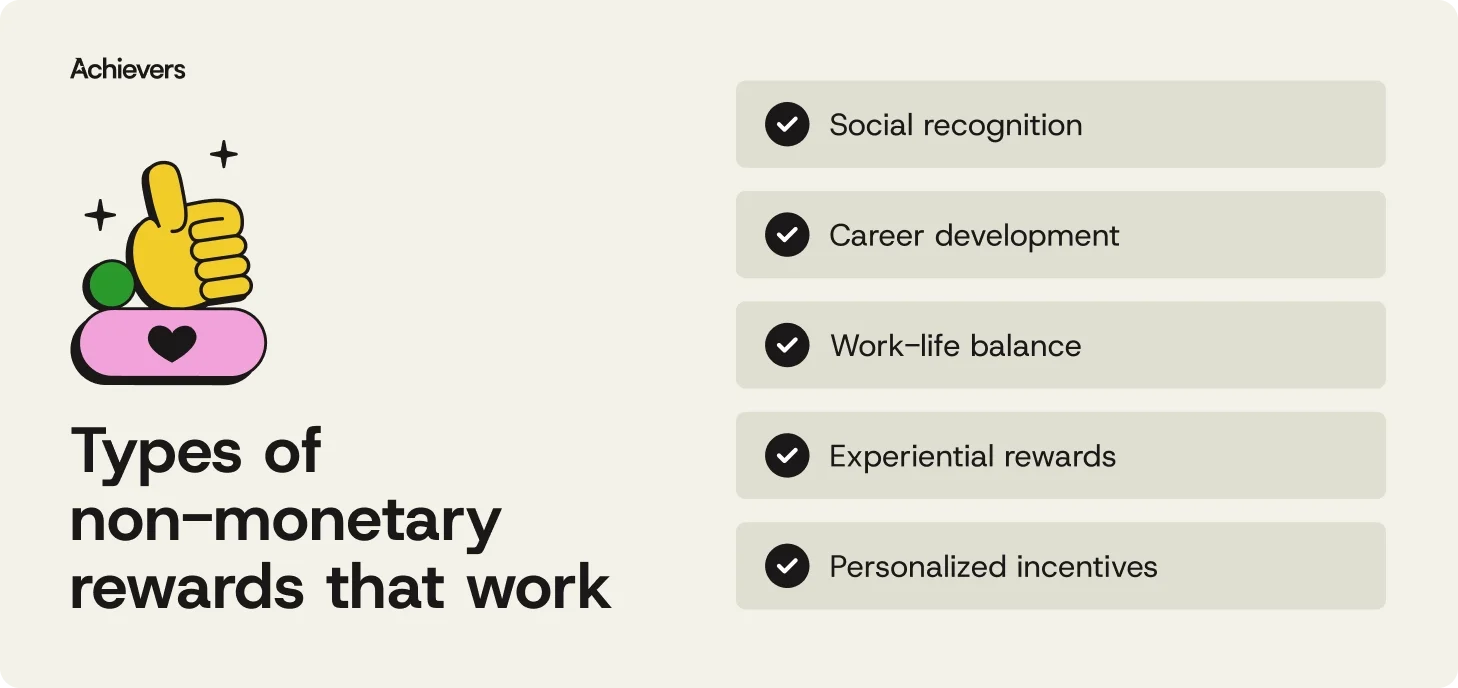
5 types of non-monetary rewards for employees
1. Social recognition
Social recognition strengthens connection because it helps employees feel seen by the people they work with every day. Whether it comes from a manager or a peer, recognition creates stronger relationships and reinforces the behaviors that build culture.
The impact is significant. Employees who receive weekly recognition are 4.2x more likely to feel included and 4.6x more likely to report strong coworker connections, according to the 2026 State of Recognition Report. Recognition is one of the strongest drivers of belonging in the workplace.
2. Career development opportunities
Career development is one of the most valuable non-monetary rewards because it shows employees you’re investing in their future.
Recognition and employee development are closely connected. Employees who receive weekly recognition are 11.7x more likely to receive coaching and 8.6x more likely to feel their manager supports their growth goals, according to the 2026 State of Recognition Report. When recognition becomes a regular leadership habit, development conversations happen more often and employees gain clearer pathways for growth.
3. Flexible work and work-life balance
Work-life balance remains one of the most effective non-monetary rewards companies can offer. Flexible schedules, wellness initiatives, extra time off, and support for personal priorities demonstrate trust and reinforce that employees are more than their job titles. Compared to employees who don’t feel appreciated or engaged, employees who do are 47x more likely to feel supported in their wellbeing, according to the 2026 Engagement and Retention Report.
Recognition plays an important role in how employees experience wellbeing at work.
4. Experiential rewards
Experiential rewards create lasting memories that employees connect to the recognition moment itself.
Employees value rewards that give them flexibility and choice. According to 2026 research from Achievers Workforce Institute, employees say access to a rewards marketplace helps shape behavior (30%) and supports retention (30%).
Travel, event tickets, team experiences, and unique activities often feel more personal than traditional merchandise because they’re tied to meaningful moments.
5. Personalized incentives: because one size never fits all
Personalized incentives are effective because employees don’t all value the same things. While one employee may appreciate a charitable donation, another may prefer a local gift card, travel experience, branded swag, or flexible reward option.
Organizations that give employees choice create recognition experiences that feel more relevant, memorable, and aligned with what employees genuinely value.
How can organizations improve non-monetary rewards for employees?
- Ask employees what feels meaningful: Use surveys, listening sessions, and program data to understand which rewards employees value and where current offerings fall short. Preferences may differ across roles, locations, and life stages, so assumptions are a poor substitute for employee input.
- Design for access, not just availability: A reward technically offered to everyone isn’t equitable if deskless employees can’t access it, workloads prevent people from using it, or approval processes create barriers. Review participation across employee groups to identify who may be left out.
- Remove unnecessary friction: Employees are less likely to use rewards that require complicated nominations, multiple approvals, or unclear eligibility rules. Make the experience simple enough to fit naturally into the workday.
- Give managers clear guardrails: Define when non-monetary rewards are appropriate, what behaviors they should reinforce, and how managers can apply them consistently. The goal is not to script every interaction. It is to prevent access from depending on who someone reports to.
Success story: How GM put recognition in the driver’s seat
When General Motors set out to reimagine employee recognition, they weren’t looking for a paint job — they needed a full-on rebuild. Employees were asking for more transparency, more appreciation, and more rewards that actually meant something. So GM hit the gas and partnered with Achievers.
Together, we rolled out a global platform that made real-time, peer-to-peer recognition not just possible — but easy and engaging. In the first month alone, 87% of employees jumped on board, sending 80,000 recognitions across the company. Turns out, when you make it simple to say “thank you,” people do it. A lot.
Since launch, 90% of GM’s workforce has continued to engage monthly, including 80% of managers — proving that recognition isn’t just a nice-to-have, it’s a cultural shift. And it’s one that stuck.
With a recognition program that reaches 67,000 employees across 26 countries, GM introduced a mix of personalized rewards and non-monetary moments that matter. Employees now have the power to turn appreciation into something meaningful, whether that’s a reward that speaks to their interests or simply the satisfaction of being seen.
The result? A more connected workforce, a culture of appreciation, and employees who feel like they truly belong. GM’s story is proof that recognition, when done right, drives engagement, culture, loyalty, and belonging.
Achievers makes non-monetary rewards go the distance
Bonuses are nice, but if you want to build a culture where employees feel truly valued, non-monetary rewards are where the real magic happens.
That’s where Achievers comes in. Our platform makes it easy to deliver real-time social recognition and offer flexible, personalized rewards that are meaningful to employees, all in a way that scales across your workforce. Whether it’s a peer-to-peer shoutout or a personalized reward from our global marketplace, Achievers helps companies make appreciation a daily habit.
Non-monetary rewards FAQs
Key insights
- Employees value meaningful recognition more than organizations realize, though many organizations are underinvesting in the experiences employees find most memorable.
- The effectiveness of a non-monetary reward depends more on relevance than cost. Employees respond best to rewards that feel meaningful to them and connected to their contributions.
- Recognition creates the moment of appreciation, while flexible reward options allow employees to personalize that experience.