Table of contents
Create a culture that means business™
Schedule a demo with an Achievers solution expert today.


 Copy URL
Let’s be direct: many workplaces in Singapore are running efficiently — but not always sustainably.
Pay is often competitive. Benefits are generally in place. Yet engagement and connection tell a different story. According to the 2026 Engagement and Retention Report — APAC edition, only 15% of employees in Singapore feel appreciated at work, and just 21% say their work feels meaningful.
That gap isn’t cosmetic. It’s consequential.
When effort goes unrecognised, motivation fades quietly. People still deliver. Targets are still met. But discretionary effort, innovation, and long‑term commitment start to thin out. Some employees stay because the role is stable or convenient. Others stay because leaving feels risky. Very few stay because they feel genuinely valued.
In a market defined by high expectations and constant pressure to perform, that’s a risk organisations can’t afford to ignore.
This is where employee incentive programs matter — not as perks, but as performance infrastructure. Singapore’s Ministry of Manpower continues to emphasise the importance of progressive workplace practices that support engagement, performance, and retention.
When employee incentive programs are designed well, they reinforce the behaviours that keep organisations moving forward. When designed poorly, they become background noise that no one pays attention to.
So let’s focus on what actually works.
What are employee incentive programs?
Employee incentive programs are structured ways to recognise and motivate employees for the behaviours that matter most to the organisation. They go beyond base pay and benefits to reinforce performance, contribution, and alignment.
At their core, effective incentive programs connect three things:
- What the organisation is trying to achieve
- How employees contribute day to day
- Why those contributions matter
In the past, many organisations in Singapore relied heavily on annual bonuses, commissions, or service‑based awards. These still have a place — but on their own, they’re no longer sufficient.
Modern incentive programs are more continuous and more human — and go beyond a pay check. They often include:
- Peer and social recognition
- Points‑based rewards with real choice
- Learning and development incentives
- Well-being and lifestyle rewards
- Experiences employees actually value
This approach aligns with Singapore’s tripartite guidance on fair and progressive employment practices. The most effective programs don’t sit on the side. They’re embedded into daily work, making recognition feel natural rather than transactional.
Why employee incentive programs matter in Singapore
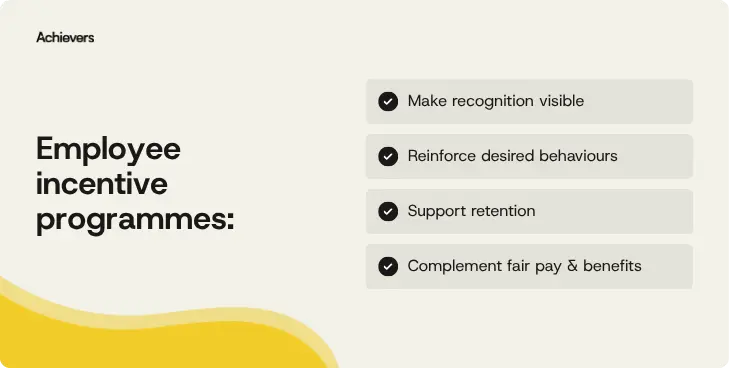
Employee incentive programs matter because they:
- Make appreciation visible and consistent
- Reinforce behaviours that drive performance
- Support retention in a competitive labour market
Singapore employees are clear about what they expect from work: fairness, clarity, growth, and recognition that feels genuine. When those elements are missing, engagement drops — even in high‑performing organisations.
Achievers Workforce Institute data shows that employees who feel appreciated are far more likely to feel connected, motivated, and committed to staying. In Singapore’s competitive talent market, that connection can’t be taken for granted.
With job mobility remaining high across APAC, organisations can no longer rely on stability or brand alone to retain talent. Employee incentive programs help create the recognition and appreciation that give people a reason to stay engaged — not just employed. Local research on workplace well-being in Singapore aligns with Achievers research, highlighting the role of feeling valued and supported in sustaining engagement over time.
When incentives sit alongside fair and compliant employment practices, they become a powerful way to shape culture intentionally.
Employee incentive programs at a glance
In Singapore’s competitive talent market, the most effective employee incentive programs are built for flexibility, frequency, and real‑time impact—meeting employees where they are and recognising what matters most.
Most effective incentive programs in Singapore
These incentive types consistently drive participation and cultural impact across diverse, high‑performing workforces:
- Points‑based recognition
- Peer‑to‑peer recognition
- Manager spot awards
- Professional development incentives
- Well-being incentives
- Values‑based incentives
- Team‑based incentives
- Experiential rewards
Best for retention
These programs help employees see a future with the organisation by reinforcing growth, appreciation, and long‑term value:
- Career development incentives
- Recognition programs
- Flexible rewards
- Best for engagement
These approaches keep motivation high by making recognition timely, visible, and connected to everyday work:
- Peer recognition
- Spot awards
- Values‑based incentives
10 employee incentive programs that actually work in Singapore
Based on what we see across high‑performing organisations in Singapore and the wider APAC region, these incentive programs consistently drive engagement and retention.
1. Points‑based recognition programs
Flexible and scalable, points‑based programs let employees earn rewards for meaningful contributions and choose what matters to them — from everyday essentials to experiences. Choice increases relevance.
2. Peer‑to‑peer recognition
Recognition shouldn’t be limited to hierarchy. Making it easy for colleagues to recognise one another builds connection and reinforces shared accountability, especially in fast‑moving teams.
3. Manager‑led spot recognition
Timely recognition from leaders still carries weight. Spot awards allow managers to acknowledge strong judgement or execution in the moment — not months later.
4. Professional development incentives
Growth matters. Incentivising learning, certifications, and skills development signals that the organisation is invested in employees’ long‑term capability, not just short‑term output.
5. Well-being‑focused incentives
Sustained performance requires balance. Incentives tied to physical, mental, and financial wellbeing show care in ways employees can actually feel.
6. Service milestones (done thoughtfully)
Milestones shouldn’t be generic. Recognising early contributions, personalising key moments, and offering meaningful choices makes service recognition relevant again.
7. Values‑based incentives
Culture is shaped by what gets recognised. Incentivising behaviours that reflect organisational values — collaboration, accountability, customer focus — brings those values to life.
8. Employee referral incentives
Referrals work best when recognition isn’t delayed until the end. Ongoing recognition throughout the referral process keeps participation high.
9. Team‑based incentives
Shared goals deserve shared recognition. Team incentives encourage collaboration and reduce silos in highly specialised environments.
10. Experiential and lifestyle rewards
Not everything needs to be cash. Experiences create stronger emotional connections and lasting impact than transactional rewards alone.
How to design an effective employee incentive program (without overcomplicating it)
The most effective employee incentive programs aren’t elaborate. They’re intentional. Strong programs share a few fundamentals:
Clear business goals
Effective employee incentive programs start with a clear purpose. Employees should understand why certain behaviours are being rewarded and how those incentives connect to broader organisational priorities. When recognition is clearly tied to outcomes like performance, customer experience, collaboration, or growth, it feels intentional — not arbitrary. Clear goals help employees see how their everyday actions contribute to something bigger, turning incentives into guidance rather than guesswork.
Visible leadership support
Incentive programs gain credibility when leaders actively participate. When managers and senior leaders recognise employees regularly — not just endorse the program in principle — they signal that appreciation matters. Visible leadership support sets the tone, reinforces expectations, and encourages wider participation. Without it, even well‑designed programs risk feeling optional or disconnected from how success is really measured.
Fairness, equity, and compliance
Trust underpins every successful incentive program. Employees need to believe recognition is fair, inclusive, and applied consistently across roles, teams, and levels. Clear criteria, transparent guidelines, and rewards that resonate across diverse employee groups help prevent perceptions of bias. When programs are equitable and compliant with local employment practices, recognition strengthens confidence rather than undermining it.
Seamless integration into daily work
If recognition feels like extra work, it won’t last. Incentive programs work best when they fit naturally into existing workflows and tools — where employees already communicate and collaborate. Simple, accessible programs encourage frequent use and broader participation. The easier it is to recognise good work in the moment, the more likely employees are to do it consistently.
Data to improve over time
The most effective incentive programs evolve. Participation trends, recognition patterns, and reward preferences provide valuable insight into what’s resonating and what isn’t. Using data to refine incentives helps organisations stay relevant, adjust to changing employee needs, and ensure recognition continues to drive the right behaviours. Without that feedback loop, programs quickly lose impact.
At the end of the day, simplicity wins. If a program is hard to use, it won’t get used. And if recognition feels generic, it won’t motivate anyone.
Common incentive program pitfalls to avoid
Even well‑intentioned employee incentive programs can fall short if a few fundamentals are missed. These are some of the most common ways programs lose impact — often without anyone realising it.
Treating recognition as an annual event
Annual awards or end‑of‑year bonuses have their place, but they can’t carry the full weight of recognition. When appreciation only shows up once a year, it feels disconnected from the day‑to‑day effort employees put in. Incentives are most effective when they’re timely and frequent, reinforcing behaviours while they’re happening — not long after the moment has passed.
Overlooking employees without desk access
If incentive programs only reach people with email, intranet access, or desk‑based tools, large portions of the workforce are left out. Frontline, operational, and shift‑based employees often miss out — not by design, but by default. That exclusion erodes trust and sends an unintended message about whose work is visible and valued.
Setting targets that feel unattainable
Stretch goals can motivate. Unrealistic ones do the opposite. When employees don’t believe they have a fair chance of earning recognition, participation drops quickly. Incentives should encourage effort and progress — not feel like a prize reserved for the few.
Offering rewards with little personal relevance
Not everyone is motivated by the same thing. Generic rewards signal convenience, not care. Programs that offer choice and flexibility consistently outperform one‑size‑fits‑all approaches, because they recognise that employees’ lives, needs, and preferences are different.
Employee incentive programs vs. bonuses and benefits
Employee incentive programs, bonuses, and benefits all play a role in the employee experience—but they serve different purposes and drive different outcomes. Understanding how they work together helps organisations in Singapore build a more effective and motivating total rewards strategy.
Incentives vs bonuses
Bonuses in Singapore are typically tied to fixed outcomes or time‑bound performance, such as annual results or contractual targets, and are often expected as part of total compensation. Employee incentive programs are designed to recognise effort and impact as work happens — using frequent recognition and rewards to reinforce behaviours, guide performance, and build a strong culture over time.
Incentives vs benefits
Benefits provide essential support and stability, covering areas such as healthcare, statutory entitlements, and wellbeing. Incentive programs are more dynamic, focusing on appreciation, motivation, and real‑time recognition that helps employees feel seen and valued beyond their base benefits package.
Shape your workforce with meaningful incentives — powered by Achievers
In Singapore, performance expectations are high. Pay matters, but recognition is what sustains commitment.
With Achievers employee incentive programs, organisations build cultures where people feel seen, heard, and appreciated every day—turning engagement into a lasting advantage.
Shape your workforce. Recognise. Reward. Get results with Achievers.
Employee incentive programs FAQs
Key insights
- In Singapore, pay is competitive—but appreciation is missing.
- Incentive programs only work when recognition is frequent and visible
- Appreciation directly drives engagement, performance, and retention.
In short, appreciation isn’t an add‑on. It’s a predictor.