Table of contents
Create a culture that means business™
Schedule a demo with an Achievers solution expert today.


 Copy URL
In many Australian workplaces, success doesn’t announce itself. It shows up in steady execution, in problems resolved before they escalate, and in people doing the work that keeps everything moving — day after day.
That’s true in offices. And it’s especially true on the frontline.
From store floors and hospital wards to warehouses, call centres, and job sites, a lot of meaningful work happens far from dashboards and decision‑making tables. It’s practical, hands‑on, and often invisible once the shift ends.
The challenge isn’t a lack of effort. It’s that recognition doesn’t always keep pace with it.
According to the Achievers Workforce Institute’s 2026 Engagement and Retention Report – APAC edition, only 22% of Australian employees feel appreciated, even though 31% say their work is meaningful. That gap between effort and appreciation affects everyone — knowledge workers and frontline teams alike — but it’s often felt most sharply where work is physically demanding, time‑bound, or customer‑facing.
Industry bodies like the Australian HR Institute consistently identify recognition as a key driver of engagement and retention. Learning how to celebrate success — consistently, authentically, and without slowing work down — isn’t about adding noise. It’s about reinforcing momentum, strengthening connection, and making sure people know their contribution matters, wherever and however they work.
How to celebrate success at work (quick guide)
To properly celebrate success at work, keep it timely, genuine, and grounded in what your people value. In Australian workplaces, recognition works best when it’s authentic, practical, and a bit down‑to‑earth — no overblown fanfare required. Here’s a quick guide to the most effective ways organisations celebrate success at work:
- Call it out early. Acknowledging wins in team meetings, stand‑ups, or company‑wide channels helps make success visible and reinforces what good looks like.
- Keep it personal. A thoughtful thank‑you from a manager — one that clearly explains why the work mattered — carries real weight.
- Encourage peer recognition. When recognition comes from teammates, it feels more natural and helps appreciation spread across the business.
- Link wins to values. Celebrations land better when they clearly connect achievements to company values or shared goals.
- Offer meaningful rewards. Whether it’s points, perks, or experiences, rewards should feel relevant and worth the effort behind the win.
- Celebrate progress, not just milestones. Recognising steady progress keeps teams motivated, especially during busy or high‑pressure periods.
- Make it part of everyday work. Success shouldn’t only be celebrated at year‑end or awards nights — consistency is what builds culture.
Celebrating success doesn’t require formal programs or milestone events. In effective teams, recognition shows up naturally in the flow of work.
It sounds like:
- “That follow‑through helped the team stay aligned.”
- “Thanks for managing that handover carefully — it prevented delays.”
- “Good judgement on that call. It kept things moving.”
It looks like:
- Leaders acknowledging consistent performance, not just peak moments
- Colleagues recognising support during high‑pressure periods
- Teams briefly reflecting on what worked before shifting focus
The impact comes from frequency, not scale. Across APAC, employees who are recognised weekly are significantly more likely to feel engaged and appreciated than those who are rarely recognised. When recognition only happens around major achievements, everyday contribution goes unnoticed.
Celebration at work isn’t about hype — it’s about continuity
Celebration at work doesn’t need spectacle. In fact, forced enthusiasm often lands flat. What employees respond to is something much simpler: being acknowledged for doing their job well, consistently.
Recognition works because it creates continuity. It links effort to impact. It reassures people that what they’re doing matters — even when the work is routine, demanding, or largely invisible.
AWI data shows that when employees feel appreciated, they’re more likely to stay engaged and committed. Recognition doesn’t just lift morale in the moment — it reinforces the behaviours organisations rely on day after day.
Why it pays to celebrate wins — especially the small ones
Large achievements are motivating — but they’re infrequent. Small wins, on the other hand, happen constantly.
When organisations acknowledge progress along the way:
- Momentum is easier to sustain
- Effort feels visible, not endless
- Teams are more likely to stay focused during long or uncertain work
This matters in Australia, where connection remains fragile. Many employees don’t feel strongly connected to their manager or colleagues — and recognition is one of the fastest ways to rebuild that sense of shared effort. Australian workplace guidance also recognises that feeling valued and supported plays a role in reducing psychosocial risks at work, critical for nurturing a sense of connection and belonging.
What it means to celebrate success for frontline and operational teams
For frontline, operational, and deskless workers, success often looks different — and it’s easier to overlook.
There’s no inbox full of thank‑yous. No calendar reminders to pause and reflect. And often, no clear line of sight between effort and impact.
In Australian organisations with large frontline populations — retail, manufacturing, healthcare, logistics, hospitality — success shows up as reliability, problem‑solving, and consistency. It’s the shift that runs smoothly. The safety issue raised early. The customer who leaves satisfied because someone took extra care.
Celebrating success here isn’t about grand gestures. It’s about recognising effort where the work actually happens.
That means:
- Acknowledging people who keep standards high when no one’s watching
- Recognising teamwork across shifts, not just individual heroics
- Calling out safe behaviours, not just productivity metrics
- Making recognition accessible — not locked behind desks or logins
When frontline employees don’t see recognition reach their world, it sends a quiet message: some work matters more than others. And that’s where disengagement starts. Best‑practice guidance from the Fair Work Ombudsman also highlights the importance of inclusive, respectful workplace practices across all roles.
What Australian leaders often get wrong about celebrating success
Most leaders don’t ignore recognition on purpose. But many misunderstand what actually makes it effective.
One common assumption is that recognition has to be formal to matter — tied to programs, awards, or performance cycles. In reality, formality often slows recognition down to the point where it loses relevance.
Another is the belief that appreciation should be saved for exceptional outcomes. That approach unintentionally trains teams to associate recognition with rarity — not reliability. Solid, repeatable effort goes unnoticed.
There’s also a tendency to treat recognition as a manager‑only responsibility. In busy Australian workplaces, that creates bottlenecks. When managers are stretched, recognition drops — even when good work continues.
Recognition isn’t about control. It’s about signal.
It signals what good work looks like, which behaviours matter, and who the organisation values. When that signal is frequent, specific, and shared, it becomes one of the most powerful tools leaders have — without adding meetings or process.
A simple framework for celebrating success at work
Recognition doesn’t need a script or a spotlight. In Australian workplaces, the most effective celebration at work is straightforward, genuine, and easy to act on — not overly formal or performative. The approaches that work best tend to share a few common traits.
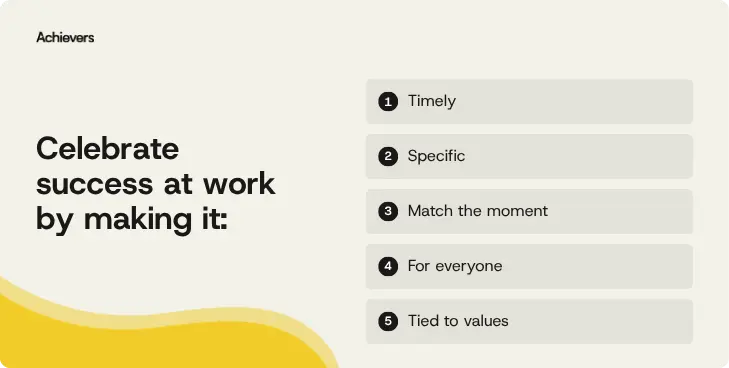
It’s timely
Recognition lands best when it’s close to the moment — while the effort is still fresh and relevant. Timely celebration helps employees clearly connect what they did with why it mattered. When appreciation is delayed, that link weakens, and recognition risks feeling like an afterthought rather than a meaningful response to real work.
What it looks like: A project lead sends a same‑day message after a client presentation, calling out how the team handled last‑minute changes and still delivered ahead of schedule — rather than waiting until the next quarterly review to acknowledge the effort.
It’s specific
Generic praise fades quickly. Calling out exactly what someone did — and why it made a difference — builds clarity and confidence. Specific recognition helps people understand which behaviours to repeat, whether that’s how they handled a customer issue, supported a teammate, or kept work moving during a busy period.
What it looks like: Instead of saying, “Great job on the report,” a manager recognises an employee for “simplifying complex data into clear recommendations that helped leadership make a faster decision.”
It fits the situation
Some moments call for a team‑wide acknowledgement. Others land better as a quiet word, message, or one‑to‑one conversation. The key is choosing what fits the situation and the person. When celebration matches the moment, it feels genuine and respectful — not forced or uncomfortable.
What it looks like: A major cross‑functional win is shared during a town hall, while a quieter contribution — like mentoring a new hire through a tough first month — is recognised privately in a one‑to‑one conversation.
It’s shared
Celebration at work shouldn’t sit solely with managers. Peer‑to‑peer recognition plays an important role, especially in frontline, operational, or distributed teams where managers can’t see every contribution. When employees are encouraged to celebrate the wins they notice each day, recognition becomes more frequent, inclusive, and embedded in how work gets done.
What it looks like: A teammate publicly thanks a colleague for stepping in to troubleshoot an issue outside their role, helping the team meet a critical deadline without escalation.
It reinforces values
When recognition reflects organisational values, those values become real. Celebrating work that demonstrates safety, collaboration, accountability, or customer focus shows employees what success looks like in practice. Over time, tying celebration to values helps shape culture by reinforcing how work gets done — not just what gets delivered.
What it looks like: An employee is recognized not just for closing a deal, but for how they collaborated across teams and put long‑term customer relationships ahead of short‑term gains — explicitly linking the recognition to the organisation’s values.
Turning celebrating at work into a habit — not a one‑off
Celebrating success at work isn’t about applause or perks. It’s about attention.
It’s noticing progress while it’s happening. Acknowledging effort before burnout sets in. Reinforcing the behaviours that keep teams safe, productive, and moving forward — whether that work happens behind a desk, on a shop floor, or out in the field.
The strongest cultures don’t separate “big wins” from everyday effort. They recognise both. They make appreciation part of how work gets done, not something saved for special occasions.
Because when people feel seen, heard, and appreciated:
- Effort feels worthwhile
- Teams stay connected under pressure
- Organisations don’t just retain talent — they build momentum
That’s the power of celebrating success the right way.
How Achievers helps Australian organisations recognise what matters
At Achievers, we see recognition as a cultural signal — not a feel‑good extra.
Our platform helps organisations:
- Recognise effort in real time
- Make appreciation visible across teams
- Celebrate progress, not just outcomes
- Reinforce behaviours that drive results
Because when people feel seen, heard, and appreciated, they don’t just stay — they contribute more consistently, collaborate more willingly, and show up with purpose.
Celebrate success FAQs
Key insights
- Organisations that celebrate success consistently reinforce momentum and strengthen connection.
- Teams that celebrate wins stay more engaged during busy, demanding periods of work.
- Meaningful celebration at work happens when organisations recognise real effort, not just outcomes.