Table of contents
Create a culture that means business™
Schedule a demo with an Achievers solution expert today.


 Copy URL
In many Singapore organisations, success is rarely loud. It shows up in work that stays on track, expectations that are met without disruption, and teams that deliver consistently under pressure.
It’s not always visible — and it’s not always celebrated.
In fast‑paced, performance‑driven environments, progress is often quickly followed by the next priority. Teams move forward. Targets reset. And the moment to acknowledge effort passes.
The issue isn’t commitment or capability. It’s that recognition often lags behind execution.
According to the Achievers Workforce Institute’s 2026 Engagement and Retention Report – APAC edition, only 15% of employees in Singapore feel appreciated at work, even though 21% say their work is meaningful. That gap between contribution and recognition affects employees across functions and seniority levels — particularly in environments where expectations are high and results are assumed.
Singapore’s Ministry of Manpower has consistently emphasised the importance of progressive workplace practices that support engagement, performance, and retention. Learning how to celebrate success at work isn’t about slowing teams down or introducing ceremony. It’s about reinforcing focus, clarity, and shared standards — so people know not just what matters, but how success is achieved.
How to celebrate success at work (quick guide)
To properly celebrate success at work, keep it timely, human, and connected to what matters most. Recognition doesn’t need to be elaborate to be effective — it just needs to be intentional. Here’s a quick, practical guide to the most effective ways organizations celebrate success at work:
- Say it out loud. Public recognition in team meetings, town halls, or internal channels makes success visible and reinforces what “great” looks like.
- Make it personal. A specific thank-you note from a manager or leader goes a long way — especially when it calls out the impact behind the effort.
- Recognise peers, not just top-down. Peer-to-peer recognition builds everyday momentum and helps appreciation travel faster across teams.
- Tie wins to values. Celebrating success is most powerful when it clearly links achievements to company values or business goals.
- Reward meaningfully. Points, perks, or experiences give recognition staying power and signal that success is worth repeating.
- Celebrate progress, not just big milestones. Small wins keep energy high and help teams stay motivated in fast-paced environments.
- Be consistent. Success shouldn’t be celebrated once a year — it should be recognised as it happens, all year long.
Celebrating success doesn’t require formal programs or milestone events. In effective teams, recognition shows up naturally in the flow of work.
It sounds like:
- “That follow‑through helped the team stay aligned.”
- “Thanks for managing that handover carefully — it prevented delays.”
- “Good judgement on that call. It kept things moving.”
It looks like:
- Leaders acknowledging consistent performance, not just peak moments
- Colleagues recognising support during high‑pressure periods
- Teams briefly reflecting on what worked before shifting focus
The impact comes from frequency, not scale. Across APAC, employees who are recognised weekly are significantly more likely to feel engaged and appreciated than those who are rarely recognised. When recognition only happens around major achievements, everyday contribution goes unnoticed.
Celebration at work isn’t about hype — it’s about consistency
In Singapore workplaces, recognition doesn’t need fanfare to be effective. In fact, overly performative appreciation can feel misaligned in cultures that value discipline, efficiency, and delivery.
What resonates more is consistency.
Celebration at work works when it reinforces expectations and effort — acknowledging progress, reliability, and follow‑through, not just standout outcomes. It creates continuity between effort and impact, helping employees understand that how they work matters, not only what they deliver.
AWI data shows that when employees feel appreciated, they’re more likely to stay engaged and committed. Recognition doesn’t just motivate in the moment — it stabilises behaviour over time. This aligns with guidance from Singapore’s tripartite partners, which highlight fair, progressive employment practices as a foundation for sustainable performance.
Why celebrating wins matters — especially small ones
Large achievements are important, but they’re infrequent. Small wins happen every day. Research on workplace wellbeing in Singapore shows that feeling valued and supported plays an important role in sustaining employee engagement over time.
When organisations recognise progress along the way:
- Momentum is easier to maintain
- Effort feels visible rather than transactional
- Teams stay focused during sustained periods of demand
This is particularly relevant in Singapore, where AWI data points to low levels of appreciation and engagement. Regular recognition helps prevent effort from blending into expectation — and gives teams clarity on what good performance looks like.
Where leaders in Singapore often misjudge recognition
Most leaders value recognition. But many underestimate what makes it effective.
One common misconception is that recognition needs to be formal to matter — tied to awards, programmes, or review cycles. In reality, formality often delays recognition to the point where it loses relevance.
Another is the belief that appreciation should be reserved for exceptional results. This unintentionally signals that consistent, dependable performance is simply expected — not valued.
There’s also a tendency to treat recognition as a manager‑only responsibility. In fast‑moving organisations, this creates friction. When managers are stretched, recognition drops — even when strong performance continues.
Recognition isn’t about control or praise. It’s about clarity. It signals what good work looks like, which behaviours are worth repeating, and how success is achieved. When that signal is timely, specific, and shared, it becomes one of the most effective leadership tools available.
A simple framework for celebrating success at work
Recognition doesn’t need scripts or staged moments. In Singapore organisations, the most effective celebration at work is practical, proportionate, and easy to act on.
The approaches that work best share a few traits:
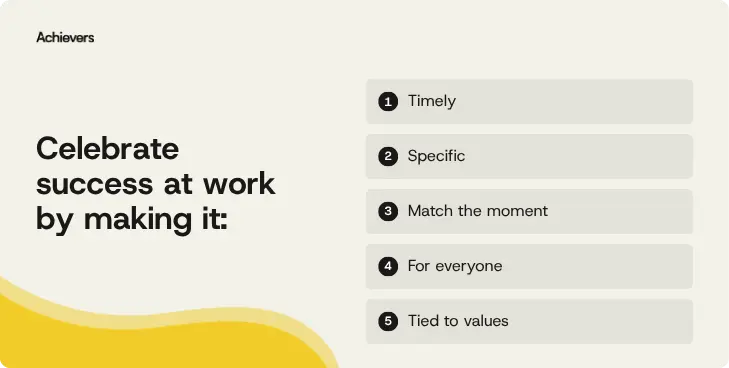
Make it timely
Recognition has the greatest impact when it happens close to the effort. When appreciation is timely, employees can clearly connect what they did with why it mattered. That immediate feedback reinforces expectations and helps people repeat the right behaviors. When recognition comes too late, it risks feeling disconnected from the work itself—and loses much of its ability to motivate or guide future action.
What it looks like: A project lead sends a same‑day message after a client presentation, calling out how the team handled last‑minute changes and still delivered ahead of schedule — rather than waiting until the next quarterly review to acknowledge the effort.
Be specific
Clear recognition explains what someone did and why it mattered. Specificity removes ambiguity and replaces guesswork with clarity. Instead of leaving employees to wonder what earned praise, specific recognition highlights the exact behavior or decision that made a difference. Over time, this helps set consistent standards and builds confidence by showing people what “good work” actually looks like.
What it looks like: Instead of saying, “Great job on the report,” a manager recognises an employee for “simplifying complex data into clear recommendations that helped leadership make a faster decision.”
Match the moment
Not every contribution needs the same level of visibility. Some moments benefit from public acknowledgment, while others land better through a private note or one‑to‑one conversation. Matching recognition to the moment—and to the individual—ensures it feels appropriate and genuine. When the channel fits the context, celebration reinforces trust rather than drawing unnecessary attention.
What it looks like: A major cross‑functional win is shared during a town hall, while a quieter contribution — like mentoring a new hire through a tough first month — is recognised privately in a one‑to‑one conversation.
Involve everyone
Celebration shouldn’t rely solely on managers. Peer recognition plays a critical role in making appreciation more frequent and more accurate. Colleagues often see effort, collaboration, and problem‑solving that leaders don’t. When everyone is empowered to recognize good work, appreciation becomes more visible, shared accountability increases, and recognition reflects how work actually gets done.
What it looks like: A teammate publicly thanks a colleague for stepping in to troubleshoot an issue outside their role, helping the team meet a critical deadline without escalation.
Tie celebration to values
When recognition reflects organizational values, those values move from statements to behaviors. Celebrating work that demonstrates collaboration, accountability, innovation, or customer focus shows employees how success is achieved—not just what success looks like. Over time, values‑based recognition shapes culture by reinforcing the behaviors the organization wants to see repeated.
What it looks like: An employee is recognized not just for closing a deal, but for how they collaborated across teams and put long‑term customer relationships ahead of short‑term gains — explicitly linking the recognition to the organisation’s values.
Turning celebration at work into a habit
Celebrating success at work isn’t about applause or perks. It’s about attention.
It’s noticing progress while it’s happening. Acknowledging effort before fatigue sets in. Reinforcing behaviours that support performance, reliability, and alignment.
Strong cultures don’t separate big wins from everyday contribution. They recognise both. They treat appreciation as part of how work gets done — not something reserved for special occasions.
Because when employees feel seen, heard, and appreciated:
- Effort feels worthwhile
- Teams stay aligned under pressure
- Organisations don’t just retain talent — they sustain performance
That’s the value of celebrating success well.
How Achievers helps organisations in Singapore recognise what matters
At Achievers, we see recognition as a signal that shapes behaviour, culture, and performance — not a feel‑good add‑on. When appreciation is timely, visible, and tied to what matters most, it becomes part of how work gets done, not something saved for special occasions.
Our platform helps organisations in Singapore and around the world recognise effort in real time, make appreciation visible across teams, and celebrate progress as it happens — not just when results are final. By reinforcing the behaviours that drive performance, recognition becomes a practical tool for alignment, engagement, and consistency.
Because when people feel seen, heard, and appreciated, they don’t just stay. They show up focused, committed, and ready to do their best work.
Celebrate success FAQs
Key insights
- When organisations celebrate success consistently, they reinforce clarity, alignment, and sustained performance.
- Regularly celebrating wins helps employees see that effort matters, not just final results.
- Meaningful celebration at work turns recognition into a practical tool for engagement, not a one‑off gesture.