Table of contents
Create a culture that means business™
Schedule a demo with an Achievers solution expert today.


 Copy URL
Success at work doesn’t always arrive with fireworks. Sometimes it looks like a project finally crossing the finish line. Sometimes it’s a tough conversation handled well. And sometimes it’s simply a team showing up, again and again, and getting the job done.
The problem? Too often, we rush straight past those moments.
If you want stronger engagement, better performance, and people who actually want to stick around, learning how to celebrate success — consistently and meaningfully — is one of the most powerful tools you have. Not just to celebrate the big wins, but to celebrate the wins that happen every day.
And the data backs this up.
Data from the Achievers Workforce Institute’s (AWI’s) 2026 Engagement and Retention Report shows us that only 26% of employees feel engaged, and just 25% feel genuinely appreciated at work. That gap between effort and appreciation is exactly where motivation starts to leak out. Here’s how celebrating success at work can bridge the divide.
Why does celebration at work matter?
Celebration at work is fundamentally about recognition. It’s about acknowledging effort, progress, and contribution — not just final results. When people feel seen, heard, and appreciated for the work they do, they’re more likely to stay engaged, repeat positive behaviors, and feel connected to their organisation and its goals.
Celebrating wins also empowers others. Research shows that 69% of employees would work harder if they felt their efforts were better appreciated. And it doesn’t have to be huge milestones. Showing appreciation for small wins and recognizing those who helped make them happen strengthens a team and creates a snowball effect of positive motivation.
And that has a measurable impact. According to AWI data, employees who feel appreciated are:
- 12x more likely to find their work meaningful
- 17x more likely to feel connected to their coworkers
- 17x more likely to see a long‑term future with their organization
When you celebrate work, you’re not just boosting morale. You’re reinforcing purpose, connection, and retention — all at once.
What does it really mean to celebrate success?
To celebrate success at work doesn’t mean waiting until the end of the year or the completion of a massive initiative. In fact, the most effective celebrations are often the smallest ones.
It looks like:
- Recognizing a team for hitting a milestone
- Calling out collaboration during a tough project
- Thanking someone for stepping up when it mattered
- Pausing to reflect on what went well — not just what’s next
Why does this matter? Because recognition frequency changes everything.
The global report shows that weekly or monthly recognition is strongly linked to higher engagement, stronger belonging, and lower intent to leave. Employees who are rarely or never recognized face dramatically higher turnover risk.
In short: celebrating success regularly beats saving it for “special occasions.”
Why it’s important to celebrate wins — especially the small ones
Big wins are easy to spot. Small wins? Not so much. But they’re often the building blocks of everything else.
When you celebrate wins along the way:
- Teams stay motivated during long projects
- Progress feels visible, not endless
- Employees feel encouraged to keep going
This is especially important today because the only about one in five employees globally feel a strong sense of connection or belonging at work. Small, frequent celebrations can help close that gap by reminding people they’re part of something — not just checking boxes on a task list.
How to celebrate success at work (without making it awkward)
Not all celebration needs to be loud. Not all recognition needs a budget. What it does need is intention. When celebration at work is thoughtful and consistent, it reinforces the behaviors you want to see more of — without feeling forced or performative.
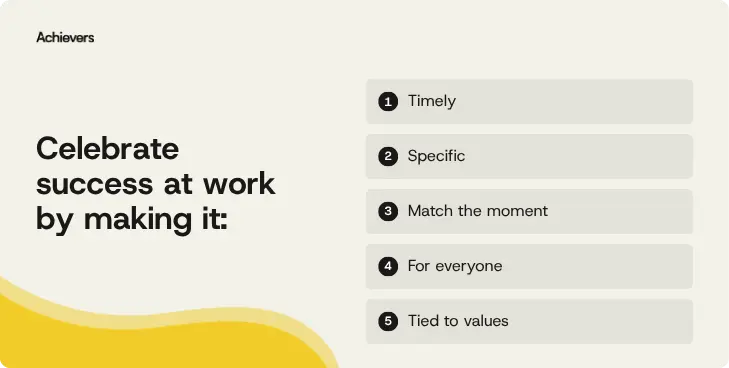
Here’s what actually works:
1. Make it timely
Recognition works best when it’s close to the moment. When appreciation is delayed, its impact fades, and the connection between effort and recognition weakens. Timely recognition reinforces behavior while it’s still fresh, helping employees understand that their actions mattered in real time, not weeks later during a formal review.
2. Be specific
“Great job” is easy. Specific recognition takes a little more thought — and delivers far more impact. Calling out what someone did and why it mattered helps employees understand exactly which behaviors to repeat. It removes ambiguity, builds confidence, and turns recognition into a clear signal, not just a nice gesture.
3. Match the moment
Not every win needs a public spotlight. Some achievements deserve a team‑wide celebration while others are better acknowledged quietly. The key is choosing the right channel for the moment and the person. When celebration matches context, it feels genuine — not performative — and lands with greater meaning.
4. Involve everyone
Celebration at work shouldn’t sit solely with managers. Peer recognition plays a critical role in building connection, especially in busy, distributed, or frontline environments where managers can’t see everything. When employees are encouraged to celebrate the wins they witness every day, recognition becomes more frequent, more inclusive, and more embedded in how work gets done.
5. Tie celebration to values
When you celebrate work that reflects your organisation’s values, those values stop being abstract. Recognition brings them to life by showing what they look like in action — whether that’s collaboration, customer focus, safety, or innovation. Over time, celebrating values‑aligned behaviors helps shape culture by reinforcing how success is achieved, not just what is delivered.
What gets in the way of celebrating success?
Most organizations don’t skip celebration because they don’t care. They skip it because they’re busy. Deadlines pile up. Priorities shift. And recognition gets postponed — indefinitely.
But here’s the risk: when appreciation disappears, so does belonging.
The 2026 Engagement and Retention Report shows that employees who feel appreciated are 54x more likely to feel a strong sense of belonging — and belonging is one of the strongest predictors of retention.
So when celebration slips, it’s not just a missed “nice moment.” It’s a missed retention lever.
Turning celebration into a habit, not a one‑off
The goal isn’t to celebrate occasionally. It’s to build a culture where celebrating success is normal.
When celebration becomes a habit:
- Employees know their effort won’t go unnoticed
- Managers reinforce expectations more clearly
- Teams build stronger connections through shared wins
This matters because only 18% of employees globally say they feel supported by their manager in ways that help them do their best work. Regular, visible recognition is one of the simplest ways to change that experience.
How Achievers helps teams celebrate success — every day
At Achievers, we believe recognition isn’t just about feeling good (though that’s a nice side effect). It’s about shaping behavior, strengthening culture, and driving real results.
Our platform helps organizations:
- Celebrate success in real time
- Make appreciation visible across teams
- Recognize both big achievements and everyday wins
- Reinforce the behaviors that matter most
Because when people feel seen, heard, and appreciated, they don’t just work harder — they work better, stay longer, and show up with more purpose.
If you’re ready to move beyond occasional applause and build a culture that truly knows how to celebrate success, Achievers is here to help.
Shape your workforce. Recognize. Reward. Get results.
Celebrate success FAQs
Key insights
- Celebrating success turns everyday effort into visible momentum that keeps people engaged and motivated.
- When organizations celebrate the wins — big and small — employees are more likely to feel connected and valued.
- Celebration at work isn’t fluff; it’s a proven way to reinforce purpose, performance, and retention.