Table of contents
Create a culture that means business™
Schedule a demo with an Achievers solution expert today.


 Copy URL
The future of work isn’t waiting for organizations to catch up. Skills are shifting, expectations are rising, and static roles are becoming obsolete almost as quickly as they’re written. In that environment, hiring more people isn’t the answer. Developing better capability is.
Within modern human resource management (HRM), training and development have become a competitive differentiator — shaping how quickly employees grow, how confidently organizations adapt, and how consistently performance improves. Done right, it turns learning into momentum and growth into a lasting advantage.
What is HR training and development?
In HRM, training and development are all about helping people thrive — today and tomorrow. It’s a strategic approach to building skills, boosting confidence, and unlocking potential across your workforce. Think of it as two sides of the same coin:
- Training: Short-term learning that equips employees with the know-how to excel in their current roles. It’s practical, focused, and immediately useful — like giving someone the right tools before asking them to build the house.
- Development: Long-term growth aimed at career progression, leadership readiness, and preparing employees for what’s next. It’s about planting seeds today for the forest you’ll need tomorrow.
The magic happens when these two work together. The best programs don’t treat training and development as separate silos — they connect them. Why? Because today’s learning should fuel tomorrow’s success.
When done right, HR training and development isn’t just a checkbox — it’s a catalyst for stronger teams, better performance, and a culture that can weather any storm (with a smile).
Why training and development in human resource management matters
Employees want more than a paycheck. They want progress. They want a clear view of what’s next — and an employer who believes in that future enough to invest in it. Meanwhile, organizations are juggling big priorities:
- Boost productivity and performance
- Spark innovation
- Improve turnover and keep top talent
- Stay ahead of tech shifts
- Close critical skill gaps
Training and development is the bridge between these ambitions. It turns learning from a one-off event into a living, breathing culture — one that keeps people engaged and businesses moving forward. Because when employee growth becomes part of the everyday, everyone wins. And honestly, who doesn’t love a win-win?
How to build your HR training and development strategy
Great training and development strategies in HRM aren’t accidental. They’re intentional, scalable, and people centered. Here’s a practical framework:
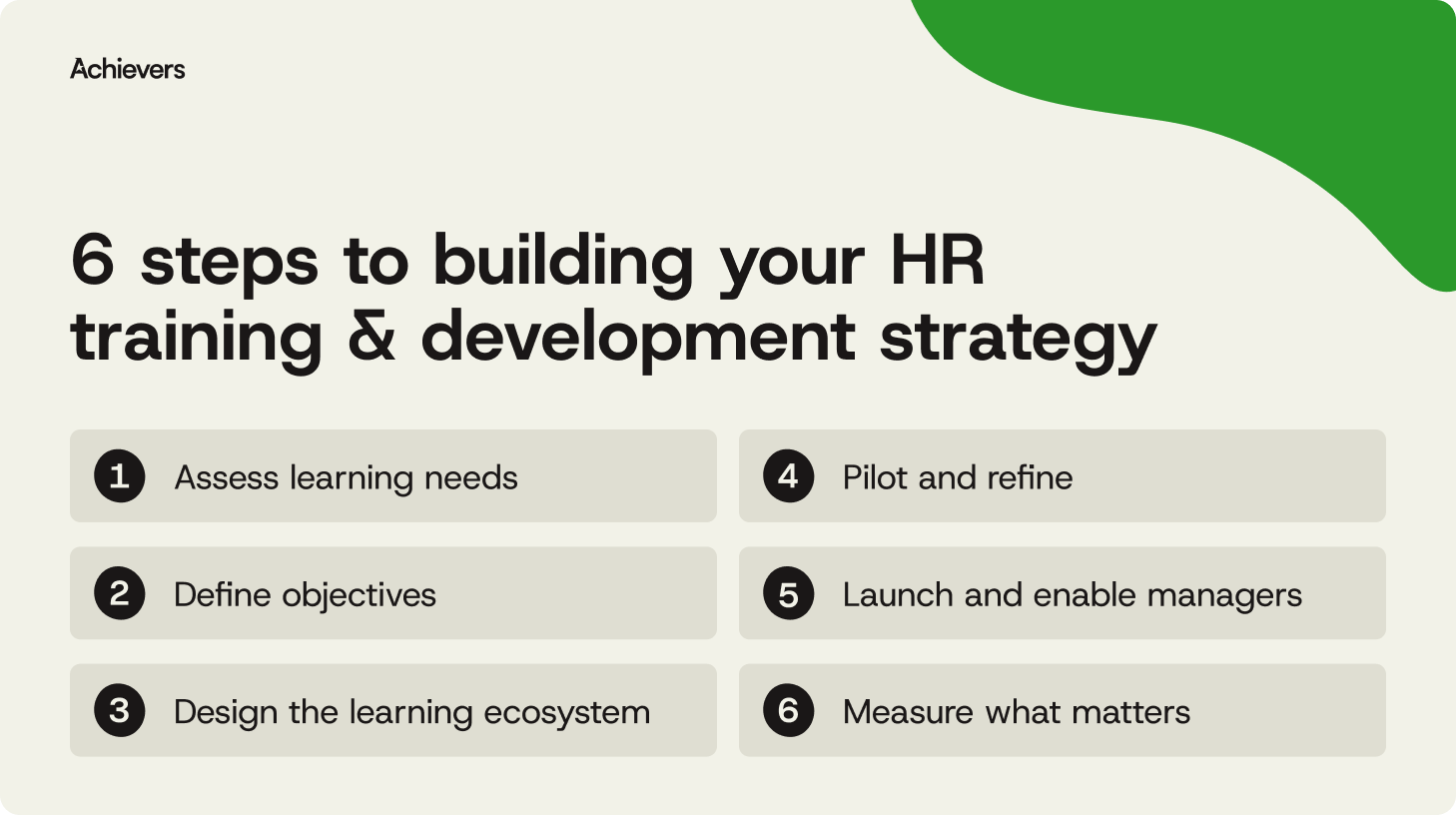
Step 1: Assess learning needs
Use pulse surveys, check-ins, performance data, and strategic planning to identify where employees need support.
Step 2: Define objectives
Set learning goals that are tied to business metrics — not just completion badges.
Step 3: Design the learning ecosystem
Balance formal programs with just-in-time learning and coaching to make development accessible.
Step 4: Pilot and refine
Test content with smaller groups and iterate based on feedback and adoption.
Step 5: Launch and enable managers
Managers must reinforce learning daily — not leave it to HR alone.
Step 6: Measure what matters
Evaluate program impact through performance improvement, skill acquisition, and internal mobility.
The core components of effective HR training and development
Organizations that approach training as a box-checking exercise rarely see meaningful results. Real impact comes from a system designed with intention — one that aligns learning with business priorities and supports employees at every stage. In HRM, the most effective training and development strategies are built on the following core components:
Skills gap analysis
Effective development starts with understanding where skills stand today and where they need to be tomorrow. A thorough skills gap analysis looks beyond current job requirements to identify emerging capabilities the organization will need to stay competitive. By combining performance data, employee feedback, and strategic planning, HR can prioritize learning investments that close critical gaps and reduce future risk.
Learning experience design
In human resources development, the “how” is just as critical as the “what.” Strong programs blend formats like e-learning, microlearning, instructor-led sessions, and peer-based learning to fit different roles, schedules, and learning styles. When learning is accessible, relevant, and easy to apply, it doesn’t just check a box — it drives participation and makes skills stick for the long haul.
Career and development planning
Employees are more engaged in learning when they understand how it connects to their future. Career and development planning provides clear pathways that link skill-building to professional growth opportunities, whether that means deeper expertise, lateral movement, or leadership progression. When employees can see how development supports their goals, learning becomes purposeful rather than performative.
A workplace culture that supports learning
Training efforts struggle in workplace cultures and environments where learning is treated as an interruption instead of an expectation. A strong learning culture reinforces the idea that development is continuous and encouraged at every level. Managers support learning through regular conversations, leaders model growth through participation, and employees feel safe investing time in building new skills without fear of falling behind.
Measurement and analytics
Without measurement, talent development becomes guesswork. Effective programs track participation, skill acquisition, and performance outcomes to understand what’s working and what isn’t. Analytics help HR connect learning activity to real results such as improved productivity, stronger engagement, or increased internal mobility — and make informed decisions about where to invest next.
Integration with HR strategy
Employee development strategies work best when they’re not living in a silo. Integration with performance management, recognition, succession planning, onboarding, and career progression ensures learning isn’t just a standalone event. Instead, it becomes part of how employees are supported, evaluated, and developed throughout their journey. When growth is woven into the fabric of everyday work, it stops feeling like an extra task — and starts driving real impact.
Common challenges and solutions
Even well-designed training and development programs face obstacles. The difference between stalled initiatives and successful ones isn’t the absence of challenges — it’s how intentionally HR addresses them.
Low participation
When learning feels generic, disconnected from real work, or difficult to access, participation drops quickly. Employees are far more likely to engage when training is relevant to their role, offered at the right moment, and easy to consume. Personalization helps learning feel purposeful, while micro-learning formats make it possible to build skills without disrupting productivity. The easier learning fits into the workday, the more likely people are to show up and stick with it.
Lack of time
Time is one of the most common barriers to learning, especially in fast-paced environments. To fix this, embed development directly into the flow of work rather than treating it as a separate activity. Short, focused learning moments, manager-led coaching conversations, timely reminders, and employee recognition for applying new skills all reinforce learning without requiring employees to step away from their responsibilities. When development happens alongside work, it becomes sustainable.
Limited leadership support
Training initiatives struggle when leaders treat learning as optional or secondary. Employees take cues from their managers, and when leaders don’t participate, prioritize, or reinforce development, engagement suffers. HR plays a critical role in enabling leaders with the tools, guidance, and expectations they need to support learning. When managers actively develop their own skills and encourage growth conversations, learning becomes part of the culture — not just an HR initiative.
No follow-up after training
Without reinforcement, even the best training fades quickly. One-time sessions rarely lead to lasting behavior change unless they’re supported by ongoing coaching, feedback, and performance insights. This gap can be closed by building in post-training touchpoints that help employees apply what they’ve learned. Regular check-ins, peer discussion, recognition for skill application, and visibility into progress all help turn learning into real, measurable impact.
One-size-fits-all programming
Employees don’t learn the same way or aspire to the same outcomes. Generic programs often miss the mark by ignoring individual strengths, career goals, and development needs. Personalized learning paths allow employees to focus on the skills that matter most to them and their role, increasing motivation and relevance. When people see a clear connection between learning and their own growth, they’re far more likely to stay engaged and invested.
Best practices and emerging trends in HR training and development
Learning isn’t standing still — and neither should development strategies. Leading organizations are embracing:
- Skill-based talent strategies: Aligning hiring, progression, and rewards to skill mastery
- Blended learning models: Combining virtual, live, and social learning experiences
- Microlearning: Small learning bursts delivered in the flow of work
- Career and leadership pathways: Transparent development trajectories that retain top talent
- Mentorship and peer learning: Knowledge transfer that builds culture as much as capability
- Analytics and insights: Real-time measurement of learning impact on performance
The best strategies aren’t the most complicated — they’re the most consistent.
The role of leadership and HR in human resource development training
HR designs development, but leaders make it stick. Managers influence:
- Whether employees feel encouraged to learn
- Whether learning becomes a priority or an optional extra
- Whether new skills are reinforced or forgotten
- Whether growth conversations happen regularly
HR’s role is to enable those managers with tools, guidance, and confidence. Leadership’s role is to model a company culture that embraces learning by participating in it themselves. When both partner effectively, development becomes a shared success.
How to measure the success of training and development programs
If development isn’t measured, it can’t be improved. Evaluating the success of training and development programs requires looking beyond completion rates to understand what’s actually changing. Key indicators include:
- Skill improvement: Before-and-after competency assessments that show whether employees are building meaningful capabilities.
- Performance impact: Stronger outcomes, faster execution, and improved results that reflect skills being applied to the job.
- Employee engagement: Signals that employees feel more supported, confident, and motivated to grow.
- Retention and advancement: Higher retention and increased internal mobility as employees move into new or expanded roles.
- Adoption and participation: Consistent use of learning resources, tools, and development opportunities.
The most powerful measure of success is simple: does learning translate into real business impact? When training improves performance, the results don’t need explanation, they speak for themselves.
Developing people means developing results
HR training and development has moved from enablement to execution. It’s how organizations build real capability, reduce risk, and keep performance moving forward as roles and expectations evolve. When learning shows up in everyday work, employees don’t just build skills, they use them. Behaviors change, performance strengthens, and people are better equipped to grow with the business instead of chasing the next reset.
The organizations that see development as an ongoing discipline — not a one-time program — are the ones that stay competitive over time. Investing in people isn’t aspirational. It’s operational. And it’s how modern organizations turn growth into results.
At Achievers, we help organizations turn that investment into impact by connecting people to purpose through recognition, rewards, and programs that make growth part of the culture. Because when employees feel seen, supported, and celebrated, results follow.
HR training and development in HRM FAQs
Key insights
- HR training and development now plays a central role in driving performance, retention, and how well organizations adapt to change.
- The strongest programs balance practical, in-the-moment skill building with long-term career growth that supports business goals.
- Lasting learning cultures are built through manager support, ongoing reinforcement, and clear measurement — not one-and-done courses.