Table of contents
Create a culture that means business™
Schedule a demo with an Achievers solution expert today.


 Copy URL
Everyone wants to feel seen, heard, and appreciated — yet, according to the 2025 State of Employee Recognition Report, only 25% of employees would recommend their company as a great place to work. That’s less “we’re in this together” and more “don’t ask me for a Glassdoor review.”
One way to change that? Strengthen your employee voice strategy. Done well, employee voice boosts engagement, sparks innovation, and supports retention; done poorly, it can sink morale faster than a surprise 7 a.m. “quick sync.”
In this post, we’ll break down the real advantages and disadvantages of employee voice — aka what happens when employee feedback is supported or sidelined — and how to build a culture where people feel truly heard and ready to contribute.
Advantages of employee voice
When employees believe their opinions carry weight, you see the real advantages and disadvantages of employee voice in action — and the advantages are powerful, helping teams become stronger, smarter, and more connected.
Here’s what happens when you genuinely listen and act:
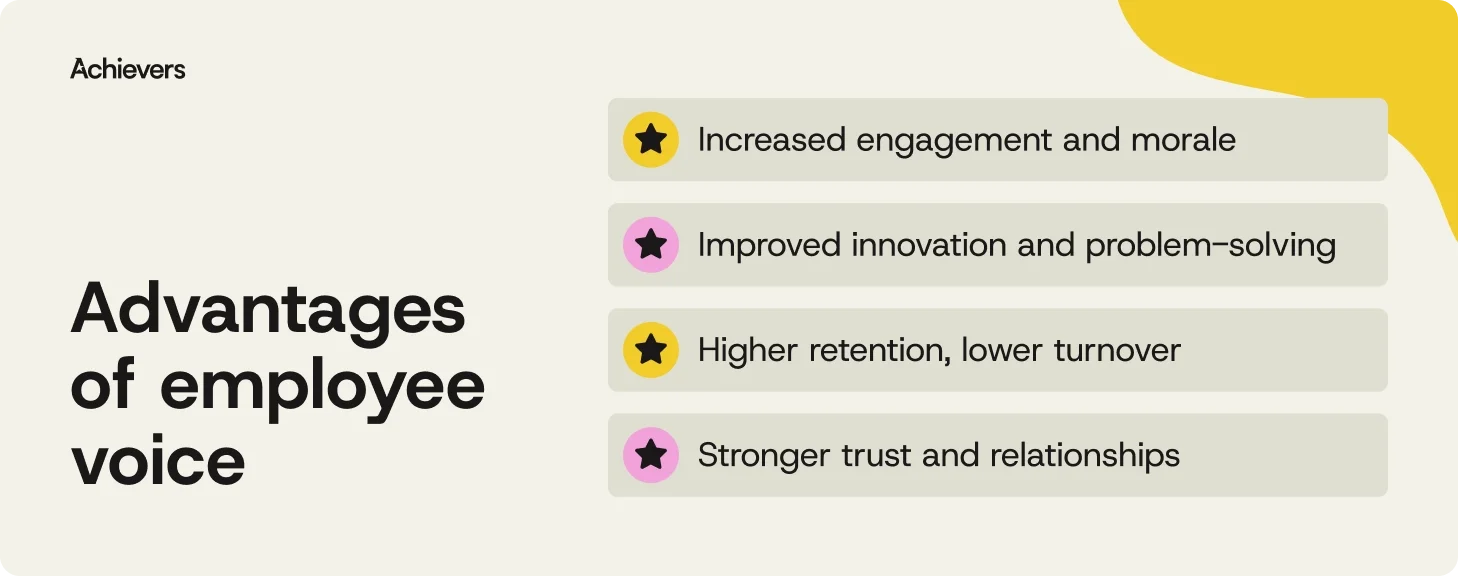
1. Increased engagement and morale
Heard employees are invested employees. When people see their feedback influencing decisions, they feel connected to your mission statement. That sense of belonging is a far better motivator than free muffins in the kitchen.
2. Improved innovation and problem-solving
The people closest to the work are often the first to spot opportunities — or pitfalls. Creating channels for their ideas turns everyday observations into solutions that can save money, improve processes, or spark the next big breakthrough.
3. Higher retention, lower turnover
Valued employees stick around. Acting on upward feedback shows people they matter, which makes them less likely to dust off their résumés. Fewer exits mean less time and money spent recruiting replacements.
4. Stronger trust and relationships
Trust grows when employees see leaders not just listening, but doing something with what they hear. It builds a culture where people collaborate more and second-guess less.
5. An early warning system for trouble
A strong employee feedback loop acts like an early warning system for workplace issues — a built‑in risk radar without the 3 a.m. false alarms.
6. Clearer alignment with company goals
When employees have a say, they also gain a better understanding of the “why” behind decisions. That connection between their daily work and the bigger picture drives focus and follow-through.
7. Smoother change management
Change lands better when people can ask questions, voice concerns, and share ideas for making it work. Instead of pushing back, employees are more likely to help push things forward.
Disadvantages of employee voice
Even with all the advantages of employee voice, most of the “disadvantages” appear when organizations don’t prioritize it. Encouraging employees to speak up can transform culture, but when feedback is ignored or mishandled, it creates pitfalls that quietly derail even the best intentions.
1. Lack of follow‑through erodes trust in employee feedback
Inviting feedback and then shelving it sends a louder message than you think — and it’s not a good one. When nothing changes, employees stop speaking up, and trust takes the hit.
2. Manager resistance blocks healthy employee voice
Some managers struggle to accept feedback, especially when it challenges how they work. Without coaching and support, they can become roadblocks instead of allies, shutting down valuable conversations before they start.
3. Unstructured feedback channels create negativity
Open feedback channels can sometimes become complaint boxes. Without a way to channel concerns into constructive action, negativity can spread and morale can dip.
4. Unclear communication weakens your employee voice strategy
If employees aren’t sure how their input will be used — or whether it’s truly confidential — they may hold back. Ambiguity around process and purpose leads to watered-down feedback or silence altogether.
5. Limited time and resources stall feedback programs
Collecting, reviewing, and acting on feedback takes effort. Without the right tools or processes, employee voice initiatives can drain resources and lose momentum.
6. Poorly managed discussions can create conflict
Differing opinions can be healthy, but if feedback isn’t managed with care, it can spark tension. Skilled facilitation is key to keeping disagreements productive rather than personal.
How to support employee voice — with Achievers
Turning “we want your feedback” into something employees actually believe — and act on — takes more than a few satisfaction surveys and good intentions. Here’s how to build a program that makes employee voice a real driver of engagement, innovation, and retention:
Use the right tools to collect honest feedback
Anonymous channels and always-on feedback options give employees the confidence to speak freely. Achiever’s Voice of Employee makes it simple to collect input through surveys, polls, and quizzes — all integrated into the tools people already use. This means no chasing down responses or wondering if you’re getting the full story.
Build action plans with employees to turn feedback into results
Feedback without a follow-up plan is just noise. Work with employees and managers to turn feedback into clear next steps with deadlines. Achievers’ employee recognition platform includes reporting and analytics that highlight trends, pinpoint hot spots, and help you measure whether changes are making an impact.
Recognize employees for contributing ideas and sharing their voice
When employees see that sharing ideas or concerns earns recognition — not repercussions — they’re more likely to keep speaking up. Achievers’ recognition tools tie appreciation directly to company values and behaviors, reinforcing a culture where openness is rewarded.
Keep your feedback process transparent to build trust
If employees can’t see how their feedback is shaping decisions, trust evaporates. Share updates on what’s being addressed, what’s on the horizon, and why certain ideas may not move forward. Achievers’ internal communication tools make it easy to keep these updates visible across locations and devices.
Make feedback a part of the flow of work
Feedback should be easy to give, not another “task” to remember. Achievers integrates with Workday, Microsoft Teams, Outlook, Slack, and more — so recognition, surveys, and updates happen where people are already working.
Close the loop with data to drive continuous improvement
Use feedback as more than a temperature check. Pair it with recognition and performance data to spot patterns, predict challenges, and prove ROI. With Achievers’ flexible reporting and analytics, leaders can track engagement shifts over time and tie them directly to business results.
Turn feedback into actionable next steps with Voice of Employee
Collecting feedback is easy. Turning it into something that shapes culture, boosts engagement, and supports business goals? That’s where Achievers Voice of Employee comes in.
Our always-on feedback solution lets you gather input through surveys, polls, quizzes, and forms — all in the flow of work. With 100+ customizable templates and lifecycle-focused options like onboarding, retention, and exit surveys, you can capture the right insights at the right moments.
The best part? It’s built to do more than take the temperature. Self-serve reporting, HRIS software integration, and analytics give you a clear view of sentiment trends, so you can act quickly and measure results. Pair it with recognition and rewards to not only hear your employees but also show them their voice drives change.
Employee voice: Turning advantages into opportunities
The advantages and disadvantages of employee voice aren’t just theory — they’re the difference between a culture that grows stronger and one that quietly fractures. When employees are heard and see their input in action, engagement, trust, and innovation follow. When feedback is ignored or mishandled, the silence that follows is deafening.
The fix isn’t complicated — but it does require commitment. Listening must be intentional. Action must be visible. Follow-through must be part of the culture, not an afterthought.
Achievers makes that possible. Our VoE solution turns everyday feedback into insights you can act on, backed by values-based recognition and a global rewards marketplace to reinforce the behaviors that drive results. The outcome? A workplace where every voice matters — and every action moves you closer to your goals.
Key insights
- Employee voice boosts engagement, innovation, and retention when organizations actively listen and act on feedback.
- The biggest risks to employee voice include ignored feedback, resistant managers, unclear processes, and resource strain.
- Achievers’ Voice of Employee solution turns continuous feedback into measurable action by capturing insights, enabling transparency, and reinforcing openness through recognition.