Table of contents
Create a culture that means business™
Schedule a demo with an Achievers solution expert today.


 Copy URL
Employee engagement and recognition are two of the most powerful drivers of how people show up at work.
Engagement reflects how invested employees are in what they do. Recognition is how organisations actively build and sustain that investment, by reinforcing the behaviours, values, and outcomes that matter most. The proof? Data from the UK State of Recognition Report shows that when employees are engaged at least monthly, they’re 2x more likely to feel engaged at work. You can’t argue with stats like that.
Why employee recognition and engagement matter together
Recognition and employee engagement work together to shape how people behave, how culture forms, and how productivity and performance show up day to day. Here’s how:
Recognition makes engagement actionable
Recognition turns engagement from an abstract goal into visible action. By thanking effort, reinforcing core values, and spotlighting impact, recognition shows employees what good work looks like and encourages them to repeat it.
Recognition sustains emotional commitment
Recognition sustains engagement by building trust, pride, and motivation over time. When appreciation is consistent — not occasional — it strengthens belonging and keeps people emotionally connected to their work.
Recognition links effort to impact
According to People Insight, 61% of employees say they’ve received praise or thanks in the past week. Recognition helps employees see why their work matters. By tying individual effort to team, customer, or business outcomes, it gives everyday work meaning and reinforces purpose — not ego.
How recognition impacts employee engagement
Recognition and employee engagement work together to shape how people behave, how culture forms, and how productivity and performance show up day to day. Here’s how:
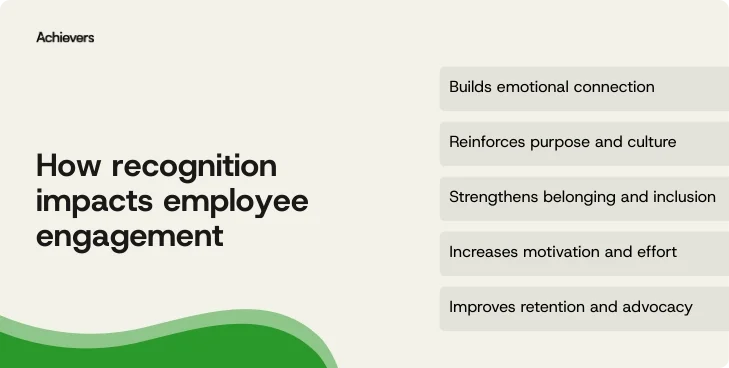
Builds emotional connection
Feeling recognised creates a personal connection to work. When effort is acknowledged, people feel seen — not invisible — which strengthens trust and commitment to the organisation. In other words, recognition is important to engagement because it reminds people that their work counts.
Reinforces purpose and culture
Recognition brings purpose into everyday moments. By calling out behaviours that reflect company values, it helps employees understand how their work fits into the bigger picture — and what success looks like in practice.
Strengthens belonging and inclusion
Who gets recognised — and how often — sends a powerful signal about who belongs. Fair, visible recognition gives employees a voice, increases workplace inclusion, and helps people feel part of something shared, not sidelined. And when people feel they belong, they’re far less likely to mentally check out.
Increases motivation and productivity
Recognition fuels momentum. When progress and effort are acknowledged, employees are more motivated to keep going — investing more focus, energy, and care into their work. Recent data says 91% of employees say they’d put in more effort if they felt meaningfully recognised. Turns out appreciation is a pretty strong productivity tool.
Improves retention and advocacy
People are more likely to stay where they feel appreciated. Consistent recognition reinforces that employees matter — which not only improves retention but also turns people into advocates for the organisation.
Recognition strategies to boost engagement
Recognition is one of the simplest ways to spark engagement, but doing it well takes more than good intentions and an annual shoutout. It takes rhythm, clarity, and a workplace culture that believes appreciation is part of the work, not an extra step.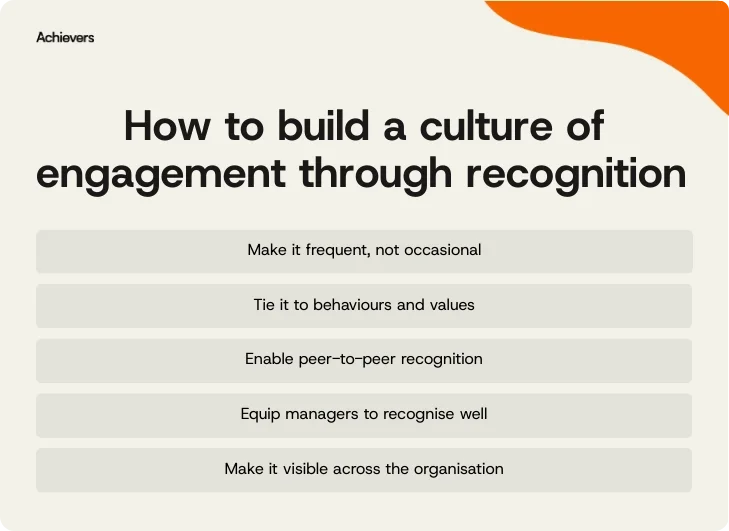
Here are a few practical ways to turn recognition into engagement:
1. Make recognition frequent, not occasional
Engagement grows in the daily moments where effort gets noticed. Frequent, in‑the‑flow recognition keeps momentum high and gives employees real‑time feedback on what’s working. Think of it as removing guesswork: when people know their impact is seen, they stay engaged in creating more of it.
2. Tie recognition to behaviours and values
Generic “great jobs” don’t change culture. Specific recognition does. When you call out the exact behaviour and connect it to your organisation’s values, you show employees how their work moves the business forward. It builds clarity, confidence, and a shared understanding of what great looks like.
3. Enable peer-to-peer recognition
Peers see the moments managers miss — the quick assist, the creative workaround, the save of the day that didn’t make it into a meeting. Empowering employees to recognise each other creates more touchpoints, more connection, and a more human culture. It turns recognition into something that belongs to everyone, not just leaders.
4. Help managers recognise often and well
Manager recognition carries outsised impact, but only if managers feel confident delivering it. Help them focus on recognition that is timely, specific, and tied to impact. When managers develop strong recognition habits, they strengthen trust, build alignment, and make engagement feel personal, not programmatic.
5. Make recognition visible across the organisation
Visible recognition openly helps people understand what’s valued beyond their own team. When employees can see recognition happening across teams and departments, it reinforces what your culture rewards. It also helps people learn from one another’s strengths and feel part of something larger than their immediate role.
6. Use insights to close engagement gaps
Recognition data helps organisations understand where engagement is thriving — and where it’s at risk. By looking at who’s being recognised — and who isn’t — leaders can quickly spot blind spots, inequities, or struggling teams. Using data to adjust recognition habits ensures appreciation is felt consistently and inclusively, long before disengagement turns into turnover.
The proof behind employee engagement and recognition
If you’ve ever wondered whether recognition really moves the needle on engagement, the data has something to say — loudly. Between the EMEA Engagement & Retention Report and the UK State of Recognition Report, we’re sitting on thousands of data points that all tell the same story: when people feel seen, everything else gets easier.
Here are five proof points that cut through the noise and show what recognition actually does inside an organisation:
1 in 4 employees feel appreciated — and they’re 12x more likely to find work meaningful
When employees feel appreciated, work stops being a list of tasks and becomes a place where what they do actually matters. That sense of meaning is the foundation of sustainable engagement. It’s not sentimental. It’s the anchor that keeps employees aligned to values, connected to purpose, and interested in building a future with you.
Weekly recognition makes employees 3x more engaged and 2.6x more productive
Weekly recognition doesn’t just feel good, it gives employees a clear feedback loop that helps them stay focused, confident, and energised. When recognition is frequent, employees don’t waste time guessing whether they’re on the right track; they already know. That clarity boosts motivation, and reinforces the behaviours leaders want more of.
Manager recognition makes employees 19x more likely to trust their leader
Trust isn’t built in performance reviews — it’s built in the everyday moments where managers acknowledge effort, progress, and impact. And when trust goes up, everything else gets easier: communication, alignment, psychological safety, and the willingness to follow a leader through change.
Nearly 1 in 3 employees say better recognition would reduce their job hunting
Retention isn’t always about pay or perks. Sometimes it’s about reassurance. When recognition is missing, employees interpret the silence as a lack of value or future potential. But when they consistently hear what they’re doing well, suddenly, staying feels like the smart move. Recognition reduces uncertainty, builds psychological commitment, and gives employees a reason to stop refreshing job boards.
Achievers: The link between recognition and engagement
Engagement doesn’t live in a single programme or moment. It’s built through everyday employee experiences — feeling informed, valued, supported, and connected to meaningful work. Recognition plays a central role in all of it. It turns values into action, effort into impact, and intention into behaviour people want to repeat.
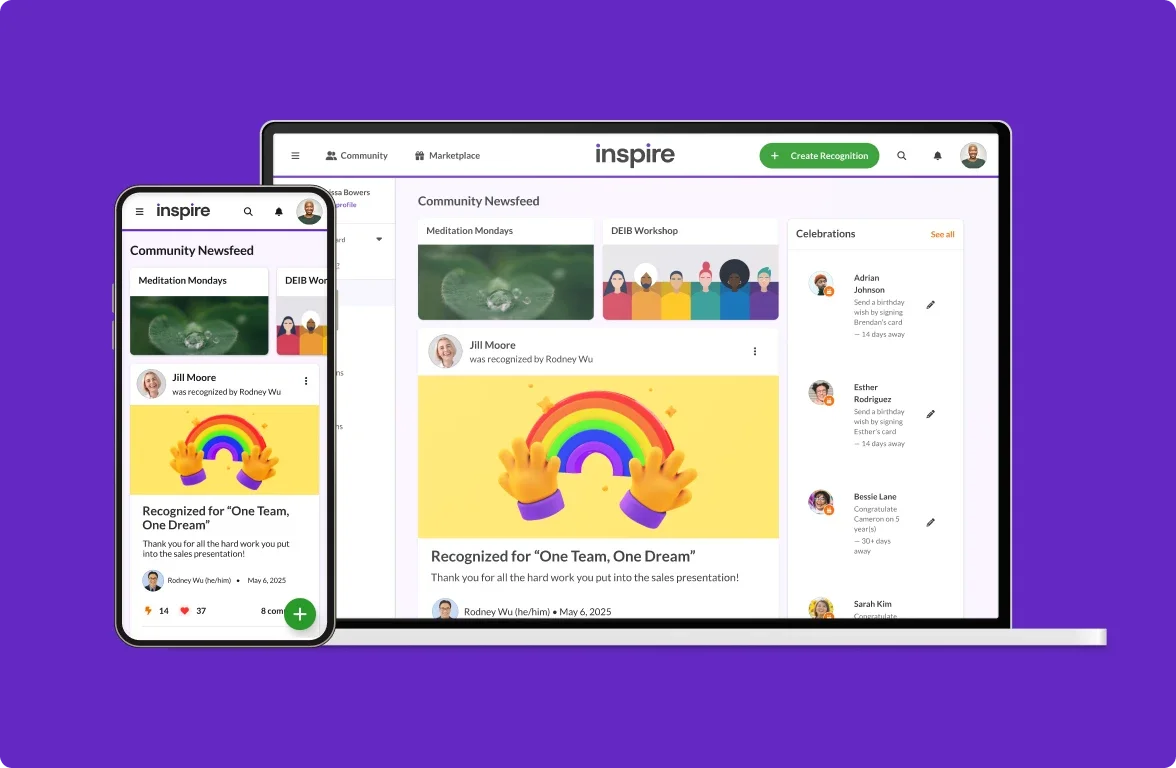
That’s where Achievers comes in. Achievers connects recognition, insights, and employee voice into one experience — so engagement isn’t left to chance or scattered across tools. By making recognition frequent, meaningful, and visible, organisations can reinforce what matters most, close engagement gaps sooner, and build cultures where people don’t just perform — they participate, feel proud, and promote the work they’re part of.
Because when recognition is woven into how work gets done, engagement doesn’t have to be chased. It shows up, and it shows up proud.
Employee engagement and recognition FAQs
Key insights
- Engagement reflects how invested employees feel, while recognition is how organisations actively build and sustain that investment.
- Done well, recognition strengthens emotional connection, clarifies what success looks like, and helps employees see how their work matters.
- Organisations see the greatest impact when recognition is embedded into daily work, enabled across peers and managers, made visible, and informed by insights.