
Table of contents
Create a culture that means business™
Schedule a demo with an Achievers solution expert today.


 Copy URL
The UK workplace doesn’t have an enthusiasm problem. It has a confidence problem.
People are showing up. Work is getting done. But belief — that sense that effort is noticed, valued, and worth repeating — is quietly eroding. Hybrid work has blurred visibility. Change fatigue is real. And while many employers have done the right thing on pay and benefits, engagement is still slipping.
According to the Achievers Workforce Institute’s 2026 Engagement and Retention Report – EMEA edition, only around one in four UK employees feel genuinely appreciated at work, and even fewer feel strongly connected to their organisation’s values. At the same time, a growing proportion of employees are either actively job hunting or undecided — not disengaged enough to leave tomorrow, but not committed enough to stay long‑term.
That’s not about motivation. We’re talking about trust.
This erosion of trust and engagement mirrors broader UK research. The CIPD’s employee engagement factsheet highlights how recognition, fairness, and employee voice play a critical role in sustaining motivation and commitment — especially during periods of organisational change.
When people aren’t sure their contribution matters, discretionary effort disappears. Innovation slows. Loyalty becomes transactional. You may keep people employed — but you won’t keep their best thinking, their energy, or their long‑term commitment.
This is where employee incentive programmes earn their place — not as perks, but as signals.
Done well, they clarify what matters, reinforce the right behaviours, and rebuild belief that effort leads somewhere. Done poorly, they become background noise — well‑intentioned, well‑designed, and quietly ignored.
Let’s focus on doing them properly.
What are employee incentive programmes?
Employee incentive programmes — also known as employee incentive schemes or employee rewards programmes —are structured ways organisations recognise and reinforce the behaviours they want more of. They sit alongside base pay and benefits, using targeted monetary and non‑monetary rewards to acknowledge contribution, performance, and values in action.
At their core, incentive programmes answer two questions UK employees are always asking — even if they don’t say them out loud:
- Is this effort worth it?
- Does anyone actually notice?
For years, many UK organisations relied on annual bonuses, commission schemes, or long‑service awards to answer those questions. They still have a role — but on their own, they’re too distant, too infrequent, and too blunt.
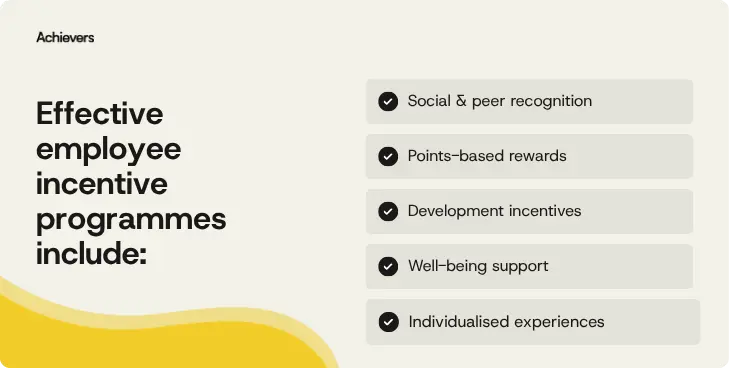
Modern employee incentive programmes are more deliberate. They include:
- Social and peer recognition
- Points‑based rewards
- Development and skill‑building incentives
- Well-being and lifestyle support
- Experiences employees can choose themselves
Most importantly, they’re embedded into everyday work. They don’t live in policy documents. They show up where work actually happens.
Why employee incentive programmes matter in the UK
UK employees tend to care deeply about fairness, consistency, and credibility. If recognition feels random or performative, it doesn’t motivate — it irritates.
Achievers Workforce Institute data makes this clear. Employees who feel appreciated are far more likely to find their work meaningful, feel connected to colleagues and managers, and see a future with their organisation.
In other words: appreciation isn’t a nice‑to‑have. It’s a predictor.
Employee incentive programmes matter because they:
- Make appreciation visible and repeatable
- Clarify what “good” actually looks like
- Reinforce behaviours aligned to business goals
- Support retention without undermining fair pay practices
It’s no coincidence that guidance from organisations like Acas and CIPD consistently highlights recognition, employee voice, and fair reward as foundations of strong employee relations — especially during periods of change.
15 employee incentive programmes that work in UK organisations
Because subtle, consistent signals beat grand gestures every time)
Skip the gimmicks. UK organisations need incentive programmes that feel thought‑through, fair, and genuinely motivating. These 15 do exactly that.
1. Points‑based recognition programmes
A clear, consistent way to recognise contribution. Points give flexibility and choice — and avoid the awkwardness of one‑size‑fits‑all rewards. They also make appreciation easier to repeat, turning recognition from a one‑off moment into a habit that actually sticks.
2. Peer‑to‑peer social recognition
Recognition doesn’t need a job title. Peer recognition builds credibility and connection, especially in hybrid teams where good work can easily go unseen. When appreciation flows in every direction, not just top‑down, it strengthens trust and reminds people that their impact is felt across the team.
3. Manager‑led spot awards
A timely “thank you” from a manager still matters. Spot awards reinforce effort when it happens — not months later in a performance review. They help managers show what “great” looks like in real time, which is far more motivating than trying to remember it at year‑end
4. Skills and capability incentives
Recognise new skills as they’re developed, not just when roles change. Progress matters, even when promotions aren’t immediate. By rewarding learning along the way, organisations signal that growth is valued — not just outcomes — which keeps people invested for the long term.
5. Learning and development incentives
Incentivising courses and certifications signals long‑term investment — not short‑term extraction. UK government research has also highlighted the link between learning, development, and employee engagement — reinforcing why development‑focused incentives resonate so strongly with employees who are thinking about long‑term employability, not just short‑term rewards.
6. Well-being‑aligned incentives
Guidance from Acas and NICE makes it clear that supporting mental well-being and sustainable work practices is central to long‑term performance — not separate from it. Well-being‑aligned incentives help reinforce that commitment in practical, visible ways.
7. Flexible, time‑based rewards
Extra leave or flexible scheduling recognises effort without adding pressure — a big win for work‑life balance. By rewarding time and flexibility, organisations reinforce sustainable performance rather than quietly incentivising burnout.
8. Values‑based recognition
If values matter, recognise them in action. Incentives tied to behaviours like collaboration or integrity reinforce culture far better than posters ever will. They also give employees clarity on what “good” actually looks like in practice, not just in principle.
9. Team‑based incentives
Shared goals deserve shared rewards. Team incentives reduce silos and encourage collective accountability. They help teams move from individual optimisation to collective success — where most meaningful progress actually happens. They help teams move from individual optimisation to collective success — where most meaningful progress actually happens.
10. Employee referral incentives
Referrals work when recognition is timely and ongoing — not delayed until probation ends. Recognising effort throughout the process keeps momentum high and signals that helping build the team is genuinely valued.
11. Innovation and idea‑sharing incentives
Recognise people for speaking up, not just delivering. It tells employees their voice is safe — and valued. When ideas are rewarded, curiosity and continuous improvement stop being “nice extras” and start becoming habits.
12. Performance‑linked micro‑bonuses
Smaller, more frequent financial rewards feel more immediate (and motivating) than one distant annual payout. They create a clearer connection between effort and reward, reinforcing the behaviours you want more of in real time.
13. Inclusion and belonging incentives
Recognise behaviours that build psychological safety, allyship, and inclusion. Belonging doesn’t happen by accident — it’s centred around appreciation. AWI data shows that employees who feel appreciated are 54x more likely to feel a strong sense of belonging, making inclusion‑driven recognition one of the most powerful levers organisations have for connection and retention.
14. Experiential rewards
Experiences create meaning, not clutter. They’re remembered far longer than cash. Whether it’s learning, travel, or giving back, experiences help employees associate recognition with moments that genuinely matter.
15. Practical, everyday rewards
Sometimes the most appreciated rewards are the most useful. Everyday value shows appreciation without trying too hard. These rewards meet people where they are — and often land harder than anything flashy ever could.
How to implement an employee incentive programme
Implementing an employee incentive programme is most effective when it follows a clear, step‑by‑step approach. Each stage builds on the last, helping you create a programme that’s meaningful for employees and delivers measurable impact across the organisation.
1. Set clear objectives from the start
Begin by defining what the programme is designed to achieve. This may include improving engagement, supporting retention, reinforcing core values, or driving specific business outcomes. Clear objectives give recognition purpose and ensure it’s linked to the behaviours that matter most. When employees understand the “why” behind recognition, it feels intentional rather than arbitrary.
2. Secure leadership and stakeholder buy‑in
Successful incentive programmes are supported from the top. Engage leaders and key stakeholders early to ensure the programme aligns with wider organisational priorities. Visible leadership support reinforces that recognition is a strategic priority—not a side initiative—and helps build long‑term credibility and momentum.
3. Understand what your workforce values
Listen before you design. Use employee surveys, focus groups, and workforce data to understand what motivates your people and what they value most. When incentives reflect real employee preferences, participation increases and recognition feels more personal. One‑size‑fits‑all rewards rarely drive sustained engagement.
4. Design the incentive structure with intention
Create a balanced mix of recognition and rewards that reflect your workforce, roles, and ways of working. This might include points‑based rewards, financial incentives, experiences, wellbeing benefits, or development opportunities. Most importantly, embed recognition into everyday work through both peer‑to‑peer and manager‑led moments. Recognition is most powerful when it happens in real time, not just during annual events.
5. Build in fairness, transparency, and compliance
Transparency builds trust. Clearly define how recognition is earned, what great performance looks like, and how rewards align with your organisation’s values. For UK employers, it’s also important to consider how incentives are treated for tax and employment compliance purposes. Some rewards may be subject to PAYE and National Insurance contributions under HMRC rules, and programmes should be designed to support fair and consistent treatment across the workforce in line with employment legislation. Clear, multi‑channel communication helps ensure employees understand how the programme works and builds confidence from day one.
6. Measure engagement and outcomes
Track participation, engagement levels, and reward usage using data and employee feedback. Reporting dashboards and workforce insights help identify what’s working and where adjustments are needed. Measurement also links recognition to business outcomes such as improved retention, stronger performance, and closer alignment to organisational values.
7. Evolve the programme over time
Treat your incentive programme as a living system. Regularly review results, listen to employee feedback, and adapt your approach as your workforce and business priorities change. Programmes that remain relevant, fair, and trusted continue to deliver value well beyond launch.
When recognition is done right, employees feel seen, heard, and appreciated — and organisations see the results.
Key budgeting strategies for employee incentive programmes
Start with a meaningful investment
Recognition works when it’s taken seriously. As a general guideline, allocating 1%–3% of payroll helps ensure your program is consistent, credible, and sustainable. Some organisations choose to invest more to accelerate impact, but the goal is the same: fund recognition in a way that reflects its importance to your people and your culture.
Budget for frequency, not just moments
Recognition shouldn’t be rare. Achievers Workforce Institute research shows that aiming for at least one recognition moment per employee each month builds connection, reinforces values‑led behaviours, and drives measurable engagement gains. Frequent, timely recognition delivers far more value than occasional, high‑profile awards alone.
Use a points‑based model for flexibility and control
Points‑based budgets empower leaders to recognise great work in the moment while maintaining clear financial guardrails. Managers receive a set allocation of points to distribute, and employees choose rewards that matter most to them. The result: recognition that feels personal, fair, and motivating — without overspending.
Track spend in real time
Modern recognition platforms provide visibility into points issued, points redeemed, and overall programme liability. This real‑time insight helps organizations stay on budget while giving managers the freedom to recognize often and authentically.
Balance everyday recognition with milestone moments
High‑impact programs blend formal awards — such as service milestones or performance recognitions — with frequent, low‑cost social recognition like peer shout‑outs or points‑based appreciation. Together, they create a culture where employees feel valued in both everyday moments and major achievements.
Leverage technology for accountability and insight
Digital recognition platforms offer team‑ and department‑level reporting, budget dashboards, and forecasting tools. This transparency supports fairness and consistency while helping leaders align recognition activity to business priorities.
Measure ROI to reinforce the business case
A well‑funded recognition programme delivers more than feel‑good moments. Tracking outcomes like retention, engagement, productivity, and reduced turnover costs helps show how recognition directly supports performance and long‑term organizational value.
How to build an employee incentive programmes that actually works
Designing a successful employee incentive programme isn’t about chasing trends or piling on perks — it’s about creating a system where recognition is frequent, fair, and built into everyday work. That’s exactly where Achievers shines.
Our platform helps organisations turn appreciation into action, using recognition and rewards to reinforce the behaviours that drive performance, connection, and retention. With science‑backed insights from the Achievers Workforce Institute, seamless integrations into the tools your people already use, and rewards employees genuinely value, Achievers makes it easier to build incentive programmes that don’t just look good on paper — they work in real life. Seen. Heard. Appreciated. That’s how you shape your workforce for results.
Employee incentive programs FAQs
Key insights
- Employee incentive programmes work best in the UK when recognition is consistent, fair, and built into everyday work — not saved for special occasions
- Appreciation isn’t a perk; it’s a signal that effort matters and is worth repeating
- The strongest incentive programmes don’t buy engagement — they earn it by reinforcing the behaviours that drive culture, performance, and retention
In short: appreciation isn’t a perk. It’s a predictor.
(Retention savings + productivity gains + absenteeism reduction + employer brand value – total program costs) ÷ total program costs = ROI %