Table of contents
Create a culture that means business™
Schedule a demo with an Achievers solution expert today.


 Copy URL
For HR leaders and people managers across the UK, the pressure is familiar. Retain talent while budgets tighten. Support well-being through constant change. Keep teams motivated as workloads increase and expectations remain high.
In that environment, one question matters more than most: do employees feel valued at work?
Not through token gestures or once‑a‑year recognition schemes — but through everyday experiences that signal effort is noticed, contributions matter, and people are more than just output.
Yet the 2026 Engagement and Retention Report shows that this experience is far from consistent in the UK. Only 25% of employees say they’re engaged at work. While 37% find their work meaningful, that sense of purpose isn’t translating into day‑to‑day feelings of recognition.
For HR teams, this gap is frustrating — and familiar. The intention to recognise employees is there. But it doesn’t always show up in the moments that matter most. And when that gap persists, disengagement doesn’t arrive with a dramatic exit. It shows up quietly: lower energy, reduced discretionary effort, and rising retention risk.
The opportunity, however, is significant. Research consistently shows that engaged employees are more productive, more loyal, and more resilient — even in challenging economic conditions.
So the question for UK HR and people leaders is clear: how do you make employees feel genuinely valued — consistently, credibly, and at scale?
Ways to make employees feel valued at work
To make employees feel valued at work, you must recognise them often, listen intentionally, and act on what they tell you. Feeling valued doesn’t come from an annual review or a once‑a‑year bonus — it’s built through everyday moments that show people their work matters and their voice counts.
One of the most common missteps organisations make is treating recognition as an event instead of a habit. Annual awards matter — but they can’t make up for months of silence in between.
What actually makes the difference is frequency. When appreciation shows up regularly, employees don’t just feel thanked in the moment — they feel connected to their work, motivated to keep going, and committed to the organisation behind it. Research consistently shows that making employees feel valued comes down to small, consistent actions — not grand gestures — rooted in respect, recognition, and genuine human connection.
Many organisations struggle here, not because they don’t care, but because recognition isn’t built into everyday work. When appreciation isn’t embedded into the tools and workflows teams already use — like Workday, Outlook, Slack, and Microsoft Teams — it becomes something leaders intend to do “when there’s time”. And in fast‑moving, delivery‑driven environments, that time rarely materialises.
When employees feel seen — for effort, progress, and impact — engagement follows. When they don’t, even strong performers can begin to disengage quietly.
In the UK, the gap between how employees want to feel at work and how they actually feel is clear. AWI data shows that:
- Only around 1 in 4 UK employees feel genuinely appreciated at work
- Similarly, just about 1 in 4 feel connected to their organisation’s values
- About 1/4 see a long‑term career with their current employer
Because that gap isn’t just a signal something’s wrong; it’s a chance to act. When organisations make appreciation frequent, visible, and part of everyday work, they don’t just close the gap — they build stronger connection, deeper purpose, and a far clearer reason for employees to stay.
Feeling valued at work in the UK starts with being seen
Feeling valued at work isn’t about grand gestures or performative praise. It’s about visibility.
When employees feel seen — for effort, progress, and impact — engagement follows. When they don’t, even capable, committed people begin to disengage quietly. Not because they’ve stopped caring, but because they’re unsure whether their contribution is recognised or understood.
UK employees generally understand their organisation’s purpose — 30% say they feel connected to company values, and 35% understand how their work contributes to the organisation’s mission. But without consistent, personalized, and authenitc recognition, that clarity doesn’t always translate into motivation or commitment.
Being seen is the foundation of feeling valued — and it’s something organisations can’t afford to overlook.
Why appreciation beats perks every time
Perks and benefits matter — particularly during a cost‑of‑living crisis — but they don’t replace appreciation.
Flexible working, well-being initiatives, and employee discounts can support people, but they don’t answer a more fundamental question: does my work actually matter here?
Across the UK, retention pressure is rising. When appreciation is missing, employees don’t always speak up. Instead, they quietly reassess their future — often long before they hand in their notice.
That’s why feeling appreciated at work isn’t a “nice to have.” It’s one of the most effective, and most affordable, retention levers organisations have.
How employee value propositions shape how employees feel valued at work
For many UK organisations, figuring out how to make employees feel valued at work starts with a strong employee value proposition.
What is an employee value proposition
An employee value proposition is the combination of experiences, benefits, and values an organisation offers employees in return for their time and effort—and it explains, in practical terms, why people choose to join, stay, and do their best work.
On paper, most EVPs are clear enough: flexibility, meaningful work, growth, well-being, fairness. The challenge isn’t what’s promised — it’s how consistently those promises show up in everyday work.
Because an employee value proposition isn’t lived on a careers page. It’s lived in moments of recognition.
When recognition programmes reflect the EVP, employees feel the difference. When it doesn’t, the gap is obvious. A company that talks about development but rarely recognises learning or progress sends mixed signals. One that champions inclusion but rewards only a narrow set of behaviours does the same.
In the UK, where trust and consistency matter, this is a big part of how to make employees feel valued at work. Employees don’t just listen to what organisations say they value — they watch what gets recognised.
That’s where recognition does the real work. It turns EVP promises into everyday proof.
Tie recognition to purpose, not just performance
Recognition has the greatest impact when it connects effort to meaning.
That means going beyond what someone delivered and explaining why it mattered, such as:
- How someone lived a company value
- How their work helped a customer, client, or colleague
- How their actions supported broader organisational goals
UK employees aren’t lacking purpose — but without recognition, that purpose can feel distant. When appreciation reinforces the “why” behind the work, recognition becomes a tool for alignment, not just motivation.
Employees who understand their impact don’t just feel valued. They feel anchored.
Make appreciation inclusive and visible
Another reason employees struggle with feeling valued at work? Recognition is often uneven.
When appreciation depends on proximity to leadership or individual manager style, blind spots appear. Important contributions go unnoticed — particularly in hybrid teams, frontline roles, or matrixed organisations.
Peer‑to‑peer recognition helps close that gap. It captures everyday impact managers may not always see and makes appreciation a shared responsibility across the organisation.
Visibility matters too. When recognition is visible, it reinforces standards, builds trust, and shows what good work looks like in practice.
7 practical steps for making employees feel valued at work
Knowing why appreciation matters is important. Knowing how to act on it is what actually changes the employee experience. These seven steps turn good intentions into everyday habits.
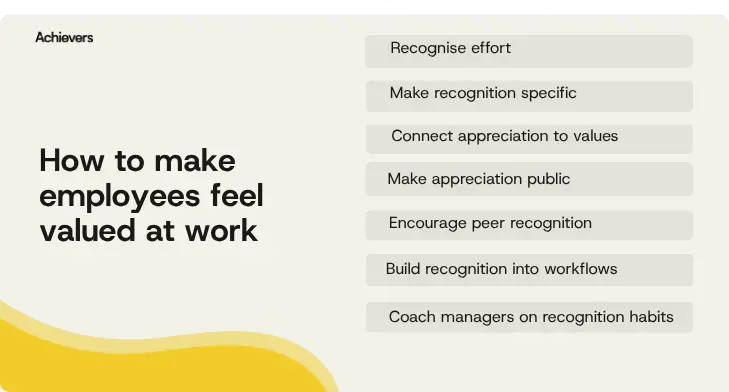
1. Recognise effort in the moment, not just outcomes
Don’t wait for perfect results or major milestones. Recognising progress, problem‑solving, or resilience as it happens reinforces that effort itself is valued — not just final outcomes, such as a manager calling out how a team member handled a difficult customer escalation calmly and professionally, even before the issue was fully resolved.
2. Be specific about what you’re recognising
Vague praise fades quickly. Specific recognition builds clarity and confidence by showing employees exactly what they did well and why it mattered, like thanking someone for clearly summarising complex information for senior stakeholders and helping a meeting stay focused and on track.
3. Connect appreciation to values and purpose
Recognition resonates more deeply when it reflects what the organisation stands for. Linking appreciation to values, customer impact, or strategic goals helps employees see their role in the bigger picture. For example by recognising a colleague for supporting a teammate during a busy period and explicitly linking it to your organisation’s value of collaboration or integrity.
4. Make recognition visible, not private by default
Private thanks have their place — but visible recognition amplifies impact. Public appreciation reinforces expectations and helps others learn what success looks like, such as sharing a recognition message in a company‑wide channel to highlight a cross‑team win delivered under tight timelines.
5. Empower peers to recognise each other
Managers don’t see everything — colleagues do. Peer recognition captures everyday contributions and strengthens trust and connection across teams, like when a teammate publicly thanks a colleague for stepping in to help meet a deadline during a peak workload.
6. Build recognition into everyday workflows
If recognition feels like extra work, it won’t last. Embedding appreciation into existing tools and routines makes recognising great work easier and more consistent, for example by building shout‑outs into regular team check‑ins or project wrap‑ups rather than saving them for formal reviews.
7. Coach managers to lead with appreciation
Managers shape how valued employees feel more than anyone else. Equipping them with simple, repeatable recognition habits creates consistency, trust, and stronger teams, such as encouraging managers to acknowledge specific contributions during one‑to‑ones or team meetings as a regular leadership practice.
How to make employees feel their value with Achievers
So how do you make employees feel valued at work in a way that actually lasts? You:
- Build recognition into everyday work
- Make appreciation specific, meaningful, and tied to what matters
- Connect effort to purpose and values
- Empower everyone — not just leaders — to participate
- Put systems in place that make appreciation easy, consistent, and visible
That’s where Achievers comes in.
Achievers helps organisations across the UK move beyond one‑off moments and build cultures where recognition is part of how work gets done. By embedding appreciation into daily workflows and giving employees and managers the tools to recognise what matters, Achievers turns feeling valued from an intention into a shared habit.
When employees feel valued and appreciated, culture becomes tangible. Engagement becomes sustainable. Retention becomes a choice — not a risk.
That’s not just how great workplaces feel. It’s how they’re built — with Achievers.
How to make employees feel valued at work FAQs
Key insights
- Employees feel valued when recognition is frequent, specific, and part of everyday work.
- Appreciation has the greatest impact when it clearly connects effort to purpose and values.
- Scalable recognition turns feeling valued into stronger engagement and retention.
How employees feel at work isn’t just a warning — it’s an opportunity
Visibility multiplies value