Table of contents
Create a culture that means business™
Schedule a demo with an Achievers solution expert today.


 Copy URL
Employee engagement is the strength of the emotional and professional connection employees have to their work, their teams, and their organization. When that connection is strong, people invest more of themselves, perform at a higher level, and are far more likely to stay. When it’s weak, productivity slips, culture strains, and turnover starts doing what turnover does best.
And the risk is real. In 2026, only 25% of employees see a long-term career at their current company, according to the latest Engagement and Retention Report. That’s not a snack-budget issue. It’s a connection issue. Engagement builds when recognition, communication, and culture show up in everyday work.
Ready to make engagement mean something again? Let’s break down what drives it, how to measure it, and how to turn insight into action.
What is employee engagement?
Employee engagement is the emotional commitment employees have to your organization and its goals — not just what they do, but why they do it.
Engaged employees care about their work. They care about the people they work with. And they care about whether their effort actually makes a difference. They don’t show up just for a paycheck or the next title. They show up because they feel connected to the mission, confident in what’s expected of them, and recognized when they deliver.
Why employee engagement matters
It’s easy to treat engagement as optional. In reality, it’s one of the most reliable indicators of whether a business is built to perform — or constantly forced to scramble.
When engagement is low, you feel it across the board: performance dips, customer experience suffers, and turnover rises. When it’s high, everything works better — from productivity and performance to innovation.
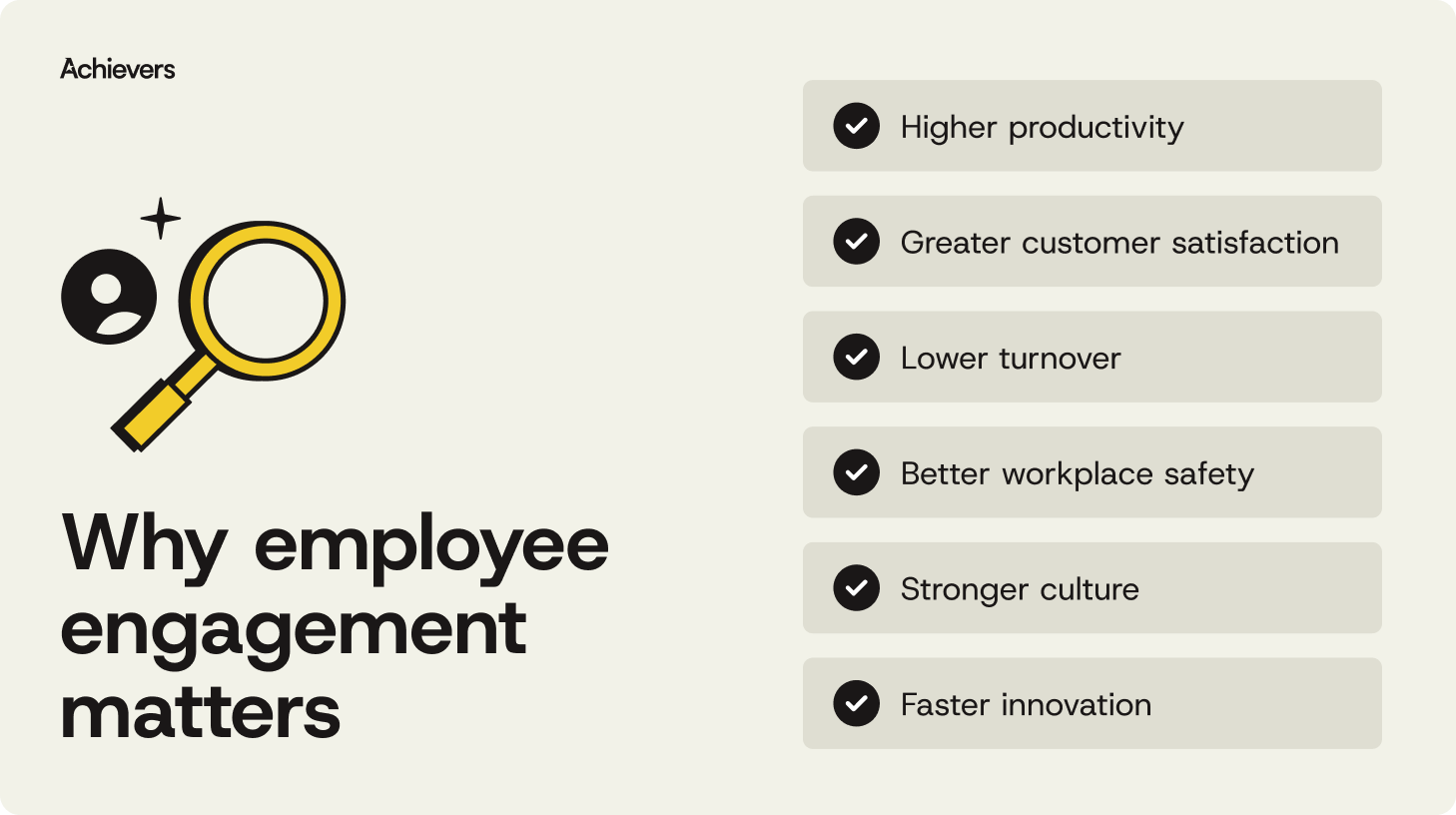
Here’s what you’re really investing in when you invest in engagement:
Higher productivity
Engaged employees don’t just get more done — they bring energy and purpose to the work. That shows up in faster execution, sharper focus, and stronger outcomes.
Greater customer satisfaction
People who feel connected to their work are more likely to go the extra mile for customers. That care and commitment ripple outward — straight to your brand experience.
Lower turnover
When employees feel seen, valued, and supported, they’re far more likely to stay. Engagement is one of the strongest predictors of retention — and it costs a lot less than replacing top talent.
Better workplace safety
A psychologically safe workplace is an engaged one. When people feel safe speaking up, asking questions, or owning mistakes, the whole organization runs more smoothly — and more safely.
Stronger culture
Engagement fuels culture — not the other way around. Recognizing the right behaviors, building trust, and reinforcing shared goals all help shape a culture people want to be part of.
Faster innovation
People do their best thinking when they care about the outcome. Engaged teams are more likely to share ideas, experiment, and collaborate — turning good intentions into big ideas.
The real power of engagement shows up in the little things. People pitch in without being asked, go further than the job description, and care about the end result — because it feels like their work matters.
7 pillars of employee engagement
Engagement doesn’t happen by accident, and it’s not about guessing what might make people happy. It’s about building the right foundation. These pillars are what actually drive employee engagement today:
Clear goals and expectations
Employees want to know where they’re going and what success looks like. Clarity gives people confidence — and makes it easier for teams to stay aligned and accountable.
Ongoing feedback and communication
Two-way communication is foundational to employee engagement. Without it, even well-intentioned messages can start to feel like announcements no one asked for.
Recognition and appreciation
Recognition plays a major role in employee engagement. When it’s specific, timely, and aligned to values, it reinforces the behaviors that drive performance — and reminds people their work actually counts.
Opportunities for growth and development
Stagnation is the enemy of engagement. Employees are more invested when they can see a future — with access to learning, stretch projects, and clear career paths.
Psychological safety and inclusion
When people feel safe to speak up, ask questions, and show up as themselves, engagement gets stronger. And it goes hand in hand with balance. Supporting work-life boundaries shows employees that their well-being matters, and that they’re trusted to manage their time and energy in a way that works for them.
A sense of purpose and impact
People want to know their work means something. Connecting day-to-day tasks to bigger goals helps employees feel like they’re part of something that matters.
Strong relationships with managers and peers
Engagement is personal — and relational. Trust, support, and meaningful connections at work have a real impact on how committed people feel to the organization.
Forward-thinking organizations are expanding how they measure engagement by incorporating behavioral data generated through recognition. Discover how recognition supports stronger organizational alignment and measurable business outcomes across the workforce.
How to improve employee engagement
If you want to improve engagement, you have to do more than measure it. You have to mean it. Because no matter how pretty your engagement survey looks, it won’t move the needle unless it’s backed by action.
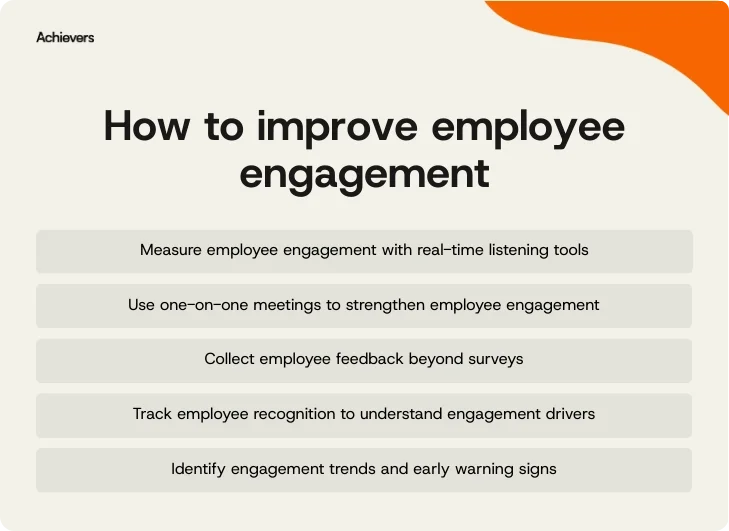
Here’s how you can get it right:
Measure employee engagement with real-time listening tools
The annual engagement satisfaction survey? It’s officially outdated. Modern platforms capture sentiment continuously — across milestones, feedback, and manager relationships — so leaders can spot friction early and act before disengagement becomes the norm.
Use one-on-one meetings to strengthen employee engagement
One-on-ones aren’t status updates. When done well, they create space for honest conversation, coaching, and support — the kind that builds trust and makes work feel a little more human.
Collect employee feedback beyond surveys
Dashboards show what is happening. Focus groups, town halls, and open forums reveal why. Together, they give employees a real voice in shaping the experience they’re part of.
Track employee recognition to understand engagement drivers
Recognition data shows which behaviors are being reinforced — and which ones aren’t. If you want to know what your culture truly rewards, this is where to look.
Identify engagement trends and early warning signs
Engagement data helps you move from reactive to proactive. Instead of waiting for exit interviews to tell the story, you can spot shifts in participation, sentiment, and recognition patterns early — and step in with the right support. If people stop participating, start burning out, or quietly check out, the data will tell you. The question is: will you notice it in time?
Why recognition drives engagement
Recognition gets written off as a “nice gesture” way too often. But the data tells a different story. According to Achievers Workforce Institute, employees who get recognized in a meaningful way at least monthly are 6x more likely to recommend their company as a great place to work.
That’s a big lift — from something that takes just a few minutes, but makes people feel seen, valued, and connected to their purpose.
That’s where Achievers comes in. Our employee recognition platform is built to make recognition more than a feel-good moment — it turns it into a habit that fuels engagement, culture, and performance. Here’s how:
- Recognition fits right into the flow of work: With integrations into the tools your teams already use, it’s easy to send recognition in real time — no extra tabs or awkward workflows.
- Backed by behavioral science: Every part of the platform is designed around what actually drives people — so recognition isn’t just frequent, it’s meaningful and aligned to the right behaviors.
- Rewards that feel personal, not uniform: With a global rewards marketplace that spans experiences, donations, gift cards, and more — across 190+ countries — employees can choose what matters to them.
- Insights leaders can act on: Real-time dashboards make it easy to spot trends, flag gaps, and understand how recognition is driving engagement — so managers and leaders can act, not just observe.
- Tools that help build a more inclusive culture: With features like the Inclusion Coach and always-on feedback, we help organizations make sure every voice is heard — and every person feels valued.
Build an employee engagement strategy that scales
At the end of the day, employee engagement doesn’t just happen — you build it. Through recognition, connection, and continuous measurement, you shape the workplace where people want to show up, contribute, and stay.
But doing that at scale is a different challenge. As organizations grow, culture can get diluted, tools become disjointed, and engagement strategies start to lose momentum. That’s where a purpose-built platform makes a real difference.
Achievers is designed to keep recognition flowing, feedback constant, and insights actionable. Every interaction is built to feel personal, no matter how large or global your team is. It’s not about adding more tools. It’s about making engagement part of how your organization works — every day.
If you’re ready for a better approach to employee engagement, we’re ready to help you build it.
Key insights
- Employee engagement is a leading indicator of performance, retention, and business health.
- Sustainable engagement is built through clear goals, ongoing communication, and systems that support real action.
- Frequent, meaningful recognition strengthens engagement by reinforcing the behaviors and values that matter most.