
Table of contents
Create a culture that means business™
Schedule a demo with an Achievers solution expert today.


 Copy URL
Peer‑to‑peer recognition isn’t always prioritised in Singapore’s results‑driven workplaces. With pressure to move quickly and deliver consistently, appreciation is often assumed rather than expressed — even when everyday contributions play a critical role in sustaining performance.
That gap matters. While manager‑led recognition still carries weight in Singapore’s more hierarchical cultures, it can’t fully capture the day‑to‑day efforts that drive results — the collaboration that prevents errors, the quiet support that keeps projects on track, or the teammate who steps in without being asked. These moments shape performance, yet they’re often unseen.
The impact is clear. According to the Achievers Workforce Institute’s 2026 Engagement and Retention Report: APAC edition, only 15% of employees in Singapore feel appreciated and engaged at work. In a competitive talent market, that lack of recognition puts engagement, retention, and trust at risk.
This is where peer‑to‑peer recognition makes the difference. When colleagues consistently recognise one another’s efforts, appreciation becomes more visible, more inclusive, and more reflective of how work actually gets done — reinforcing values, strengthening connection, and supporting the high‑performance cultures Singapore organisations rely on.
What is peer‑to‑peer recognition?
Peer‑to‑peer recognition is the practice of employees recognising and appreciating one another for meaningful contributions, collaboration, and living organisational values — clearly, consistently, and as part of everyday work.
In many Singapore workplaces, appreciation still happens quietly: a quick message on WhatsApp, a passing comment after a meeting, or a thank‑you that never travels beyond the team. Peer‑to‑peer recognition brings those moments into the open, ensuring everyday effort doesn’t remain unseen or limited to a small circle.
At its core, peer‑to‑peer recognition removes barriers to appreciation. It encourages timely, meaningful acknowledgement between colleagues, reinforcing the behaviours that drive engagement and performance across teams, functions, and locations.
When done well, peer‑to‑peer recognition turns everyday moments of appreciation into a consistent habit. Employees feel seen and valued for how they contribute, and leaders gain clearer insight into how culture shows up in day‑to‑day work — allowing them to strengthen connection and performance with intention.
Why peer‑to‑peer recognition matters in Singapore workplaces
Singapore organisations are known for high standards, fast execution, and results‑driven cultures. But in environments where efficiency and delivery take priority, recognition is often assumed rather than expressed.
While manager‑led recognition still plays an important role — especially in more hierarchical structures — it can’t capture everything that drives performance day to day. The collaboration that prevents errors. The colleague who supports a teammate under pressure. The quiet contribution that keeps work moving. These moments are most visible to peers, not managers.
Informal recognition approaches — quick messages, passing comments, or one‑off initiatives — often rely on individual effort and memory. Across Singapore’s hybrid teams, regional roles, and shift‑based workforces, that makes appreciation inconsistent and easy to miss.
Peer‑to‑peer recognition helps close that gap by encouraging colleagues to recognise one another’s impact as work happens. When recognition becomes part of everyday interactions, appreciation is more consistent, more inclusive, and more reflective of how work actually gets done — strengthening connection, reinforcing shared values, and supporting the high‑performance cultures Singapore organisations depend on.
15 best practices for peer‑to‑peer recognition
Peer‑to‑peer recognition delivers real impact — but without intention and consistency, it can be difficult to sustain. When appreciation relies on ad‑hoc moments or individual effort, recognition becomes uneven and easy to miss. A strong peer‑to‑peer recognition approach helps organisations make appreciation part of everyday work, not an occasional gesture.
Below are 15 best practices for peer‑to‑peer recognition, designed to help Singapore organisations build recognition cultures that strengthen engagement, trust, and performance.
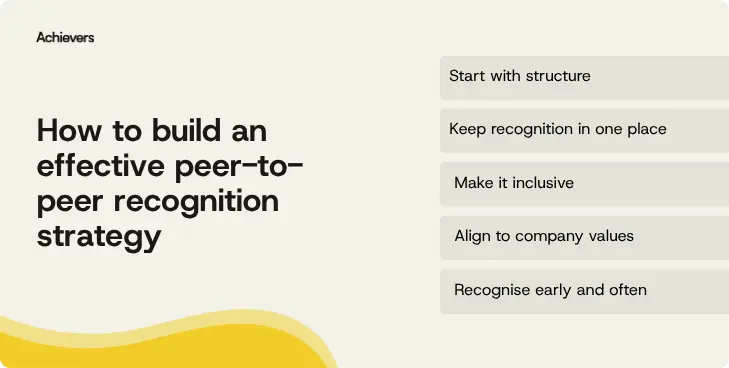
1. Start with structure
Peer‑to‑peer recognition works best when employees understand what great work looks like and why it matters. Clear guidelines and alignment to organisational values help focus recognition on behaviours that drive performance — not just outcomes.
Example: A team member recognises a colleague for demonstrating the organisation’s accountability value by flagging a risk early and helping resolve it.
2. Keep recognition visible
When appreciation is shared quietly or inconsistently, its impact is diluted. Making peer recognition visible helps reinforce shared standards and ensures meaningful contributions are seen across teams.
Example: Recognition shared openly allows colleagues across departments to see how collaboration helped prevent a last‑minute issue.
3. Make recognition inclusive
Effective peer recognition isn’t limited by role, seniority, or personality. Everyone should be able to recognise and be recognised — not just the most vocal employees.
Example: A junior team member recognises a behind‑the‑scenes colleague who helped keep a project on track.
4. Align recognition to organisational values
Recognition is most powerful when it reinforces what the organisation stands for. Tying recognition to values turns abstract principles into everyday behaviours employees can see and celebrate.
Example: A peer recognises a teammate for living the organisation’s integrity value by being transparent under pressure.
5. Encourage frequent, in‑the‑moment recognition
Recognition has the greatest impact when it happens close to the behaviour it celebrates. Timely appreciation makes recognition more meaningful and more likely to be repeated.
Example: A colleague says thank you immediately after a smooth client handover.
6. Make recognition visible
Shared recognition amplifies impact. When appreciation is visible to others, it helps reinforce what success looks like in practice.
Example: Public recognition highlights cross‑team effort that helped meet a tight deadline.
7. Keep it simple
If recognition feels complicated, participation drops. The easier it is to recognise a colleague, the more likely it becomes a habit.
Example: An employee recognises a peer in a short message without needing approvals or formal steps.
8. Support recognition in the flow of work
Recognition shouldn’t feel like extra admin. When appreciation integrates into everyday tools, it becomes part of how teams operate.
Example: A quick recognition moment is shared at the end of a regular team meeting.
9. Reinforce recognition with meaningful rewards
Recognition doesn’t need rewards, but thoughtful rewards can strengthen its impact when used intentionally and fairly.
Example: A recognised employee chooses a reward that reflects their personal interests.
10. Empower employees — not just managers
Recognition is more effective when it flows in every direction. Empowering employees to recognise one another increases frequency and authenticity.
Example: Team members regularly recognise one another without waiting for manager involvement.
11. Prioritise authenticity over automation
Recognition should feel human. Personalised messages that reflect real effort and impact ensure appreciation feels genuine.
Example: A recognition note explains exactly how a colleague’s support helped the team succeed.
12. Use insight to understand what’s working
Recognition shouldn’t be a black box. Understanding where and how recognition happens helps organisations reinforce the behaviours that matter most.
Example: Leaders notice collaboration is frequently recognised and reinforce it as a cultural priority.
13. Celebrate everyday wins
Not every contribution comes with a milestone. Recognising small, everyday actions keeps teams engaged and moving forward.
Example: A peer recognises a colleague for consistently helping others during peak workloads.
14. Reinforce recognition consistently
One‑off initiatives don’t build culture. Peer‑to‑peer recognition needs to be reinforced regularly to become a lasting habit.
Example: Teams build recognition into weekly rhythms rather than saving it for annual events.
15. Connect recognition to business outcomes
Recognition isn’t just about feel‑good moments. When employees feel appreciated, they’re more engaged, more likely to stay, and more motivated to perform.
Example: Teams with regular peer recognition show stronger engagement and lower turnover over time.
How peer‑to‑peer recognition software brings these best practices to life
These best practices provide a strong foundation — but without the right technology, they’re difficult to apply consistently across Singapore’s diverse workplaces.
Peer‑to‑peer recognition software turns best practice into everyday practice. A single, shared platform gives recognition the structure, visibility, and consistency it needs — so appreciation doesn’t depend on location, work arrangement, or who happens to be in the room.
Recognition moves out of policy documents and annual programs and into the flow of work — strengthening connection, reinforcing values, and supporting engagement and retention across the organisation.
Building a recognition culture that scales with Achievers
Peer‑to‑peer recognition works because it’s personal. A genuine thank‑you from a colleague carries weight in a way top‑down praise often can’t — especially when it reflects real effort, collaboration, or support.
But for recognition to scale and deliver meaningful impact, it needs to be encouraged, reinforced, and embedded into everyday ways of working. Recognition has to move beyond isolated moments and become part of how people show up for one another.
That’s where Achievers supports Singapore organisations in strengthening peer‑to‑peer recognition. By helping teams consistently recognise the behaviours that matter most and reinforcing appreciation as a shared responsibility, Achievers enables cultures where people feel seen, heard, and appreciated.
The result is a recognition culture that truly scales — driving stronger engagement, higher retention, and better performance across the organisation.
Peer-to-peer recognition FAQs
Key insights
- Peer recognition captures everyday impact managers miss.
- Structure and visibility make peer recognition consistent.
- Frequent recognition drives engagement, retention, and performance.