Table of contents
Create a culture that means business™
Schedule a demo with an Achievers solution expert today.


 Copy URL
In today’s workplace, “busy” has somehow become a badge of honor — and resilience is often confused with “just push through it.” But HR leaders know better. There’s a fine line between a high-performing workforce and a workforce quietly running on fumes. Cross that line, and suddenly you’re not talking growth—you’re talking attrition.
Here’s the truth: employee burnout isn’t a personal flaw or a time-management problem. It’s feedback. When your top performers — the ones who usually raise their hands, solve the hardest problems, and carry the team — start checking out, the issue isn’t motivation. It’s the system they’re working in.
For leaders juggling hybrid teams, global time zones, and employees who expect more than free snacks and a meditation app, burnout prevention is no longer a “nice-to-have” wellness initiative. It’s a business-critical strategy. If you want sustainable performance, you have to design a workplace where people can actually sustain it.
That means moving beyond surface-level perks and tackling what really matters: how work gets done, how decisions get made, and whether employees feel genuinely seen, heard, and valued — not just measured.
In this guide, we’ll break down what burnout really looks like, unpack the six organizational mismatches that fuel it, and share practical, HR-ready strategies to build a culture that supports resilience without glorifying exhaustion.
Beyond tired: Understanding the true nature of burnout
Before you can fix burnout, you have to stop misdiagnosing it.
One of the most common mistakes organizations make is treating burnout like a fancier word for stress. The logic usually goes something like this: “People are overwhelmed — let’s lighten the workload and call it a win.” Well-intentioned? Yes. Effective? Not usually.
Here’s why: stress and burnout are not the same thing. They’re cousins, not twins — and confusing them leads to solutions that look helpful on paper but fall flat in real life.
Stress is a “too much” problem
Too many deadlines. Too many meetings. Too much urgency. Stressed employees still believe that if they can just get things under control, they’ll feel better. There’s pressure — but there’s also hope.
Burnout is a “not enough” problem
Not enough energy. Not enough motivation. Not enough emotional connection or belief that things will actually improve. Burnout feels less like panic and more like emptiness. People don’t feel overwhelmed; they feel checked out.
The World Health Organization (WHO) classifies burnout as an occupational phenomenon and breaks it into three key dimensions:
Energy depletion or exhaustion
This is the classic burnout symptom — deep physical and emotional fatigue that no amount of coffee can fix.
Mental distance from work
Think cynicism, detachment, and eye rolls in meetings. This isn’t apathy, it’s self-protection. Employees are creating emotional distance to avoid further drain.
Reduced professional efficacy
Work starts to feel pointless, or systems make it impossible to do a good job. People may work long hours but get very little done, which only fuels frustration and self-doubt.
Why does this distinction matter? Because burnout prevention isn’t solved with a long weekend alone. If you only address exhaustion (time off) but ignore cynicism (lack of recognition or trust) or reduced efficacy (broken processes and unclear priorities), burnout will be waiting right where it left off — as soon as the employee logs back in.
Real prevention starts with understanding the full picture, not just the most visible symptom.
The six root causes of workplace burnout
If burnout isn’t a personal problem, then the obvious next question is: where should leaders actually look?
Decades of research in organizational psychology point to a clear answer. Burnout shows up when there’s a mismatch between employees and the systems they work in. When enough of these mismatches pile up, even your most engaged, capable people start to unravel.
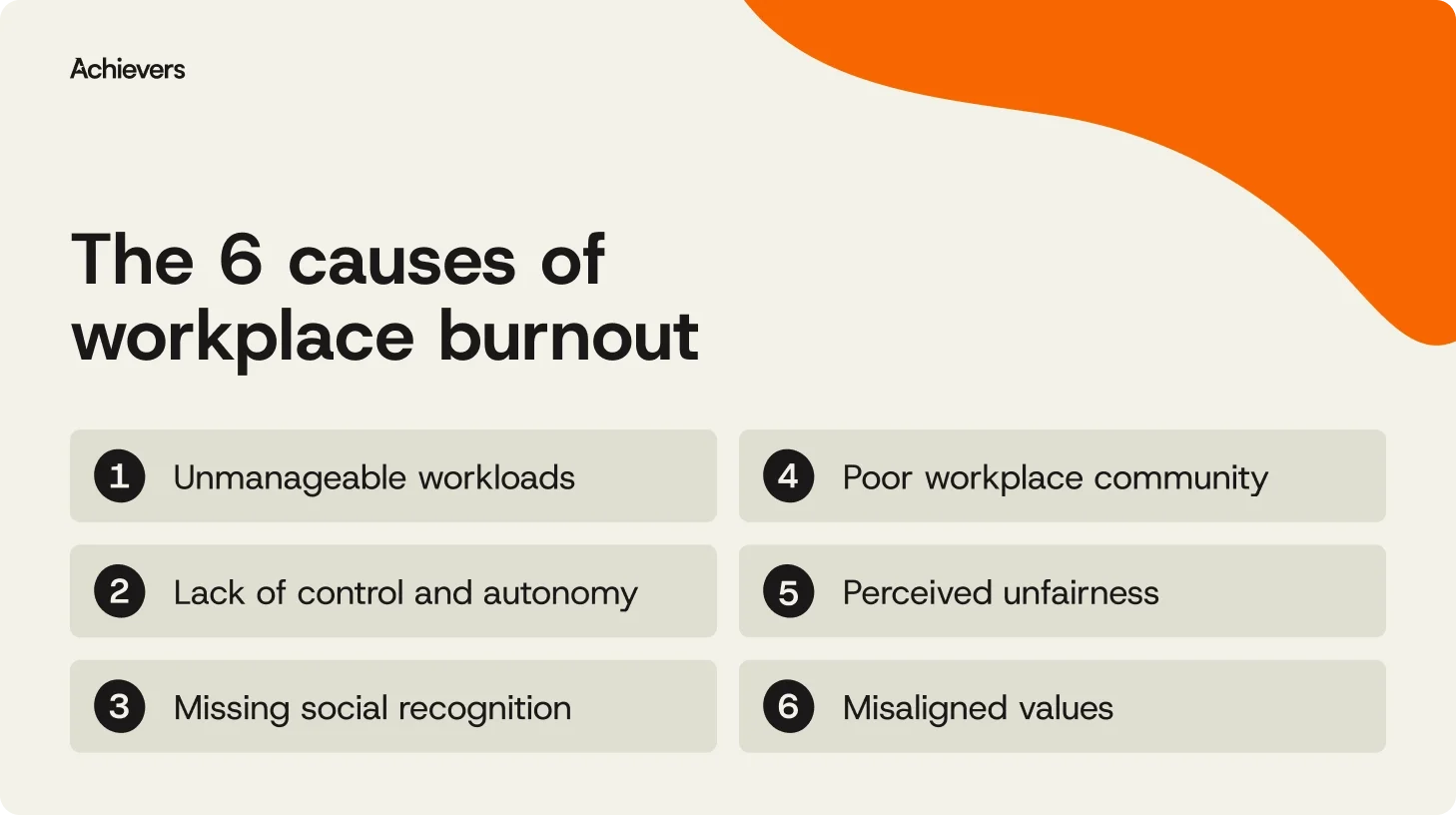
There are six core areas where things tend to go sideways. Think of them as the workplace equivalent of poor alignment — ignore them, and performance (and morale) takes the hit.
1. Workload
This is the most obvious culprit, but it’s often misunderstood. Yes, workload matters, but not in the “just count the hours” way. A sustainable workload isn’t only about how much work gets done. It’s about mental strain and whether employees have any real opportunity to recover. When rest becomes optional and urgency is constant, burnout isn’t a risk, it’s a guarantee.
That said, workload alone is rarely the villain. High-performing teams can handle intense periods of work if the other five areas are in balance. Burnout happens when heavy workload meets broken systems.
2. Control
Autonomy isn’t a perk, it’s a psychological need.
Burnout flourishes in environments where employees are held accountable for outcomes but stripped of decision-making power. Micromanagement, unclear authority, and constant second-guessing create a special kind of frustration — one that high achievers feel most acutely.
When people are responsible for results but powerless over the process, disengagement isn’t a choice. It’s a survival response.
3. Reward
And no, this isn’t just about pay. Fair compensation is table stakes. The bigger issue is recognition. Do people feel noticed? Is effort acknowledged? Or does great work disappear into the void while someone else takes the credit?
When contribution goes unseen, motivation drains fast. Over time, silence turns into cynicism, which is one of burnout’s favorite hiding spots.
4. Community
Work is still a human experience — even on Zoom.
When community breaks down through isolation, unresolved conflict, or lack of psychological safety, stress levels spike. In hybrid and distributed teams, the loss of casual connection (“water cooler moments”) can quietly erode belonging.
Without strong peer relationships, work stops feeling collaborative and starts feeling transactional, and that’s a fast track to disengagement.
5. Fairness
Nothing burns trust faster than perceived unfairness. Uneven workloads, opaque promotions, inconsistent policies — when employees feel the rules change depending on who you are, morale tanks. People don’t need perfection, but they do need consistency and transparency.
Once employees believe the game is rigged, resilience disappears. You simply can’t build a healthy culture on top of distrust.
6. Values
This one cuts deepest. Burnout accelerates when there’s a gap between what an organization says it values and what it actually rewards. If quality is praised but speed is all that matters, or if ethics are celebrated but corners are quietly encouraged, employees feel the tension.
That disconnect creates moral stress — and people don’t stay energized in environments that ask them to compromise what matters to them.
The 6 strategies to prevent employee burnout
Burnout doesn’t show up overnight — it sneaks in when work slowly drains energy faster than it refills it. Long hours, low recognition, and zero control will do that. The good news is that preventing burnout doesn’t require yoga apps, beanbag chairs, or a once-a-year wellness email. It comes down to a handful of smart, human choices leaders make every day.
The six strategies below focus on the levers that matter most — recognition, autonomy, management, and purpose — and how to redesign work so people can do their best work without running on empty.
Strategy 1: Make recognition a habit, not a holiday
Of all six burnout mismatches, reward — especially recognition — is the fastest lever leaders can pull. Cynicism usually starts when employees think, “It wouldn’t matter if I tried harder.” At that point, burnout has already unpacked its bags.
The fix isn’t another “Employee of the Month” plaque. It’s frequent, visible, social recognition woven into everyday work. Data from the Engagement and Retention Report highlights the power of recognition on employee well-being. Compared to employees who don’t feel appreciated or engaged, employees who do are 47x more likely to feel supported in their well-being. That’s huge.
Why it works
Recognition refuels emotional energy. It reinforces self-efficacy, strengthens connection, and reminds people their work actually matters.
What makes it effective
- Frequent: Annual reviews don’t count. Monthly recognition is the minimum for engagement.
- Specific: “Nice work” is forgettable. Clear, behavior-based praise sticks.
- Values-based: Tie recognition to company values to reinforce purpose.
- Peer-driven: Manager praise matters, but peer recognition builds community and breaks isolation.
Organizations that embed recognition into daily workflows consistently see lower turnover and higher engagement.
Strategy 2: Give people back a sense of control
Burnout thrives where autonomy goes to die. Total freedom isn’t realistic — but small shifts in control have outsized impact.
- Design for flexibility: Focus on outcomes, not chair time. Flex hours and hybrid choice signal trust.
- Involve teams early: Burnout spikes when leaders roll out tools or targets without input from the people doing the work.
- Set real boundaries: No-meeting days, after-hours email norms — and leaders actually modeling them—matter more than policy documents.
Control restores momentum. Micromanagement kills it.
Strategy 3: Turn managers into burnout first responders
Managers see burnout coming long before HR does — but they’re often burned out themselves.
The goal isn’t to make managers therapists. It’s to make them empathetic coaches.
Effective 1:1s go beyond status updates and ask:
- “What’s slowing you down right now?”
- “Do you have what you need to succeed this month?”
- “How’s your energy compared to last month?”
Burnout prevention depends on psychological safety. If employees can’t say, “I’m struggling,” problems stay hidden until someone quits.
And remember the oxygen-mask rule: support managers with the right tools and insights, or they won’t have the capacity to support anyone else.
Strategy 4: Build well-being into the flow of work
If burnout prevention requires extra clicks, it won’t happen.
Recognition, feedback, and wellness tools should live where work already happens — not buried in a forgotten portal. Reducing digital friction preserves mental energy for work that actually matters.
Smart organizations also move beyond annual surveys to continuous listening. Real-time data helps leaders spot burnout hot spots early and intervene before disengagement turns into attrition.
Strategy 5: Connect daily work to real purpose
The values mismatch is the quietest, and deadliest, driver of burnout.
Employees want to know their work means something. Leaders must constantly connect everyday tasks to real impact: customers helped, problems solved, progress made.
Recognition becomes storytelling. When you recognize someone for innovation, collaboration, or integrity, you’re not just saying thanks — you’re showing the entire organization what “good” actually looks like.
That alignment between values and reality reduces the kind of cognitive dissonance that drains energy and fuels burnout.
Bottom line: Burnout prevention isn’t about doing more — it’s about designing work better.
Preventing employee burnout starts with better work design
Even with the best prevention strategies in place, burnout can still happen. Life doesn’t pause for performance reviews. Personal stress, global uncertainty, and business crises all take their toll. When burnout shows up, how your organization responds matters just as much as how you tried to prevent it — and employees remember.
Destigmatize recovery
Burnout recovery should be treated with the same professionalism as a physical injury. If someone needs time off or a lighter load, that’s not fragility — it’s reality. In fact, burnout often hits your most dedicated people first. They didn’t disengage because they didn’t care. They disengaged because they cared for too long without enough support.
The message leaders send here is critical: recovery is respected, not penalized.
Make re-entry intentional
When an employee returns from burnout-related leave, don’t toss them back into the deep end and hope for the best. Hold a re-entry conversation focused on what changes moving forward.
Ask:
- “Was the workload sustainable?”
- “Were the right tools and resources in place?”
- “What boundaries need to be reset?”
If nothing changes, burnout isn’t cured — it’s postponed.
At its core, this is a culture challenge. It requires shifting from a transactional mindset to a human one. It asks leaders to listen, managers to lead with empathy, and systems to make appreciation easy and visible. The organizations that win tomorrow won’t be the ones that squeeze the most out of their people today. They’ll be the ones that invest in their people’s ability to thrive over time.
Avoid employee burnout with Achievers
When recognition is consistent, values are lived, and work is designed with humans in mind, performance follows naturally and sustainably. That’s where the Achievers employee engagement platform shines.
Our platform ensures your people feel seen, heard, and genuinely appreciated every day. Because when you lead with authentic empathy and understanding, you can get ahead of burnout before its effects are felt, leading to a much better employee experience, improved workplace culture, and optimal performance and productivity.
How to prevent employee burnout FAQs
Key insights
- Burnout isn’t a personal failure — it’s organizational feedback that signals misaligned systems, not unmotivated people.
- Preventing burnout requires designing work that supports recognition, autonomy, fairness, and purpose — not just reducing hours or adding perks.
- Organizations that treat burnout recovery with empathy and intention build stronger trust, engagement, and long-term performance.