Table of contents
Create a culture that means business™
Schedule a demo with an Achievers solution expert today.


 Copy URL
Work burnout isn’t a fringe issue anymore — it’s a shared workplace reality. New research shows that 66% of American employees are experiencing some form of burnout, and the impact reaches far beyond fatigue. Burnout affects performance, well-being, relationships, and long-term retention — for people and organizations.
In this guide, we’ll break down burnout symptoms, signs of burnout at work, why it happens, and what actually helps prevent it — without the fluff, guilt, or silver-bullet promises.
What is work burnout?
Work burnout is a state of chronic workplace stress that hasn’t been successfully managed. It develops over time and shows up as emotional exhaustion, growing detachment from work, and a declining sense of effectiveness.
The World Health Organization recognizes burnout as an occupational phenomenon, not a medical condition — which matters. Burnout isn’t a personality flaw, a lack of resilience, or a motivation problem. It’s what happens when workplace stress becomes the norm instead of the exception.
Common signs of burnout at work
Recognizing the common signs of burnout is one of the most important steps in preventing it — for individuals, teams, and organizations. While workplace burnout can look different across roles, cultures, and regions, the underlying patterns tend to be pretty consistent worldwide.
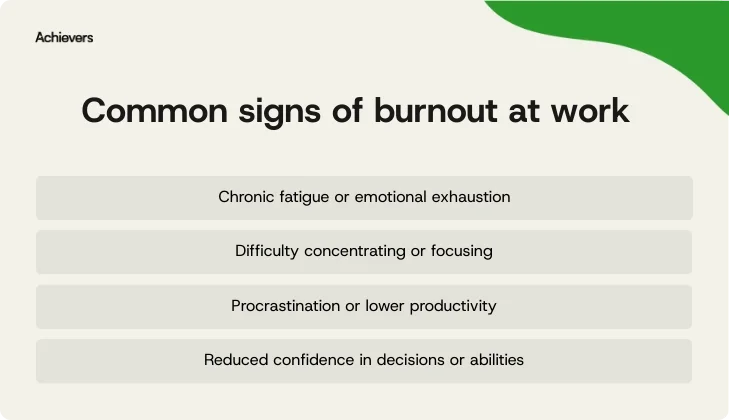
Emotional signs of work burnout
Emotional burnout affects how people feel about their work and themselves. Signs might include:
- Chronic fatigue or emotional exhaustion
- Emotional numbness or detachment
- Loss of enthusiasm or enjoyment
- Increased irritability or mood swings
- Cynicism, negativity, or hopelessness
Mental and cognitive signs of work burnout
Burnout also changes how people think, process, and evaluate their own performance. Mental and cognitive signs might include:
- Difficulty concentrating or focusing
- Reduced confidence in decisions or abilities
- Persistent self-doubt
- Feeling overwhelmed by simple tasks
- Trouble remembering details or staying mentally organized
Behavioral signs of work burnout
As burnout deepens, it often changes habits and interactions. Behavioral signs could include:
- Withdrawal from colleagues or social activities
- Avoidance of tasks or responsibilities
- Procrastination or lower productivity
- Increased absenteeism
- Heightened frustration or short temper
Physical signs of work burnout
Because burnout is rooted in chronic stress, the body often feels it first. Physical signs might include:
- Sleep disruption or insomnia
- Headaches, muscle tension, or general aches
- Ongoing fatigue
- Appetite changes — eating more or less than usual
It’s important to remember: one symptom alone isn’t burnout. Patterns over time are what matter. When several of these signs appear together and persist, they often point to work burnout symptoms — not a lack of effort, resilience, or ambition.
The risk of untreated burnout in the workplace
When burnout is left untreated at work, it reshapes how people feel, how teams function, and how organizations perform. Over time, burnout becomes less about individual stress — and more about cultural, operational, and workforce risk. The kind that doesn’t show up neatly on a spreadsheet but still manages to cost you plenty.
Here’s what that looks like:
Individual health and well-being
Burnout increases the likelihood of chronic fatigue, anxiety, sleep disruption, and declining confidence. Employees may feel emotionally depleted, disconnected from purpose, and unsure of their value. The longer burnout lingers, the harder it becomes to improve engagement, energy, motivation, and well-being.
Team morale and collaboration
Burnout weakens trust and connection. Exhaustion reduces patience. Detachment limits empathy. Collaboration becomes transactional instead of creative. Teams that once supported each other start working in silos, and psychological safety quietly fades.
Organizational productivity and retention
Burnout directly affects performance and loyalty. Engagement declines. Errors increase. Innovation slows. And retention becomes fragile.
Data from the latest Engagement and Retention Report makes the contrast hard to ignore: only 28% of employees who feel highly appreciated are looking for work, compared to 71% of those who feel undervalued. Appreciation doesn’t just boost morale — it quietly protects retention, performance, and future stability.
Long-term workforce sustainability
When burnout becomes normalized, organizations face rising turnover, growing talent gaps, higher safety and error risk, and gradual cultural erosion. Institutional knowledge walks out the door. Employer reputation softens. And momentum gives way to maintenance.
How leaders and organizations can prevent burnout at work
Preventing employee burnout isn’t about leadership teaching people to cope better with broken systems. It’s about building workplaces where sustained performance is possible. When managers and the organizations at large treat burnout prevention as a cultural commitment — not a wellness initiative — everything changes.
Here’s where that starts:
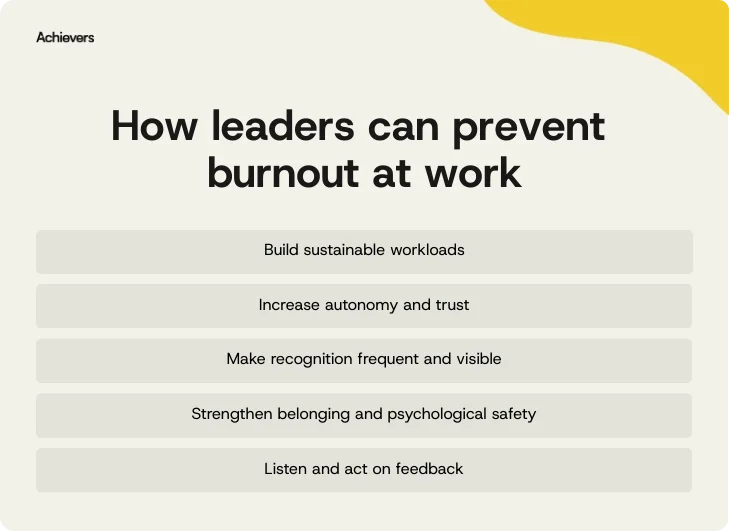
Build sustainable workloads that protect performance
Sustainable workloads protect performance by giving people room to do great work without constantly running on empty. Start by prioritizing impact over activity. Clarify what truly matters, remove low-value work, and normalize realistic timelines. When teams aren’t rewarded for busyness alone, they gain energy, focus, and momentum.
Sustainability isn’t about slowing down — it’s about making performance something people can sustain.
Increase autonomy and trust at work
Autonomy reduces burnout because control restores confidence. Give people flexibility in how they approach their work, make decisions, and manage their time. Replace unnecessary approvals with clear expectations and support.
When employees feel trusted, they become more motivated, capable, and resilient. Trust-based leadership doesn’t remove structure — it removes friction.
Make recognition frequent and visible
Recognition prevents burnout by reminding people that their effort, progress, and values matter — not just their final results. Make recognition part of everyday work, not just special occasions. Call out small wins, steady progress, and values in action. Managing frontline teams? Recognition in industries like healthcare, manufacturing, and retail helps people feel seen in roles where appreciation is often the first thing to get skipped.
Strengthen belonging and psychological safety
Belonging protects energy. Create space for people to contribute, ask questions, and share ideas without fear. Encourage peer connection, model empathetic leadership, and respond with respect — especially when feedback is hard. When people feel included and safe, engagement becomes sustainable. Burnout doesn’t grow in supportive environments. It grows in silence.
Listen to employees continuously — and act on what you hear
Burnout prevention starts with listening — and succeeds with action. Use employee feedback tools to check in often, not just annually. Look for patterns, respond visibly, and close the loop. When employees see that their feedback leads to change, trust grows. When it doesn’t, belief fades. Listening isn’t just about collecting insight. It’s about showing people their voice matters.
From burnout to balance
Work burnout doesn’t mean people care less about their jobs. It means the way work is designed, supported, and recognized needs attention — no matter where or how your people work.
The good news? Burnout is common — and it’s reversible. When organizations create sustainable workloads, build trust, recognize effort, strengthen belonging, and truly listen, work starts to feel different. Not easier in a superficial way — but healthier, clearer, and more human.
That’s where culture does its real work.
At Achievers, we believe recognition, connection, and insight are not perks. They’re the tools that help organizations shape better behaviors, stronger cultures, and more resilient teams. When people feel seen, supported, and valued for how they show up — not just what they deliver — burnout loses its grip, turnover improves, and balance becomes possible again.
Because the goal isn’t to help people survive work. It’s to help them do work that actually feels worth showing up for.
Work burnout FAQs
Key insights
- Burnout develops from chronic workplace stress and cultural conditions — not from a lack of resilience or motivation.
- Recognizing burnout patterns at work early is the first step toward prevention and recovery.
- Sustainable workloads, trust, recognition, belonging, and continuous listening don’t just reduce burnout — they build cultures where people can perform, stay, and grow.