Table of contents
Create a culture that means business™
Schedule a demo with an Achievers solution expert today.


 Copy URL
Engagement programmes are shaping how UK organisations respond to a changing world of work — one where people want to feel supported, recognised, and connected to what they do. But in the UK, that reality is still uneven. While research from Nottingham Trent University found engagement levels have risen to 77%, two in five employees say people issues are overlooked where they work. That tension is telling: progress on paper, but gaps in lived experience.
The good news is that these programs can make a real difference. When engagement is left to chance, disconnect grows. When it’s designed with purpose, it drives performance.
In this blog, we break down 14 employee engagement programmes UK organisations are using right now to close that gap. Plus, how you can design, implement, and measure your very own.
What is an employee engagement programme?
An employee engagement programme is a structured, ongoing approach to improving how people experience work. Rather than relying on one‑off initiatives or annual surveys, engagement programmes bring together recognition, feedback, communication, development, and manager support into a connected system. It’s the difference between hoping employees feel engaged and actually giving them reasons to be.
The business impact of engagement programmes
When engagement is designed intentionally, its impact shows up quickly and across the business. Here are some of the key business impacts of employee engagement programmes:
Engagement programmes drive motivation and discretionary effort
Well‑designed engagement programmes motivate employees by showing that effort is noticed, valued, and reinforced consistently. When people understand that their contributions matter, not just final outcomes, they’re more likely to invest energy, take initiative, and go beyond the basics because they feel genuinely connected to their work.
Engagement programmes strengthen commitment and retention
Engagement programmes build commitment by creating an environment where employees feel recognised, supported, and able to grow. And when employees are recognised regularly, Achievers Workforce Institute research tells us that 26% are much more likely to stay. By improving the everyday experience of work, you’re helping employees see a future with the organisation, instead of viewing their role as a short‑term stop.
Engagement programmes improve productivity and performance
Productivity improves when engagement programmes bring clarity to priorities, expectations, and feedback. By reducing friction caused by inconsistent management or poor communication, engagement programmes help teams focus on what matters most — supporting strong performance without relying on overwork or burnout.
Engagement programmes align employees with company goals and values
Engagement programmes turn organisational goals and values into behaviours employees can recognise and repeat. This alignment helps teams focus effort in the right direction and make better decisions independently, particularly in hybrid and fast‑moving work environments.
Engagement programmes support long‑term business performance and profitability
Over time, engagement programmes strengthen retention, productivity, and employee advocacy in ways that are measurable and repeatable. By embedding engagement into everyday work, it stops being something HR reacts to and becomes something that consistently supports performance.
14 employee engagement programmes UK organisations are using today
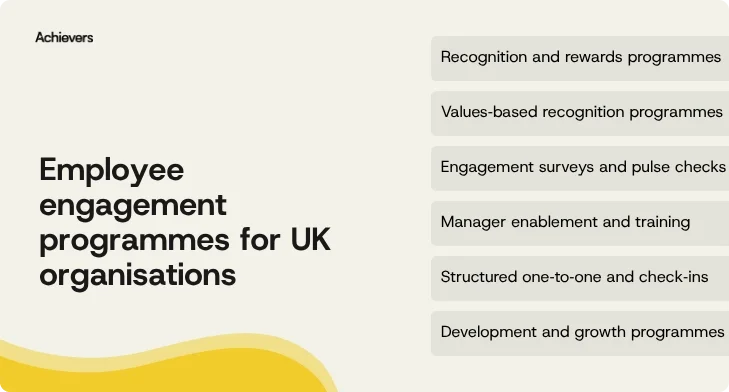
Engagement improves when organisations put the right programmes in place — programmes that shape everyday behaviour, reinforce what matters, and make people feel seen, heard, and valued. These examples reflect what’s working in UK workplaces right now:
1. Employee recognition and reward programmes
Employee recognition and reward programmes create consistent moments of appreciation that reinforce effort, values, and contribution. When recognition is frequent, visible, and fair, it strengthens connection and motivates people to keep showing up with intent.
How to implement
- Build recognition into daily work, not just annual awards or milestone moments.
- Enable both manager‑led and peer‑to‑peer recognition to avoid bottlenecks.
- Tie recognition clearly to company values so employees understand why it matters.
How to measure
- Track recognition frequency and participation across teams, not just top contributors.
- Monitor engagement survey scores related to feeling valued or appreciated.
- Look for correlations between recognition activity and retention trends.
2. Values‑based recognition programmes
Values‑based recognition programmes help bring company values out of presentations and into practice. By recognising behaviours that reflect those values, organisations reinforce what “good” looks like at work.
How to implement
- Define a small set of clear, behaviour‑based values employees can recognise in others.
- Encourage specific recognition messages that explain what was done and why it mattered.
- Ensure recognition is inclusive and accessible across roles, locations, and working models.
How to measure
- Review which values are recognised most — and which are rarely mentioned.
- Assess whether employees can articulate company values in engagement surveys.
- Track consistency of recognition across departments and demographics.
3. Regular engagement surveys and pulse checks
Surveys and pulse checks give employees a voice — but their real value lies in what happens next. Used well, they surface friction early and guide leaders toward meaningful action.
How to implement
- Combine an annual engagement survey with shorter, regular pulse checks.
- Keep surveys focused, relevant, and easy to complete to avoid fatigue.
- Communicate results openly and clearly outline what will change as a result.
How to measure
- Track response rates and completion trends over time.
- Monitor changes in key engagement indicators after actions are taken.
- Measure trust and confidence in leadership through follow‑up questions.
4. Manager enablement and recognition training
Managers shape the day‑to‑day employee experience more than any programme alone, but in the UK, only 21% feel recognised by their leader in a way that makes them feel valued. Manager enablement programmes give leaders the skills and confidence to recognise, support, and engage their teams consistently.
How to implement
- Train managers on how to give timely, specific, and meaningful recognition.
- Set clear expectations for regular check‑ins and feedback conversations.
- Equip managers with simple tools and prompts that fit into existing workflows.
How to measure
- Compare engagement and recognition activity across teams and managers.
- Track manager participation in training and follow‑through behaviours.
- Monitor employee feedback related to manager support and communication.
5. Structured one‑to‑one and check‑in programmes
Regular one‑to‑one conversations are one of the most direct ways managers influence engagement — yet they remain surprisingly rare. Research from the EMEA Engagement and Retention Report shows that in the UK, only 20% of employees have regular 1:1s, and just 21% feel connected to their manager. That gap matters.
How to implement
- Establish a predictable cadence for one‑to‑one conversations.
- Encourage managers to balance performance discussions with well‑being and development.
- Provide simple frameworks or prompts to guide meaningful conversations.
How to measure
- Track completion rates of scheduled check‑ins.
- Monitor employee clarity around goals, priorities, and expectations.
- Watch for improvements in engagement and retention within teams using the programme consistently.
6. Career development and growth programmes
Career development programmes help employees understand how they can grow within the organisation, not just perform in their current role. In UK workplaces, a lack of visible progression is one of the fastest ways engagement erodes — especially when effort isn’t clearly linked to opportunity.
How to implement
- Make career paths and development options visible, even when promotion isn’t immediate.
- Encourage regular career conversations alongside performance discussions.
- Offer access to learning, upskilling, and stretch opportunities that feel relevant to real roles.
How to measure
- Track employee sentiment around growth and future opportunities in engagement surveys.
- Monitor internal mobility and participation in learning initiatives.
- Watch retention trends among high‑performing and early‑career employees.
7. Mentorship and peer learning programmes
Mentorship and peer learning programmes strengthen engagement by creating connection, shared learning, and support beyond the direct manager relationship. They’re especially important in hybrid environments, where employees have fewer chances to learn informally from those around them.
How to implement
- Pair employees intentionally based on skills, experience, or development goals.
- Offer light structure and guidance, without over‑engineering the relationship.
- Recognise and value mentors’ contributions, not just participants’ outcomes.
How to measure
- Track participation and completion rates across mentorship cohorts.
- Collect qualitative feedback on confidence, capability, and connection.
- Look for improvements in engagement and retention among participants.
8. Well‑being and mental health programmes
Well‑being programmes support engagement by addressing the realities employees face inside and outside of work. In the UK, employees increasingly expect organisations to support mental, physical, and financial wellbeing in ways that feel genuine and accessible.
How to implement
- Focus on normalising wellbeing conversations, not just offering resources.
- Equip managers to recognise signs of burnout at work and direct employees to support.
- Align wellbeing initiatives with existing benefits and flexible working practices.
How to measure
- Track awareness and usage of wellbeing resources over time.
- Monitor engagement survey results related to stress, balance, and support.
- Watch absence, burnout indicators, and retention trends for improvement.
9. Internal communication and connection programmes
Clear, consistent communication helps employees feel informed, included, and aligned. Engagement suffers quickly when communication is fragmented, overly top‑down, or disconnected from employees’ day‑to‑day work.
How to implement
- Simplify communication channels so messages are easy to find and understand.
- Make communication two‑way by creating regular opportunities for feedback.
- Connect updates back to purpose, priorities, and employee impact.
How to measure
- Assess employee understanding of organisational goals and direction.
- Track participation in feedback forums, Q&As, or pulse surveys.
- Monitor trust and confidence in leadership through engagement data.
10. Inclusion and belonging programmes
Inclusion and belonging programmes help employees feel respected, valued, and able to contribute fully. Engagement deepens when people believe they belong — not just that they’re invited to participate.
How to implement
- Focus on everyday inclusion through recognition, voice, and fair access to opportunity.
- Support employee‑led communities while embedding inclusion into core programmes.
- Ensure managers model inclusive behaviours consistently.
How to measure
- Track engagement survey responses related to belonging and psychological safety.
- Review recognition and participation data for patterns or gaps.
- Monitor retention and engagement across different employee groups.
11. Onboarding and early‑tenure engagement programmes
Onboarding programmes set the tone for how employees experience the organisation — and whether they feel connected early on. Strong early‑tenure engagement helps people build confidence, relationships, and clarity from the start, instead of leaving connection to chance.
How to implement
- Extend onboarding beyond the first week to cover the first 60–90 days.
- Introduce early recognition moments to reinforce belonging and contribution.
- Help new starters build relationships across teams, not just within their role.
How to measure
- Track early engagement and confidence through pulse surveys.
- Monitor retention and engagement within the first year of employment.
- Collect feedback on onboarding clarity, connection, and support.
12. Recognition‑led performance programmes
Recognition‑led performance programmes focus on reinforcing progress, behaviours, and effort — not just outcomes at review time. By recognising how work gets done, organisations support performance without waiting for annual cycles.
How to implement
- Encourage managers to recognise progress, collaboration, and improvement in real time.
- Link recognition to performance expectations and values, not just results.
- Use recognition moments to support coaching and development conversations.
How to measure
- Track recognition patterns alongside performance outcomes.
- Monitor employee clarity around expectations and feedback.
- Look for improvements in engagement and performance consistency.
13. Continuous listening and feedback programmes
Continuous listening programmes help organisations stay connected to how employees are actually experiencing work. Regular feedback builds trust when employees see that their input is acknowledged and actioned on.
How to implement
- Use short, regular pulse checks alongside deeper engagement surveys.
- Create clear ownership for acting on feedback at team and organisational levels.
- Close the loop by communicating what was heard and what will change.
How to measure
- Track participation and response rates over time.
- Monitor changes in engagement scores following action.
- Assess employee trust in leadership and feedback processes.
14. Recognition‑led culture programmes
Recognition‑led culture programmes embed appreciation into everyday work so it becomes part of how the organisation operates, not an initiative that fades over time. When recognition is consistent and values‑based, organisational culture strengthens naturally.
How to implement
- Make recognition visible, frequent, and accessible across the organisation.
- Reinforce values through recognition rather than relying on slogans.
- Encourage leaders to model recognition behaviours consistently.
How to measure
- Track recognition frequency, reach, and participation across teams.
- Monitor long‑term trends in engagement, retention, and advocacy.
- Look for alignment between stated values and recognised behaviours.
How to implement an employee engagement programme
Here’s how effective UK organisations build engagement programmes that people actually use — and leaders can stand behind:
Start by listening to employees
Effective engagement programmes begin with understanding how employees are really experiencing work. Surveys, pulse checks, and open feedback channels help surface what’s working, what isn’t, and where effort will have the greatest impact.
Use listening tools to identify patterns rather than chasing every individual comment. Focus on the themes that show up consistently across teams, roles, or locations, and make listening part of how you operate — like something you return to regularly, not a box you tick off once.
Prioritise programmes based on impact, not volume
Prioritise initiatives that address your biggest engagement gaps — whether that’s recognition, manager effectiveness, growth, or connection.
A smaller number of well‑run programmes will do more for engagement than a long list of under‑supported initiatives. Build momentum by starting where employees are most likely to feel the difference quickly.
Equip managers to lead engagement day to day
Even the best‑designed initiatives fall flat if managers aren’t confident using them or don’t see engagement as part of their role.
Support managers with clear expectations, simple tools, and practical guidance. Engagement should feel like part of how they manage — not another task added to an already full workload.
Build engagement into existing workflows
Engagement programmes are most effective when they fit naturally into how work already happens. Recognition, feedback, and check‑ins shouldn’t live in separate systems or moments — they should show up where employees collaborate, communicate, and get work done.
Look for opportunities to embed engagement into regular meetings, one‑to‑ones, performance conversations, and internal communications, so engagement fits into everyday work instead of competing with it for attention.
Measure what matters — and close the loop
Measurement gives engagement programmes credibility and staying power. Track a mix of participation, perception, and outcome measures, such as engagement survey results, recognition activity, retention trends, and manager effectiveness.
Just as importantly, share what you’re learning. Let employees know what feedback was heard, what actions are being taken, and why certain decisions were made. Closing the loop builds trust and encourages people to keep engaging.
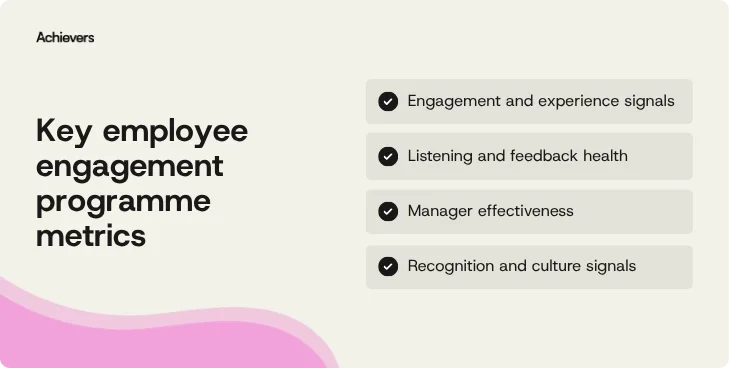
Engagement programme metrics: What organisations should track
Engagement and experience signals
These metrics show whether your programmes are improving how work actually feels for employees.
- Track overall engagement and employee experience scores by team, role, and location.
- Monitor trends over time rather than reacting to single data points.
- Pay close attention to questions tied to feeling valued, supported, and clear on expectations.
Listening and feedback health
Low participation is often a trust issue, not a tooling issue.
- Measure survey and pulse response rates to understand whether employees feel safe speaking up.
- Track how quickly feedback turns into visible action or communication.
- Watch for drops in participation as an early warning sign of disengagement or fatigue.
Manager effectiveness
Engagement is often shaped at the manager level.
- Track the consistency of 1:1s and check‑ins across teams.
- Measure employee perceptions of manager support, communication, and recognition.
- Compare engagement outcomes between teams to spot where managers may need support.
Recognition and culture signals
Recognition data shows whether appreciation is becoming a habit or staying sporadic.
- Monitor recognition frequency and participation across the organisation.
- Look at how recognition is distributed across teams, roles, and working models.
- Review which values are being recognised most often, and which are rarely reinforced.
Retention and movement outcomes
These metrics confirm whether engagement is translating into stability and growth.
- Track retention and turnover overall, and within critical roles or populations.
- Monitor internal mobility and progression as indicators of perceived opportunity.
- Pair retention data with engagement trends to understand cause, not just effect.
How Criteo increased employee engagement and happiness with Achievers
As Criteo scaled rapidly across 20 countries, the challenge wasn’t just growth — it was consistency. The global commerce media company needed a single way to recognise employees, align them to shared values, and keep their entrepreneurial culture intact. Criteo worked with Achievers to launch Spotlight, a global recognition programme embedded directly into everyday tools like Slack and Outlook.
The results were instant. Within a year, 96% of employees were active on the platform, with 7 in 10 participating monthly. Employee happiness with recognition rose by 17 percentage points, and every employee now receives recognition at least once a month on average. Even better, Criteo reduced admin effort and aligned its global workforce around one clear set of goals, values, and behaviours — all in the first year.
Start building more engaged teams today
An employee engagement programme gives organisations something most initiatives lack: cohesion. It brings recognition, listening, manager enablement, growth, and wellbeing into one connected experience employees actually feel — not just hear about. Instead of scattered efforts, you get clarity, consistency, and momentum.
Achievers helps organisations make that connection real. By putting recognition at the centre, we help engagement show up in everyday moments, not just annual plans. When people feel seen, heard, and appreciated, engagement stops being an ambition — and starts delivering results.
Employee engagement programmes FAQs
Key insights
- Employee engagement programmes create consistency and ensure employees experience engagement regularly.
- Well‑designed engagement programmes reinforce what matters most. They turn values, goals, and behaviours into everyday actions employees can see, feel, and repeat.
- Engagement programmes drive results because they’re intentional, becoming measurable, scalable, and easier to sustain over time.