4 ways pulse surveys can positively impact employee engagement
How employee pulse surveys improve engagement, feedback, and retention.
This resource is brought to you by:
Topics Covered:
Productivity and Performance
Gathering and acting on employee feedback is crucial if you want to improve engagement, which drives greater business outcomes related to the employee experience, such as productivity and retention.
Research shows that most employers measure engagement only once a year, if that, while many employees want more frequent opportunities to share feedback. There is a clear connection between survey frequency and engagement, showing how a pulse survey approach can support a more responsive employee experience.
Some organizations use pulse surveys alongside their annual engagement survey as a complementary way to collect employee feedback, respond to changing needs, and take timely action.
What is an employee pulse survey?
Pulse surveys are short questionnaires conducted three or more times a year. They typically offer a quick turnaround for results and focus on taking action based on the information received.
Unlike an annual employee engagement survey, a pulse survey helps an organization understand how employees are feeling at a particular moment. Since engagement can change frequently, these shorter surveys give HR leaders a more current view of employee sentiment.
How often do companies conduct employee engagement surveys?
Almost half, or 43%, of organizations conduct an engagement survey just once a year. Another 24% conduct surveys less than once a year.
Only 14% of companies conduct employee engagement surveys three or more times per year. These frequent surveys are generally considered pulse surveys.
Frequency of employee engagement surveys
Less than once a year: 24%
Once a year: 43%
Twice a year: 19%
Three or more times a year: 14%
Achievers Workforce Institute recommends pulse surveys because research shows that engagement is fluid, meaning it changes frequently.
By surveying employees only once a year or less, and then taking months to act on the results, companies miss opportunities to engage their people through quick action based on recent feedback.
There is no one-size-fits-all solution to engagement surveys. Each organization must determine the best survey cadence for its employees. A customized approach based on the organization’s needs and capabilities is the most effective method.
Which industries use employee pulse surveys most often?
The finance industry is the most likely to conduct pulse surveys, with 21% of respondents in the industry saying their organization conducts surveys at least three times a year.
Pulse survey adoption by industry
Finance: 21%
Healthcare: 17%
Retail: 14%
Manufacturing: 14%
Do employees want more frequent engagement surveys?
More than half of respondents, including both leaders and individual contributors, say they wish their company conducted engagement surveys more frequently.
Yes: 58%
No: 42%
The percentage is even higher in retail, where 67% of respondents agree that employees should be surveyed more frequently.
Canadians are the most likely respondents to want more frequent surveys, with 65% saying they are not surveyed often enough. Interestingly, Canadian organizations are also the most likely to offer pulse surveys, with 24% of respondents saying they are surveyed more than three times a year.
Australians are the least likely to request additional surveys, although 51% still say they want more frequent opportunities to provide feedback.
Achievers Workforce Institute recommends pulse surveys because they maintain a consistent flow of feedback in the workplace. However, introducing pulse surveys requires clear communication. Employees need to understand why a survey is taking place and how their responses will be used.
How pulse survey frequency relates to employee engagement
There is a clear correlation between survey frequency and employee engagement levels. The more often companies survey their workforce, the higher their overall engagement tends to be.
Among employees surveyed more than three times a year, 39% say they are very engaged.
Percentage of employees who say they are very engaged
Surveyed less than once a year: 27%
Surveyed once a year: 28%
Surveyed twice a year: 35%
Surveyed three or more times a year: 39%
Achievers Workforce Institute does not conclude that surveys directly cause engagement to increase. Surveys alone are not enough to move the dial on employee engagement.
Instead, organizations with pulse or always-on feedback methods are likely also responding to employee feedback quickly. These timely micro-actions demonstrate that employees are being heard and that the organization cares about their opinions.
That responsiveness can increase advocacy, commitment, and enthusiasm, the three ingredients for employee engagement.
Why anonymous pulse surveys encourage honest employee feedback
Managers may hold regular check-ins and one-to-one meetings, but those conversations do not necessarily capture everything employees are thinking.
More than three-quarters of respondents, or 77%, say they would be more honest in a survey than in a conversation with their manager.
More likely to be honest in a survey: 77%
Not more likely to be honest in a survey: 23%
It can be difficult for an employee to speak candidly to someone’s face, especially when that person may be part of the problem. A survey can generate more honest and open responses than a manager’s face-to-face meetings.
That candor gives leaders a clearer understanding of employee sentiment, concerns, and priorities. Of course, asking the question is only the beginning. Employees also need to see that their feedback leads to meaningful action.
How employee listening can support retention
Employees who say their company gathers feedback are almost twice as unlikely to leave compared with the average employee.
Frequent listening helps organizations identify changing employee needs and address concerns before they become larger engagement or retention problems. When feedback is followed by timely, visible action, employees are more likely to feel heard, valued, and connected to the organization.
Turn employee feedback into meaningful action
At Achievers, our mission is to change the way the world works. That starts with building a culture of recognition and appreciation.
Our industry-leading adoption rates tell us that employees value our recognition platform. Organizations can build on that participation to evaluate employee engagement with Achievers Listen, capture actionable insights, strengthen belonging, and improve the employee experience.
Get the complete employee pulse survey research
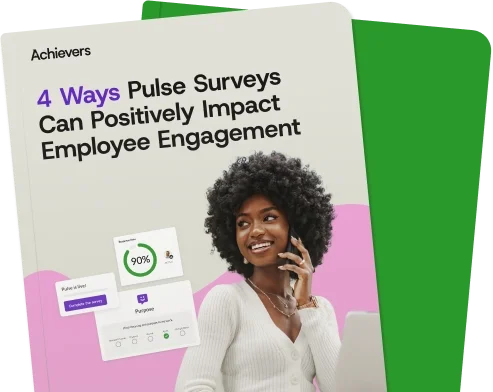
Download your copy of 4 Ways Pulse Surveys Can Positively Impact Employee Engagement whitepaper to explore the data behind employee survey frequency, engagement, candor, and retention.
Want to turn feedback into action?
Only 14% of companies conduct employee engagement surveys three or more times per year
Companies miss opportunities to engage their people through quick action based on recent feedback
There is a clear correlation between survey frequency and employee engagement levels
Advocacy, commitment, and enthusiasm — the three ingredients for employee engagement


Join our mailing list
Stay up to date with the latest in workforce science from Achievers Workforce Institute.