Table of contents
Create a culture that means business™
Schedule a demo with an Achievers solution expert today.


 Copy URL
At its core, employee productivity is about whether people can focus on the right work, with the right support, and make steady progress without unnecessary friction.
Right now, that’s a challenge for many organizations. Only 20% of employees worldwide were engaged in 2025, contributing to an estimated $10 trillion in lost productivity globally. The causes are rarely dramatic — they’re structural: unclear priorities, disconnected tools, inconsistent recognition, and work that feels busy but not meaningful.
In this blog, we break down 10 practical strategies to boost employee productivity, from simplifying communication to strengthening recognition — so efficiency and engagement can work together (instead of competing for attention).
Understanding employee productivity
Employee productivity refers to how efficiently employees complete their tasks, typically measured by output relative to input — think quality work done in a reasonable amount of time.
Productivity isn’t measured by how many tasks get checked off. It’s about finding a sustainable balance between efficiency and well‑being, because overwork leads to burnout at work — and burnout doesn’t improve results. According to Gallup, engaged employees are 17% more productive than their disengaged counterparts.
So, balance is key: drive performance without driving people crazy. A happy team is a productive team — who knew, right?
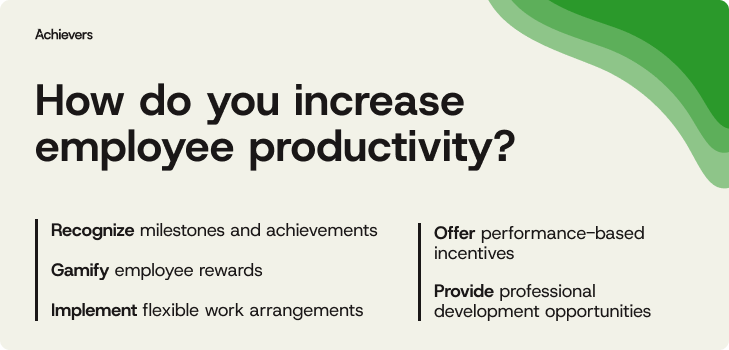
10 ways to increase employee productivity at work
Increasing employee productivity is a constant goal for any organization, but it’s not just about working harder — it’s about working smarter. By addressing key factors like recognition, clear goals, communication, and work-life balance, companies can create a more efficient, motivated, and engaged workforce.
Here are 10 ways to increase productivity at work while keeping morale high:
1. Foster a culture of recognition and engagement
Recognition is about reinforcing the behaviors that drive results. When employees know their work is noticed and valued, they’re more likely to stay engaged and put effort where it counts. Consistent, timely recognition builds momentum, not just morale, and helps people understand what good performance actually looks like.
2. Provide clear goals and expectations
Productivity drops quickly when priorities are vague or constantly shifting. Clear goals give employees a shared understanding of what matters most and how success is measured. Frameworks like SMART goals help teams focus their time and energy, reducing rework and confusion. When expectations are clear, people can move forward with confidence instead of second‑guessing.
3. Improve communication and collaboration
Good work depends on good information flow. Clear internal communication and strong collaboration reduce delays, duplication, and unnecessary friction between teams. When people can easily share updates, ask questions, and align on decisions, work moves faster — and with fewer avoidable headaches.
4. Offer professional development and training
Productivity improves when employees have the skills to keep pace with changing demands. Training and development help people work more effectively today while preparing them for what’s next. When growth is supported, employees are more confident, capable, and invested in the quality of their work.
5. Optimize the workplace environment
The work environment — physical or remote — plays a bigger role in productivity than it often gets credit for. Comfortable setups, thoughtful design, and fewer distractions make it easier for employees to focus. When the environment supports the work, people spend less time compensating and more time producing meaningful results.
6. Leverage technology and automation
The right technology reduces busywork and frees employees to focus on higher‑value tasks. Automation can handle repetitive processes, while collaboration and planning tools help teams stay organized and aligned. When systems work together, productivity improves — not because people work faster, but because they work smarter.
7. Encourage work-life balance and well-being
Sustained productivity depends on energy, not endurance. Flexible work options, wellness support, and realistic workloads help prevent burnout before it shows up as disengagement or errors. When employees have time to recharge, they’re better able to focus, problem‑solve, and maintain consistent performance.
8. Streamline processes and reduce unnecessary meetings
Complex processes and meeting overload quietly drain productivity. Streamlining workflows and cutting meetings that don’t add value gives employees back time for focused work. Fewer interruptions mean clearer thinking, faster execution, and less frustration across teams.
9. Implement performance tracking and feedback systems
Productivity improves when feedback is timely and specific. Ongoing performance tracking and regular check‑ins help employees understand how they’re doing and where to adjust. Clear feedback loops reduce surprises, support continuous improvement, and keep progress aligned with expectations.
10. Promote team building and workplace connections
Strong working relationships make collaboration at work easier and more effective. When employees trust one another and feel connected to their teams, communication improves and problems are solved faster. Productivity benefits when people enjoy working together — not because it’s fun, but because it removes friction.
Key factors that influence employee productivity
Productivity doesn’t happen in a vacuum — it’s shaped by everything from your office culture to your tech stack. Understanding the drivers behind employee performance helps you create an environment where people can thrive (and maybe even enjoy their Mondays). Let’s break down the most important factors — and what happens when they go right… and wrong:
Workplace culture and environment
A good culture brings out the best — while a bad one lights up the exit signs.
- The good: A positive, inclusive culture fuels teamwork and trust. Natural light helps, but psychological safety is what keeps people showing up and pitching in.
- The bad: Toxic cultures kill collaboration and morale. When gossip and micromanagement rule, even top talent starts checking LinkedIn.
Employee engagement and motivation
When employees care, they contribute — when they don’t, they coast.
- The good: Recognition, growth, and purpose keep people fired up and focused — even on back-to-back meeting days.
- The bad: Without recognition or meaning, work becomes a soul-crushing grind. Cue disengagement, turnover, and suspiciously long “coffee breaks.”
Access to the right tools and technology
Great tools turn time into output — bad ones turn time into troubleshooting.
- The good: Automation and AI do the heavy lifting, freeing teams to focus on the work that actually matters.
- The bad: Outdated or clunky tools slow everything down. If your software needs a manual and a prayer, it’s time for an upgrade.
Workload management and role clarity
Clear roles and fair loads keep people focused — not frazzled.
- The good: Defined roles and balanced workloads = less chaos and more progress. A little autonomy goes a long way.
- The bad: When everyone’s overwhelmed or unsure of their role, productivity nosedives — right into burnout territory.
Leadership and management style
A great boss lights the way — a bad one blocks it.
- The good: Supportive, communicative leaders build trust, spark ideas, and keep productivity humming.
- The bad: Micromanagers and mixed signals leave teams lost, frustrated, and quietly plotting their escape.
How do employee rewards boost productivity?
Employee rewards boost productivity by reinforcing the exact actions that lead to results, so employees repeat them more often. In the 2026 Engagement and Retention Report, conducted by Achievers Workforce Institute from 3,500 employees across eight regions, 34% of those who redeem rewards report productivity gains. When employees experience rewards that feel relevant to them, they see a direct link between their work and something that benefits them personally, and they put more effort into repeating it.
Four specific ways rewards improve productivity are:
1. They connect effort to something that feels personal
Rewards only work when they reflect what employees actually want. When employees can choose rewards that match their interests or needs, the connection between effort and outcome is stronger. Instead of just seeing tasks completed, they see a direct return for the work they put in.
2. They make people repeat high‑value actions and behaviors
People repeat what leads to a clear and meaningful outcome. When employees redeem rewards, they’ve already experienced that connection. They know what action led to it, and they’re more likely to do it again.
3. They improve follow‑through
When employees know their effort leads to something they value, they are more likely to complete tasks, stay focused, and maintain progress over time.
4. They build consistency and improve performance
Rewards help keep performance steady. When employees regularly see their effort lead to something that matters to them, they continue showing up and delivering at the same level.
Measuring success: How to track productivity improvements
You can’t improve what you don’t measure — and guessing doesn’t work for productivity. Start with KPIs that align with your goals, like output per employee or project turnaround time. Focus on real performance, not just busy work (spoiler: answering emails fast isn’t always productive).
But numbers alone don’t tell the full story. Employee feedback and engagement surveys give you insights into motivation and support. Achievers helps capture real-time sentiment, so you can track engagement and productivity more accurately.
Take our partner, Sobeys: by integrating recognition and feedback through Achievers, they boosted both engagement and productivity across their 131,000 employees.
The takeaway? Combining KPIs with employee feedback gives you a clear picture of productivity and the tools to improve it.
Driving sustainable productivity: The path forward
Boosting productivity isn’t about squeezing every last drop of energy from your team — it’s about building a workplace where people want to do their best. From fostering a culture of recognition to setting clear goals, streamlining tools, and supporting well-being, the most effective strategies focus on people first, processes second.
If you want long-term results, it’s time to stop relying on coffee and crossed fingers. Invest in the right tools, listen to your employees, and create an environment that helps them thrive. Because when your people are empowered, engaged, and just the right amount of caffeinated — productivity follows.
And the best part? A productive workforce isn’t just good for today’s numbers — it drives retention, innovation, and growth for years to come. Turns out, doing right by your people is also the smartest business strategy out there.

Key insights
- Employee productivity improves most when organizations focus on recognition, clear goals, and meaningful engagement.
- The most effective productivity strategies balance performance with well‑being by streamlining tools, supporting growth, and preventing burnout.
- Sustainable productivity is driven by people‑first cultures where employees feel seen, supported, and connected to purpose every day.