Table of contents
Create a culture that means business™
Schedule a demo with an Achievers solution expert today.


 Copy URL
Everyone wants to feel valued at work. Not “employee of the month” valued. Not a once‑a‑year shoutout valued. Real, everyday, I see you and what you did mattered valued.
And yet, the data shows just how rare that experience still is. According to the 2026 Engagement and Retention Report, only 25% of employees feel appreciated or engaged at work, and just 26% are engaged overall.
That gap between intention and experience is where disengagement lives. It’s also where opportunity presents itself. According to Gallup, engaging employees leads to higher productivity and profitability, lower absenteeism and turnover, fewer safety incidents and quality defects, and stronger customer loyalty.
So how do you make employees feel valued and engaged — consistently, credibly, and at scale?
Ways to make employees feel valued at work
To make employees feel valued at work, you must recognize them often, listen intentionally, and act on what they tell you. Feeling valued doesn’t come from an annual review or a once‑a‑year bonus — it’s built through everyday moments that show people their work matters and their voice counts.
One of the most common missteps organizations make is treating recognition as an event instead of a habit.
Annual awards matter — but they can’t compensate for months of silence.
What actually makes the difference is frequency. When appreciation shows up regularly, employees don’t just feel thanked in the moment — they feel connected to their work, motivated to keep going, and committed to the organization behind it. The Harvard Business Review echoes that making employees feel valued requires consistent, small actions — not just grand gestures—focused on respect, recognition, and personal connection
Many organizations struggle here, not because they don’t care, but because recognition isn’t built into everyday work, integrated with software like Workday, Outlook, Slack, and more. When appreciation depends on remembering to do it “when there’s time,” it gets crowded out by deadlines and demands.
When employees feel seen — for effort, progress, and impact — engagement follows. When they don’t, even strong performers begin to disengage quietly.
The data makes this clear. Employees who feel appreciated are:
- 12x more likely to find their work meaningful
- 56x more likely to feel connected to their organization
- 17x more likely to see a long‑term career with their employer
Why appreciation beats perks every time
Free lunches and swag might spark momentary interest, but they don’t create lasting connection.
Appreciation does — because it answers a more human question: Does what I do here matter?
Workforce research shows that fewer than half of employees plan to stay with their current employer, and appreciation is one of the strongest signals influencing that decision. In fact, employees who feel appreciated are 2.5x more likely to stay with their organization.
That’s why feeling appreciated at work isn’t a “nice to have.” It’s a retention strategy.
Tie recognition to purpose, not just performance
Recognition has the greatest impact when it connects effort to meaning. That means going beyond what someone did and highlighting why it mattered. For example:
- How someone lived a company value
- How their work helped a customer or teammate
- How their actions supported the broader mission
When recognition reinforces purpose, employees can see how their individual contributions fit into the bigger picture. That clarity builds alignment — not just motivation.
Employees who understand the “why” behind their work don’t just feel valued. They feel anchored.
Make appreciation inclusive and visible
Another reason employees struggle with feeling valued at work? Recognition is often uneven.
When appreciation depends on proximity to leadership or individual manager style, blind spots form. Important contributions go unnoticed. Over time, people disengage — not because they don’t care, but because they feel invisible.
Peer‑to‑peer recognition helps close that gap. It surfaces impact managers can’t always see and turns appreciation into a shared responsibility across the organization.
When recognition is visible, it also reinforces what good looks like. One moment of appreciation can inspire many others.
Visibility multiplies value.
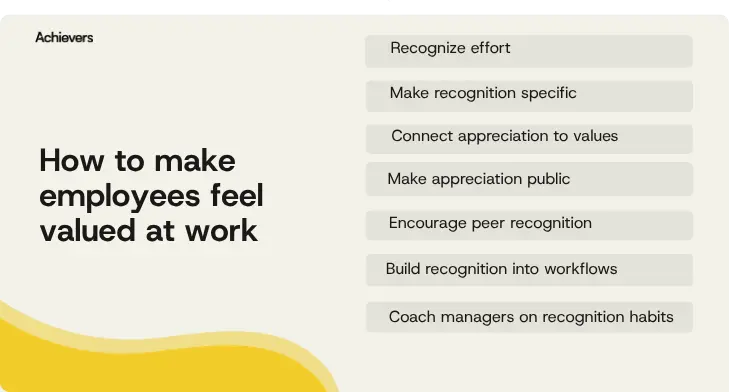
7 practical steps for making employees feel valued at work
Knowing why appreciation matters is important. Knowing how to act on it is what actually changes the employee experience. These seven steps turn good intentions into daily habits that help people feel genuinely valued and appreciated at work.
1. Recognize effort in the moment, not just outcomes
Don’t wait for perfect results or big wins. Calling out progress, problem‑solving, or resilience as it happens reinforces that effort itself is valued — not just the final score — like a manager posting a quick Teams message after a tough client call to thank someone for staying calm, reframing the conversation, and keeping the customer engaged before the project is even finished.
2. Be specific about what you’re appreciating
Vague praise fades fast. Specific recognition sticks because it tells employees exactly what they did well and why it mattered — such as a leader saying, “The way you simplified the data and tied it back to customer impact helped the exec team make a decision quickly,” instead of a generic “Great job.”
3. Connect appreciation to values and purpose
Recognition lands deeper when it reinforces what your organization stands for. Tie appreciation back to company values, customer impact, or team goals so employees can see how their work contributes to something bigger — like recognizing someone in a team meeting for mentoring a new hire and explicitly linking it to your organization’s value of collaboration.
4. Make recognition visible, not private by default
Private thanks have their place, but public recognition multiplies impact. When appreciation is visible, it reinforces expectations, spreads positive behavior, and helps employees feel proud of their contributions, such as when a leader shares a recognition post in a company‑wide channel highlighting a cross‑functional win and tagging everyone involved.
5. Empower peers to recognize each other
Managers don’t see everything — but coworkers do. Peer‑to‑peer recognition surfaces everyday contributions that might otherwise go unnoticed and makes appreciation a shared responsibility, like when a teammate recognizes a colleague for jumping in to help meet a tight deadline even though it wasn’t part of their role.
6. Build recognition into everyday workflows
If recognition feels like an extra task, it won’t happen consistently. Embed appreciation into the tools, meetings, and routines employees already use so recognizing great work feels natural — not forced — such as making recognition part of weekly stand‑ups, project retrospectives, or everyday tools like Workday, Outlook and Slack.
7. Coach managers to lead with appreciation
Managers shape how valued employees feel more than anyone else. Equip them with simple recognition habits — and the expectation to use them — so appreciation doesn’t depend on personality or mood, like encouraging managers to recognize at least one team member each week using prompts that make appreciation easy and consistent.
Make employees feel their value with Achievers
So, how do you make employees feel valued at work in a way that actually lasts? You,
- Build recognition into everyday work
- Make appreciation specific, meaningful, and tied to what matters most
- Connect effort to purpose and values
- Empower everyone — not just leaders — to participate
- Put systems in place that make appreciation easy, consistent, and visible
That’s exactly where Achievers comes in.
Achievers helps organizations move beyond one‑off moments and build cultures where recognition is frequent, meaningful, and woven into how work gets done. By embedding appreciation into daily workflows and giving employees and managers the tools to recognize what matters, Achievers turns feeling valued from an intention into a shared habit.
When employees feel valued and appreciated, culture becomes tangible. Engagement becomes sustainable. Retention becomes a choice — not a risk. That’s not just how great cultures feel. It’s how they’re built — with Achievers.
How to make employees feel valued at work FAQs
Key insights
- Employees feel valued when recognition is frequent, specific, and part of everyday work.
- Appreciation has the most impact when it connects effort to purpose and values.
- Scalable recognition systems turn feeling valued into a lasting cultural advantage.
That’s not correlation. That’s culture in action.