Table of contents
Create a culture that means business™
Schedule a demo with an Achievers solution expert today.


 Copy URL
Human resources development (also known as HRD) is the art and science of helping people get better at what they do while also preparing them for what they might do next. If HRM is the department that handles the paperwork, policies, and paychecks, HRD is the part of HR that asks, “How can we help our people grow?” Think of it as the difference between managing employees and developing humans. Same workplace, very different vibe.
At its core, HRD exists to build skills, knowledge, and confidence employees need to succeed today and shape a workforce that can handle tomorrow’s challenges. Organizations get a more capable, adaptable team; employees get opportunities to learn, stretch, and maybe even discover talents they didn’t know they had. Everybody wins.
Understanding HRD vs. HRM
Still feeling a little unsure about the difference between HRD and HRM? You’re not alone. Plenty of people mix it up with HRM, or human resource management, because the names sound almost identical. But their purposes are very different.
HRM focuses on the administrative and operational side of managing employees. It deals with hiring, payroll, compliance, policies, and all the structural stuff that keeps a workplace running without chaos.
HRM is the “make sure everyone gets paid, follows the rules, and has the right paperwork” function. Necessary? Absolutely. Glamorous? Not usually.
HRD, on the other hand, is the strategic, people-growth side of HR. It asks questions like: How do we build skills? How do we support performance? How do we prepare people for future roles? While HRM manages the employment relationship, HRD provides employee development to build human potential. HRM keeps the machine running; HRD upgrades the engine.
A simple way to remember the difference: HRM manages people. HRD develops people. Put together, they create a workplace that works well and helps employees become better versions of themselves.
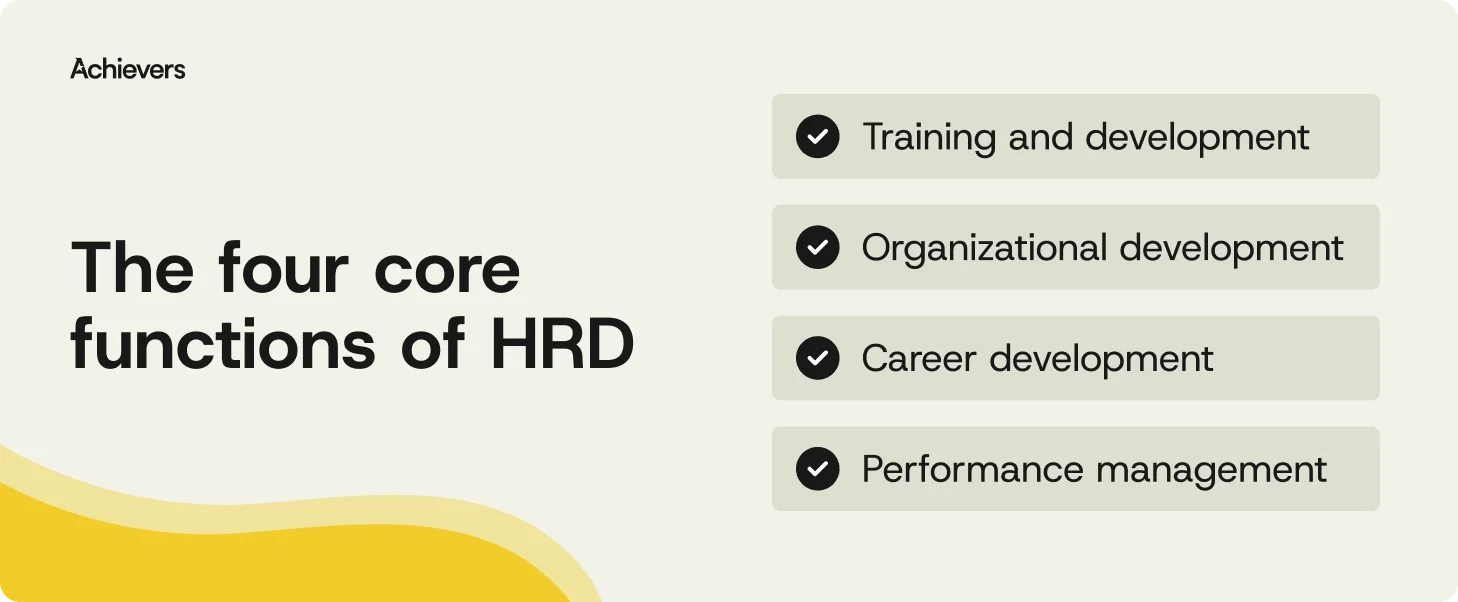
The four core functions of HRD
Human resources development may sound like one big bucket of “helping employees grow,” but it actually breaks down into four clear functions — each with its own purpose, tools, and real-world impact. Together, these functions make HRD the engine behind a skilled, motivated, future-ready workforce. Here’s a quick, no-nonsense breakdown of what each one does (with examples you’ll actually recognize from everyday work life):
1. Training and development
This is the part everyone recognizes — workshops, online courses, lunch-and-learns, leadership programs, you name it. Training helps people do their current jobs better. Talent development helps them prepare for future roles or bigger responsibilities. One is about right now and the other is about what’s next.
What it looks like: Your customer service team gets trained on a new ticketing tool so they stop accidentally deleting customer emails (oops). Meanwhile, your high-potential employees join a leadership program so that, someday, they’re ready to run a whole team without breaking into a cold sweat.
2. Organizational development (OD)
Organizational development is all about improving how the whole organization functions — its culture, communication, workflows, and overall health. If training is about helping individuals shine, OD is about making sure the system they work in isn’t sabotaging them.
OD practitioners do things like assess the workplace culture, facilitate team-building, or help leaders navigate major change. They’re the ones who ask, “Is this a people problem, or is the process just…terrible?”
What it looks like: After a merger, HRD hosts cross-team workshops to help two formerly separate groups stop glaring at each other in meetings and start collaborating like they’ve worked together for years. Suddenly things run smoother, and meetings require fewer deep breaths.
3. Career development
Career development helps employees understand where they’re going and how to get there — without needing a crystal ball or a fortune cookie. It’s about building internal mobility, offering mentorship, and giving people tools to grow their careers inside the organization rather than out the door.
What it looks like: An engineer who’s dreaming of becoming a project manager gets paired with a mentor, builds a development plan, and takes on stretch assignments. A year later, they’re confidently running a project instead of quietly wondering, “Could I actually do this?”
4. Performance improvement
Performance improvement is HRD’s version of detective work. When performance dips, HRD doesn’t jump straight to “more training!” Instead, it looks for root causes — confusing processes, unclear expectations, missing tools, or bottlenecks that make good employees look bad.
What it looks like: Sales numbers are down, and everyone assumes the team needs retraining. But after digging in, HRD discovers the real problem: a clunky pricing system that even the managers can’t explain. Fixing the system does more for performance than any workshop ever could.
Key HRD strategies and methods: From training to transformation
Human resources development isn’t a single strategy — it’s a whole toolkit of methods designed to help people and organizations level up. The trick is knowing which tool to use and when. HR training programs don’t have to be dry — they’re where the magic happens, turning “just another employee” into a confident, capable superstar. Each approach tackles a different need, but the result is the same: a sharper, more adaptable, and happier workforce.
Here’s how the major approaches stack up and when they shine:
Formal training
This is the go-to option when you need consistent, scalable learning across a group. It’s perfect for technical skills, compliance topics, and any situation where “everyone needs to know how to do this the same way.” Think software rollouts, safety guidelines, or customer service protocols. The organizational payoff? Reduced errors, faster onboarding, and a more predictable level of performance. Formal training is the workhorse—reliable, structured, and especially useful when time is tight and clarity matters.
Mentoring and coaching
This approach is more personal and relationship-driven. They’re ideal when the goal isn’t just to transfer knowledge but to build confidence, judgment, and real-world problem-solving skills. A mentor can help someone navigate internal politics, understand unwritten rules, or make smarter career decisions — all things you won’t find in a slide deck. Organizations that invest in mentoring programs see higher engagement, stronger internal pipelines, and better retention because people feel supported and connected.
E-learning
Online learning offers flexibility and scalability, making it great for distributed teams or employees who prefer learning at their own pace. It works especially well for foundational knowledge, just-in-time learning, and refreshers. When paired with micro-learning (short, focused modules), it becomes a powerful tool for keeping skills sharp without pulling people away from their work. The business benefit: lower training costs, more accessible learning, and faster upskilling across the board.
Leadership development
Leadership development is the long game. It targets managers, emerging leaders, and high-potential employees to build capabilities like communication, strategic thinking, and team management. Whether delivered through workshops, assessments, stretch assignments, or leadership academies, this method creates stronger decision-makers and healthier teams. The organizational outcomes are big: better succession planning, more capable managers, and fewer “accidental leaders” learning through trial and (very expensive) error.
In short, HRD strategies work best when matched to the problem at hand. Need consistency? Go formal. Need depth? Go mentoring. Need scale? Go e-learning. Need future leaders? You know what to do.
Measuring the impact of HRD
Measuring the impact of HRD is all about spotting the difference between a workplace that’s just surviving and one that’s actually thriving. Great HRD turns “we’re doing our best” into “wow, we’re actually good at this,” and the proof shows up in the numbers, the vibes, and everything in between.
Data from the Achievers Workforce Institute’s Engagement and Retention Report confirms that growth and development are strong drivers of workplace culture, retention, and engagement.
When employees have growth opportunities, they are:
- 2x more likely to see a long career at the company
- 2.5x more engaged when developing their skills
- 2.5x less likely to be looking for work elsewhere
Here are some other measures of success around development in the workplace:
Training and onboarding outcomes
Check how fast new hires ramp up, how many mistakes they’re making, and how often managers have to put out mini-fires. If HRD is working, people hit the ground running instead of wandering around like they’re on a corporate scavenger hunt.
Mentoring & career development metrics
Look at promotion rates, internal mobility, and whether employees feel they have an actual future at your company. When HRD is doing its thing, talent grows, sticks around, and doesn’t quietly Google “jobs near me” at lunch.
Leadership development indicators
Track manager effectiveness, team engagement, and turnover within teams. Strong HRD creates leaders who coach, communicate, and keep things moving — not the ones who leave a trail of confusion and awkward all-staff emails.
Organizational development signals
Measure collaboration, workflow efficiency, and culture health. If HRD is hitting the mark, silos shrink, projects run like clockwork, and people actually talk to each other without needing a meeting about the meeting.
Put it all together, and you’ll see exactly how HRD transforms your organization from “fine, I guess” into a well-oiled, people-powered machine.
How HRD drives organizational goals
Human resources development isn’t just about keeping employees busy with workshops, it’s a strategic engine that helps organizations hit their goals. By developing skills, HRD ensures employees can perform their roles efficiently and innovate when challenges arise, directly boosting productivity and quality metrics. Programs that support well-being — think stress management workshops, flexible learning schedules, or mentorship — lead to healthier, happier employees, which translates to lower absenteeism and higher engagement scores.
Retention is another big win. When people see opportunities to grow, learn, and advance, they’re more likely to stay, reducing costly turnover and keeping institutional knowledge in-house. Meanwhile, HRD fosters adaptability through continuous learning and organizational development initiatives, helping teams pivot quickly in response to market changes or internal restructuring.
The results are measurable: faster onboarding, improved performance metrics, higher employee satisfaction scores, reduced turnover, and a more agile workforce. In short, HRD doesn’t just benefit individuals, it powers the organization’s ability to meet strategic goals and stay competitive in a constantly changing business landscape.
Career paths in HRD
If you’ve ever wondered, “Is HRD a good career?” or “What does someone even do in HRD?”, let’s clear things up—because working in human resources development is basically being a talent wizard, with a dash of strategist, coach, and problem-solver all rolled into one. It’s a career where you get to shape people, processes, and culture, and watch real impact happen every day.
So, what do HRD roles actually look like? There’s a fair bit of variety:
HRD specialist or coordinator
This person is the doer. Organizes training programs, tracks development metrics, and keeps the learning machine running smoothly.
Training & development manager
This role involves designing workshops, oversees learning initiatives, and ensures employees actually learn something
Organizational development consultant
They focus on bigger-picture stuff like culture, change management, team effectiveness, and organizational health.
Learning & development (L&D) specialist
Combines tech and teaching to create e-learning modules, micro-learning content, and sometimes gamified courses.
Talent development manager/leadership development manager
This individual works with high-potential employees, succession planning, and leadership pipelines.
The pathways to HRD can vary. Many people start in general HR, training, or even learning roles in business schools or corporate programs, and then specialize. Degrees in HR, psychology, business, or organizational development help, but real-world experience running programs, mentoring, or designing learning initiatives often counts just as much. Certifications like CPLP, SHRM-CP, or ATD credentials can also give you an edge.
Using Achievers to support human resources development
Supporting human resources development is critical for boosting engagement, productivity, and retention — and Achievers makes it simple to do. The Achievers Platform goes beyond recognition to actively develop your workforce, helping employees grow, learn, and thrive within your organization. By providing real-time feedback, personalized recognition, and actionable insights, Achievers empowers managers and HR leaders to support skill development, career growth, and performance improvement across all teams.
With Achievers, employees feel valued and connected to your company’s mission, which is a key driver of retention and engagement. Celebrating achievements, promoting a positive culture, and offering meaningful opportunities for development all contribute to a stronger, more capable workforce. Our platform enables organizations to embed HRD principles into everyday practices, turning recognition into a tool for learning, growth, and long-term capability building.
By integrating HRD into your employee experience strategy, Achievers helps create an environment where every employee is empowered to contribute their best, develop new skills, and reach their full potential—while helping your organization achieve its strategic goals.
Making your human resources development a priority
Shaping today’s workforce centres around developing your people. By leveraging human resources development strategies and the right tools, you can build skills, boost engagement, and support career growth. Thoughtful HRD helps create a culture where employees feel valued, empowered, and ready to contribute their best, driving both personal and organizational success.
Ready to see how Achievers can help? Take a tour of our platform in action and learn how integrating HRD into your employee experience strategy can set your workforce and business up for greater success.
Human resources development FAQs
Key insights
- HRD develops employees’ skills and potential, focusing on growth over day-to-day tasks
- The four core functions of HRD are: Training, organizational development, career development, and performance improvement
- Effective HRD boosts performance, retention, agility, and long-term organizational success
Human resources development (HRD) is the people-first side of HR. Human resources development (HRD) is the people-first side of HR — it's about what's next.
The skills you need to be successful: Communication, coaching, analytical thinking, project management, creativity, and empathy.